|
|
|
| | | |
| | | |
| | | |
| | | |
|
| | | |
| | | |
|
|
|
|
|
|
|
|
|
|
| | | |
|
| | | |
| | | |
| | | |
| |
| | | |
| | | |
| | | |
| | | |
|
|
| | | |
| | | |
| | | |
| |
| | | |
| |
Forward-Looking Statements
Certain matters discussed in this Quarterly Report on Form 10-Q (this “Form 10-Q”) contain “forward-looking statements” that are intended to be covered by the safe harbor for such statements provided by the Private Securities Litigation Reform Act of 1995. East West Bancorp, Inc. (referred to herein on an unconsolidated basis as “East West” and on a consolidated basis as the “Company,” “we,” “us,” “our” or “EWBC”) may make forward-looking statements in other documents that it files with, or furnishes to, the United States (“U.S.”) Securities and Exchange Commission (“SEC”) and management may make forward-looking statements to analysts, investors, media members and others. Forward-looking statements are those that do not relate to historical facts and that are based on current assumptions, beliefs, estimates, expectations and projections, many of which, by their nature, are inherently uncertain and beyond the Company’s control. Forward-looking statements may relate to various matters, including the Company’s financial condition, results of operations, plans, objectives, future performance, business or industry, and usually can be identified by the use of forward-looking words such as “anticipates,” “assumes,” “believes,” “can,” “continues,” “could,” “estimates,” “expects,” “forecasts,” “goal,” “intends,” “likely,” “may,” “might,” “objective,” “plans,” “potential,” “projects,” “remains,” “should,” “target,” “trend,” “will,” “would,” or similar expressions or variations thereof, and the negative thereof, but these terms are not the exclusive means of identifying such statements. You should not place undue reliance on forward-looking statements, as they are subject to risks and uncertainties.
Factors that might cause future results to differ materially from historical performance and any forward-looking statements include, but are not limited to:
•changes in local, regional and global business, economic and political conditions, and natural or geopolitical events;
•the soundness of other financial institutions and the impacts related to or resulting from bank failures and other industry volatility, including potential increased regulatory requirements, Federal Deposit Insurance Corporation insurance premiums and assessments, and deposit withdrawals;
•changes in laws or the regulatory environment, including trade, monetary and fiscal policies and laws and current or potential disputes between the U.S. and the People’s Republic of China;
•changes in the commercial and consumer real estate markets;
•changes in consumer or commercial spending, savings and borrowing habits, and patterns and behaviors;
•the Company’s ability to compete effectively against financial institutions and other entities, including as a result of emerging technologies;
•the success and timing of the Company’s business strategies;
•the Company’s ability to retain key officers and employees;
•changes in key variable market interest rates, competition, regulatory requirements and product mix;
•changes in the Company’s costs of operation, compliance and expansion;
•disruption, failure in, or breach of, the Company’s operational or security systems or infrastructure, or those of third-party vendors with which the Company does business, including as a result of cyber-attacks, and the disclosure or misuse of confidential information;
•the adequacy of the Company’s risk management framework;
•future credit quality and performance, including expectations regarding future credit losses and allowance levels;
•adverse changes to the Company’s credit ratings;
•legal proceedings, regulatory investigations and their resolution;
•the Company’s capital requirements and its ability to generate capital internally or raise capital on favorable terms;
•the impact on the Company’s liquidity due to changes in the Company’s ability to receive dividends from its subsidiaries; and
•any strategic acquisitions or divestitures and the introduction of new or expanded products and services or other events that may directly or indirectly result in a negative impact on the financial performance of the Company and its customers.
For a more detailed discussion of some of the factors that might cause such differences, see the Company’s Annual Report on Form 10-K for the year ended December 31, 2023, filed with the SEC on February 29, 2024 (the “Company’s 2023 Form 10-K”) under the heading Item 1A. Risk Factors. You should treat forward-looking statements as speaking only as of the date they are made and based only on information then actually known to the Company. The Company does not undertake, and specifically disclaims any obligation to update or revise any forward-looking statements to reflect the occurrence of events or circumstances after the date of such statements except as required by law.
PART I — FINANCIAL INFORMATION
ITEM 1. CONSOLIDATED FINANCIAL STATEMENTS
EAST WEST BANCORP, INC. AND SUBSIDIARIES
CONSOLIDATED BALANCE SHEETS
($ in thousands, except shares)
(Unaudited)
| | | | | | | | | | | | | | |
|
| | September 30,
2024 | | December 31,
2023 |
|
| ASSETS | | | | |
| Cash and due from banks | | $ | | | | $ | | |
| Interest-bearing cash with banks | | | | | | |
| Cash and cash equivalents | | | | | | |
| Interest-bearing deposits with banks | | | | | | |
| Securities purchased under resale agreements (“resale agreements”) | | | | | | |
Debt securities: | | | | |
Available-for-sale (“AFS”), at fair value (amortized cost of $ and $) | | | | | | |
Held-to-maturity (“HTM”), at amortized cost (fair value of $ and $) | | | | | | |
|
| Loans held-for-sale | | | | | | |
Loans held-for-investment (net of allowance for loan losses of $ and $) | | | | | | |
| Affordable housing partnership, tax credit and Community Reinvestment Act (“CRA”) investments, net | | | | | | |
|
Premises and equipment (net of accumulated depreciation of $ and $) | | | | | | |
|
| Operating lease right-of-use assets | | | | | | |
| Goodwill | | | | | | |
| Other assets | | | | | | |
| TOTAL | | $ | | | | $ | | |
| LIABILITIES | | | | |
| Deposits: | | | | |
| Noninterest-bearing | | $ | | | | $ | | |
| Interest-bearing | | | | | | |
| Total deposits | | | | | | |
|
| Bank Term Funding Program (“BTFP”) borrowings | | | | | | |
|
| Federal Home Loan Bank (“FHLB”) advances | | | | | | |
|
| Long-term debt and finance lease liabilities | | | | | | |
| Operating lease liabilities | | | | | | |
| Accrued expenses and other liabilities | | | | | | |
| Total liabilities | | | | | | |
| COMMITMENTS AND CONTINGENCIES (Note 11) | | par value, shares authorized; and shares issued | | | | | | |
| Additional paid-in capital | | | | | | |
| Retained earnings | | | | | | |
Treasury stock, at cost and shares | | () | | | () | |
| Accumulated other comprehensive loss (“AOCI”), net of tax | | () | | | () | |
| Total stockholders’ equity | | | | | | |
| TOTAL | | $ | | | | $ | | |
|
See accompanying Notes to Consolidated Financial Statements.
5
EAST WEST BANCORP, INC. AND SUBSIDIARIES
CONSOLIDATED STATEMENT OF INCOME
($ and shares in thousands, except per share data)
(Unaudited)
| | | | | | | | | | | | | | | | | | | | | | | | | | |
| | 2024 | | 2023 | | 2024 | | 2023 |
| INTEREST AND DIVIDEND INCOME | | | | | | | | |
| Loans receivable, including fees | | $ | | | | $ | | | | $ | | | | $ | | |
| Debt securities | | | | | | | | | | | | |
| | | | | | | | |
| Resale agreements | | | | | | | | | | | | |
| Restricted equity securities | | | | | | | | | | | | |
| Interest-bearing cash and deposits with banks | | | | | | | | | | | | |
| Total interest and dividend income | | | | | | | | | | | | |
| INTEREST EXPENSE | | | | | | | | |
| Deposits | | | | | | | | | | | | |
| Federal funds purchased and other short-term borrowings | | | | | | | | | | | | |
| FHLB advances | | | | | | | | | | | | |
| Securities sold under repurchase agreements (“repurchase agreements”) | | | | | | | | | | | | |
| Long-term debt and finance lease liabilities | | | | | | | | | | | | |
| Total interest expense | | | | | | | | | | | | |
| Net interest income before provision for credit losses | | | | | | | | | | | | |
| Provision for credit losses | | | | | | | | | | | | |
| Net interest income after provision for credit losses | | | | | | | | | | | | |
| NONINTEREST INCOME | | | | | | | | |
| Deposit account fees | | | | | | | | | | | | |
| Lending fees | | | | | | | | | | | | |
| Foreign exchange income | | | | | | | | | | | | |
| Wealth management fees | | | | | | | | | | | | |
Customer derivative (losses) income | | () | | | | | | | | | | |
| | | | | | | | |
| | | | | | | | |
| Net gains (losses) on sales of loans | | | | | () | | | | | | () | |
| Net gains (losses) on AFS debt securities | | | | | | | | | | | () | |
| | | | | | | | |
| | | | | | | | |
| | | | | | | | |
| Other investment income | | | | | | | | | | | | |
| Other income | | | | | | | | | | | | |
| Total noninterest income | | | | | | | | | | | | |
| NONINTEREST EXPENSE | | | | | | | | |
| Compensation and employee benefits | | | | | | | | | | | | |
| Occupancy and equipment expense | | | | | | | | | | | | |
| Deposit account expense | | | | | | | | | | | | |
| Computer and software related expenses | | | | | | | | | | | | |
| Deposit insurance premiums and regulatory assessments | | | | | | | | | | | | |
| | | | | | | | |
| | | | | | | | |
| Other operating expense | | | | | | | | | | | | |
| Amortization of tax credit and CRA investments | | | | | | | | | | | | |
| | | | | | | | |
| Total noninterest expense | | | | | | | | | | | | |
| INCOME BEFORE INCOME TAXES | | | | | | | | | | | | |
Income tax expense | | | | | | | | | | | | |
| NET INCOME | | $ | | | | $ | | | | $ | | | | $ | | |
| EARNINGS PER SHARE (“EPS”) | | | | | | | | |
| BASIC | | $ | | | | $ | | | | $ | | | | $ | | |
| DILUTED | | $ | | | | $ | | | | $ | | | | $ | | |
| WEIGHTED-AVERAGE NUMBER OF SHARES OUTSTANDING | | | | | | | | |
| BASIC | | | | | | | | | | | | |
| DILUTED | | | | | | | | | | | | |
|
See accompanying Notes to Consolidated Financial Statements.
6
EAST WEST BANCORP, INC. AND SUBSIDIARIES
CONSOLIDATED STATEMENT OF COMPREHENSIVE INCOME
($ in thousands)
(Unaudited)
| | | | | | | | | | | | | | | | | | | | | | | | | | | | | | | | |
|
| | Three Months Ended September 30, | | Nine Months Ended September 30, | | |
| | 2024 | | 2023 | | 2024 | | 2023 | | | | | | |
| Net income | | $ | | | | $ | | | | $ | | | | $ | | | | | | | | |
| Other comprehensive income (loss), net of tax: | | | | | | | | | | | | | | |
| Net changes in unrealized gains (losses) on AFS debt securities | | | | | () | | | | | | () | | | | | | | |
| | | | | | | | | | | | | | |
| Amortization of unrealized losses on debt securities transferred from AFS to HTM | | | | | | | | | | | | | | | | | | |
Net changes in unrealized gains (losses) on cash flow hedges | | | | | () | | | | | | () | | | | | | | |
| Foreign currency translation adjustments | | () | | | | | | | | | () | | | | | | | |
| Other comprehensive income (loss) | | | | | () | | | | | | () | | | | | | | |
| COMPREHENSIVE INCOME | | $ | | | | $ | | | | $ | | | | $ | | | | | | | | |
|
See accompanying Notes to Consolidated Financial Statements.
7
EAST WEST BANCORP, INC. AND SUBSIDIARIES
CONSOLIDATED STATEMENT OF CHANGES IN STOCKHOLDERS’ EQUITY
($ in thousands, except shares and per share data)
(Unaudited)
| | | | | | | | | | | | | | | | | | | | | | | | | | | | | | | | | | | | | | |
|
| | Common Stock and Additional Paid-in Capital | | Retained Earnings | | Treasury Stock | | AOCI, Net of Tax | | Total Stockholders’ Equity |
| | Shares | | Amount | | | | |
| BALANCE, JULY 1, 2023 | | | | | $ | | | | $ | | | | $ | () | | | $ | () | | | $ | | |
| | | | | | | | |
| Net income | | — | | | — | | | | | | — | | | — | | | | |
| Other comprehensive loss | | — | | | — | | | — | | | — | | | () | | | () | |
| Issuance of common stock pursuant to various stock compensation plans and agreements | | | | | | | | — | | | — | | | — | | | | |
| Repurchase of common stock pursuant to various stock compensation plans and agreements | | () | | | — | | | — | | | () | | | — | | | () | |
| | | | | | | | |
Cash dividends on common stock ($ per share) | | — | | | — | | | () | | | — | | | — | | | () | |
| BALANCE, SEPTEMBER 30, 2023 | | | | | $ | | | | $ | | | | $ | () | | | $ | () | | | $ | | |
| BALANCE, JULY 1, 2024 | | | | | $ | | | | $ | | | | $ | () | | | $ | () | | | $ | | |
| | | | | | | | |
| Net income | | — | | | — | | | | | | — | | | — | | | | |
| Other comprehensive income | | — | | | — | | | — | | | — | | | | | | | |
| Issuance of common stock pursuant to various stock compensation plans and agreements | | | | | | | | — | | | — | | | — | | | | |
| Repurchase of common stock pursuant to various stock compensation plans and agreements | | () | | | — | | | — | | | () | | | — | | | () | |
| | | | | | | | |
|
|
|
|
|
| | | | | | | | | | |
| | | | | | | | | | |
| | | | | | | | | | |
|
|
| | | | | | | | | | |
|
|
|
|
|
|
| | | | | | | | | | |
| | | | | | | | | | |
| | | | | | | | | | |
|
|
|
|
|
|
|
|
|
|
|
|
|
|
|
|
|
|
| | |
| | |
|
|
|
| | |
| | |
|
|
|
|
|
|
|
|
|
|
|
|
|
|
|
|
|
|
|
| | |
|
|
|
|
| | |
| | |
| | |
|
| | |
|
| | |
|
|
|
|
| | |
| | |
| | |
| | |
| | |
| | |
| | |
| | |
| | |
| | |
| | |
| | |
| | |
| | |
| | |
| | |
| | |
| | |
| | |
| | |
| | |
| | |
| | |
| | |
|
| | |
| | |
| | |
| | |
| | |
| | |
| | |
| | |
| | |
| | |
| | |
| | |
| | |
| | |
| | |
| | |
| | |
| | |
| | |
| | |
| | |
| | |
| | |
| | |
| | |
| | |
| | |
| | |
| | |
| | |
| | |
| | |
| | |
| | |
| | |
| | |
| | |
| | |
| | |
| | |
| | |
| | |
| | |
| | |
| | |
| | |
| | |
| | |
| | |
| | |
| | |
|
|
|
| | |
|
|
|
|
| | |
|
|
|
| | |
|
|
|
|
|
|
|
|
|
|
|
|
|
|
|
|
| | |
| | |
|
| | |
| | |
| | |
| | |
See accompanying Notes to Consolidated Financial Statements.
10
EAST WEST BANCORP, INC. AND SUBSIDIARIES
NOTES TO CONSOLIDATED FINANCIAL STATEMENTS
(Unaudited)
Note 1 —
wholly-owned subsidiary that is a statutory business trust (the “Trust”). In accordance with Financial Accounting Standards Board Accounting Standards Codification (“ASC”) Topic 810, Consolidation, the Trust is not included on the Consolidated Financial Statements.
The preparation of the Consolidated Financial Statements in conformity with U.S. GAAP requires management to make estimates and assumptions that affect the reported amounts of assets and liabilities as of the date of the Consolidated Financial Statements, income and expenses during the reporting periods, and the related disclosures. Although our estimates consider current conditions and how we expect them to change in the future, it is reasonably possible that actual results could be materially different from those estimates. Hence, the current period’s results of operations are not necessarily indicative of results that may be expected for any future interim period or for the year as a whole. Certain items on the Consolidated Financial Statements and notes for the prior periods have been reclassified to conform to the current presentation. Events subsequent to the Consolidated Balance Sheet date have been evaluated through the date the Consolidated Financial Statements are issued for inclusion in the accompanying Consolidated Financial Statements.
Note 2 —
million.|
The following standards were also adopted on January 1, 2024, but they did not have a material impact on the Company’s Consolidated Financial Statements:
•ASU 2023-01, Leases (Topic 842): Common Control Arrangements
•ASU 2022-03, Fair Value Measurement (Topic 820) Fair Value Measurement of Equity Securities Subject to Contractual Sale Restrictions
Note 3 —
Visa B-1 shares, the Company received Visa Class B-2 common stock (“Visa B-2 shares”) and Visa Class C common stock (“Visa C shares”). The Visa B-2 shares remain subject to transfer restrictions and will continue to be held at cost. As the Visa C shares are convertible into Visa’s publicly traded Class A common stock (“Visa A shares”), the Company recognized the Visa C shares at fair value of $ thousand based on the closing price of the Visa A shares as of September 30, 2024.
Interest Rate Contracts — Interest rate contracts consist of interest rate swaps and options. The fair value of the interest rate swaps is determined using the market standard methodology of netting the discounted future fixed cash payments (or receipts) and the discounted expected variable cash receipts (or payments). The fair value of the interest rate options, which consist of floors and caps, is determined using the market standard methodology of discounting the future expected cash receipts that will occur if variable interest rates fall below (rise above) the strike rate of the floors (caps). In addition, to comply with the provisions of ASC 820, Fair Value Measurement, the Company incorporates credit valuation adjustments to appropriately reflect both its own and the respective counterparty’s nonperformance risk in the fair value measurements of its derivatives. The credit valuation adjustments associated with the Company’s derivatives utilize model-derived credit spreads, which are Level 3 inputs. Considering the observable nature of all other significant inputs utilized, the Company classifies these derivative instruments as Level 2.
Foreign Exchange Contracts — The fair value of foreign exchange contracts is determined at each reporting period based on changes in the applicable foreign exchange rates. These are over-the-counter contracts where quoted market prices are not readily available. Valuation is measured using conventional valuation methodologies with observable market data. Due to the short-term nature of the majority of these contracts, the counterparties’ credit risks are considered nominal and result in no adjustments to the valuation of the foreign exchange contracts. Due to the observable nature of the inputs used in deriving the fair value of these contracts, the valuation of foreign exchange contracts is classified as Level 2. In addition, the Bank managed its foreign currency exposure in the net investment in its China subsidiary, East West Bank (China) Limited, a non-U.S. dollar (“USD”) functional currency subsidiary, with foreign currency non-deliverable forward contracts. These foreign currency non-deliverable forward contracts were designated as net investment hedges. The fair value of foreign currency non-deliverable forward contracts is determined by comparing the contracted foreign exchange rate to the current market foreign exchange rate. Key inputs of the current market exchange rate include the spot and forward rates of the contractual currencies. Foreign exchange forward curves are used to determine which forward rate pertains to a specific maturity. Due to the observable nature of the inputs used in deriving the estimated fair value, these instruments are classified as Level 2.
Credit Contracts — Credit contracts utilized by the Company are comprised of credit risk participation agreements (“RPAs”) entered into by the Company with institutional counterparties. The fair value of the RPAs is calculated by determining the total expected asset or liability exposure of the derivatives to the borrowers and applying the borrowers’ credit spread to that exposure. Total expected exposure incorporates both the current and potential future exposure of the derivatives, derived from using observable inputs, such as yield curves and volatilities. Due to the observable nature of all other significant inputs used in deriving the estimated fair value, credit contracts are classified as Level 2.
% equity interest in Rayliant Global Advisors Limited (“Rayliant”) during the third quarter of 2023, the Company granted performance-based restricted stock units (“RSUs”) as part of its consideration, in addition to $ million in cash. The vesting of these equity contracts on September 1, 2028, is contingent on Rayliant meeting certain financial performance targets during the performance period. The fair value of liability-classified equity contracts varies based on the operating revenue and operating EBITDA of Rayliant to be achieved during the future performance period, and these performance-based RSUs are expected to vest into a variable number of the Company’s common stock, ranging from % to % of the target performance-based RSUs granted. Due to the unobservable nature of the input assumptions, these equity contracts are classified as Level 3. For additional information on the equity contracts, refer to Note 6 — Derivatives to the Consolidated Financial Statements in this Form 10-Q.
Commodity Contracts — Commodity contracts consist of swaps and options referencing commodity products. The fair value of the commodity option contracts is determined using the Black-Scholes model and assumptions that include expectations of future commodity price and volatility. The future commodity contract price is derived from observable inputs such as the market price of the commodity. Commodity swaps are structured as an exchange of fixed cash flows for floating cash flows. The fair value of the commodity swaps is determined using the market standard methodology of netting the discounted future fixed cash payments (or receipts) and the discounted expected variable cash receipts (or payments) based on the market prices of the commodity. The fixed cash flows are predetermined based on the known volumes and fixed price as specified in the swap agreement. The floating cash flows are correlated with the change of forward commodity prices, which is derived from market corroborated futures settlement prices. As a result, the Company classifies these derivative instruments as Level 2 due to the observable nature of the significant inputs utilized.
| | $ | | | | $ | | | | $ | | | | U.S. government agency and U.S. government-sponsored enterprise debt securities | | | | | | | | | | | | |
U.S. government agency and U.S. government-sponsored enterprise mortgage-backed securities (1): | | | | | | | | |
| Commercial mortgage-backed securities | | | | | | | | | | | | |
| Residential mortgage-backed securities | | | | | | | | | | | | |
| Municipal securities | | | | | | | | | | | | |
| Non-agency mortgage-backed securities: | | | | | | | | |
| Commercial mortgage-backed securities | | | | | | | | | | | | |
| Residential mortgage-backed securities | | | | | | | | | | | | |
| Corporate debt securities | | | | | | | | | | | | |
| Foreign government bonds | | | | | | | | | | | | |
| Asset-backed securities | | | | | | | | | | | | |
| Collateralized loan obligations (“CLOs”) | | | | | | | | | | | | |
| Total AFS debt securities | | $ | | | | $ | | | | $ | | | | $ | | |
| | | | |
| Affordable housing partnership, tax credit and CRA investments, net: | | | | | | | | |
| Equity securities | | $ | | | | $ | | | | $ | | | | $ | | |
| Total affordable housing partnership, tax credit and CRA investments, net | | $ | | | | $ | | | | $ | | | | $ | | |
| | | | |
Other assets: | | | | | | | | |
Equity securities (2) | | $ | | | | $ | | | | $ | | | | $ | | |
| Total other assets | | $ | | | | $ | | | | $ | | | | $ | | |
| | | | |
| Derivative assets: | | | | | | | | |
| Interest rate contracts | | $ | | | | $ | | | | $ | | | | $ | | |
| Foreign exchange contracts | | | | | | | | | | | | |
| | | | |
| Equity contracts | | | | | | | | | | | | |
| Commodity contracts | | | | | | | | | | | | |
| Gross derivative assets | | $ | | | | $ | | | | $ | | | | $ | | |
Netting adjustments (3) | | $ | | | | $ | () | | | $ | | | | $ | () | |
| Net derivative assets | | $ | | | | $ | | | | $ | | | | $ | | |
| | | | |
| Derivative liabilities: | | | | | | | | |
| Interest rate contracts | | $ | | | | $ | | | | $ | | | | $ | | |
| Foreign exchange contracts | | | | | | | | | | | | |
Equity contracts (4) | | | | | | | | | | | | |
| Credit contracts | | | | | | | | | | | | |
| Commodity contracts | | | | | | | | | | | | |
| Gross derivative liabilities | | $ | | | | $ | | | | $ | | | | $ | | |
Netting adjustments (3) | | $ | | | | $ | () | | | $ | | | | $ | () | |
| Net derivative liabilities | | $ | | | | $ | | | | $ | | | | $ | | |
|
Refer to footnotes on the following page.
| | $ | | | | $ | | | | $ | | | | U.S. government agency and U.S. government-sponsored enterprise debt securities | | | | | | | | | | | | |
U.S. government agency and U.S. government-sponsored enterprise mortgage-backed securities (1): | | | | | | | | |
| Commercial mortgage-backed securities | | | | | | | | | | | | |
| Residential mortgage-backed securities | | | | | | | | | | | | |
| Municipal securities | | | | | | | | | | | | |
| Non-agency mortgage-backed securities: | | | | | | | | |
| Commercial mortgage-backed securities | | | | | | | | | | | | |
| Residential mortgage-backed securities | | | | | | | | | | | | |
| Corporate debt securities | | | | | | | | | | | | |
| Foreign government bonds | | | | | | | | | | | | |
| Asset-backed securities | | | | | | | | | | | | |
| CLOs | | | | | | | | | | | | |
| Total AFS debt securities | | $ | | | | $ | | | | $ | | | | $ | | |
| | | | |
| Affordable housing partnership, tax credit and CRA investments, net: | | | | | | | | |
| Equity securities | | $ | | | | $ | | | | $ | | | | $ | | |
Total affordable housing partnership, tax credit and CRA investments, net | | $ | | | | $ | | | | $ | | | | $ | | |
| | | | |
| Derivative assets: | | | | | | | | |
| Interest rate contracts | | $ | | | | $ | | | | $ | | | | $ | | |
| Foreign exchange contracts | | | | | | | | | | | | |
| Credit contracts | | | | | | | | | | | | |
| Equity contracts | | | | | | | | | | | | |
| Commodity contracts | | | | | | | | | | | | |
| Gross derivative assets | | $ | | | | $ | | | | $ | | | | $ | | |
Netting adjustments (3) | | $ | | | | $ | () | | | $ | | | | $ | () | |
| Net derivative assets | | $ | | | | $ | | | | $ | | | | $ | | |
| | | | |
| Derivative liabilities: | | | | | | | | |
| Interest rate contracts | | $ | | | | $ | | | | $ | | | | $ | | |
| Foreign exchange contracts | | | | | | | | | | | | |
Equity contracts (4) | | | | | | | | | | | | |
| Credit contracts | | | | | | | | | | | | |
| Commodity contracts | | | | | | | | | | | | |
| Gross derivative liabilities | | $ | | | | $ | | | | $ | | | | $ | | |
Netting adjustments (3) | | $ | | | | $ | () | | | $ | | | | $ | () | |
| Net derivative liabilities | | $ | | | | $ | | | | $ | | | | $ | | |
|
(1)Includes Government National Mortgage Association (“GNMA”) AFS debt securities totaling $ billion and $ billion of fair value as of September 30, 2024 and December 31, 2023, respectively.
(2)Consists of exchange-traded equity securities. For additional information, see Assets and Liabilities Measured at Fair Value on a Recurring Basis — Equity Securities in Note 3 — Fair Value Measurement and Fair Value of Financial Instruments in this Form 10-Q.
(3)Represents the balance sheet netting of derivative assets and liabilities and related cash collateral under master netting agreements or similar agreements. See Note 6 — Derivatives to the Consolidated Financial Statements in this Form 10-Q for additional information.
(4)Equity contracts classified as derivative liabilities consist of performance-based RSUs granted as part of EWBC’s consideration in its investment in Rayliant.
| | $ | | | | $ | | | | $ | | | | | | | | | | | | | | | | | | | |
Total losses included in earnings (1) | | () | | | () | | | () | | | () | | | | | |
| | | | | | | | | | | | |
| | | | | | | | | | | | |
| | | | | | | | | | | | |
| | | | | | | | | | | | |
| Issuances | | | | | | | | | | | | | | | | |
| | | | | | | | | | | | |
| | | | | | | | | | | | |
| | | | | | | | | | | | |
| | | | | | | | | | | | |
| Ending balance | | $ | | | | $ | | | | $ | | | | $ | | | | | | |
| Derivative liabilities: | | | | | | | | | | | | |
Equity contracts (2) | | | | | | | | | | | | |
| Beginning balance | | $ | | | | $ | | | | $ | | | | $ | | | | | | |
| | | | | | | | | | | | |
| Issuances | | | | | | | | | | | | | | | | |
| Ending balance | | $ | | | | $ | | | | $ | | | | $ | | | | | | |
|
| | | | | | | | | | | | |
| | | | | | | | | | | | |
| | | | | | | | | | | | |
| | | | | | | | | | | | |
| | | | | | | | | | | | |
| | | | | | | | | | | | |
| | | | | | | | | | | | |
| | | | | | | | | | | | | (1)Includes unrealized losses recorded in Lending fees on the Consolidated Statement of Income.
(2)Equity contracts classified as derivative liabilities consist of performance-based RSUs granted as part of EWBC’s consideration in its investment in Rayliant.
| | Black-Scholes option pricing model | | Equity volatility | | % — % | | | % | (1) |
| | | | | | Liquidity discount | | % | | | % | |
| Derivative liabilities: | | | | | | | | | | | |
Equity contracts (2) | | $ | | | | Internal model | | Payout % designated based on operating revenue and operating EBITDA of investee | | % | | | % | |
| December 31, 2023 | | | | | | | | | | | |
| Derivative assets: | | | | | | | | | | | |
| Equity contracts | | $ | | | | Black-Scholes option pricing model | | Equity volatility | | % — % | | | % | (1) |
| | | | | | Liquidity discount | | % | | | % | |
| Derivative liabilities: | | | | | | | | | | | |
Equity contracts (2) | | $ | | | | Internal model | | Payout % designated based on operating revenue and operating EBITDA of investee | | % | | | % | |
| |
(1)Weighted-average of inputs is calculated based on the fair value of equity contracts as of both September 30, 2024 and December 31, 2023.
(2)Equity contracts classified as derivative liabilities consist of performance-based RSUs granted as part of EWBC’s consideration in its investment in Rayliant.
| | $ | | | | $ | | | | $ | | | | Commercial real estate (“CRE”): | | | | | | | | |
| CRE | | | | | | | | | | | | |
| Multifamily residential | | | | | | | | | | | | |
| Construction and land | | | | | | | | | | | | |
| | | | |
| Total commercial | | | | | | | | | | | | |
| Consumer: | | | | | | | | |
| Residential mortgage: | | | | | | | | |
| Single-family residential | | | | | | | | | | | | |
| | | | |
| | | | |
| | | | |
| Total consumer | | | | | | | | | | | | |
| Total loans held-for-investment | | $ | | | | $ | | | | $ | | | | $ | | |
| | | | |
OREO (1) | | $ | | | | $ | | | | $ | | | | $ | | |
| | | | |
| | | | | | | | |
(1)Represents the carrying value of OREO property that was written down subsequent to its initial classification as OREO and is included in Other assets on the Consolidated Balance Sheet.
| | $ | | | | $ | | | | $ | | | | CRE: | | | | | | | | |
| CRE | | | | | | | | | | | | |
| | | | |
| | | | |
| | | | |
| Total commercial | | | | | | | | | | | | |
| Consumer: | | | | | | | | |
| Residential mortgage: | | | | | | | | |
| | | | |
| Home equity lines of credit (“HELOCs”) | | | | | | | | | | | | |
| | | | |
| | | | |
| Total consumer | | | | | | | | | | | | |
| Total loans held-for-investment | | $ | | | | $ | | | | $ | | | | $ | | |
| Affordable housing partnership, tax credit and CRA investments, net | | $ | | | | $ | | | | $ | | | | $ | | |
| | | | |
| | | | | | | | |
) | | $ | | | | $ | () | | | $ | () | | | | | | | CRE: | | | | | | | | | | | | |
| CRE | | | | | | | | | | | | | | | | |
| Multifamily residential | | () | | | | | | () | | | | | | | | |
| Construction and land | | () | | | () | | | () | | | () | | | | | |
| Total CRE | | () | | | () | | | () | | | () | | | | | |
| Total commercial | | () | | | () | | | () | | | () | | | | | |
| Consumer: | | | | | | | | | | | | |
| Residential mortgage: | | | | | | | | | | | | |
| Single-family residential | | | | | | | | () | | | | | | | | |
| HELOCs | | | | | () | | | | | | () | | | | | |
| | | | | | | | | | | | |
| | | | | | | | | | | | |
| Total consumer | | | | | () | | | () | | | () | | | | | |
| Total loans held-for-investment | | $ | () | | | $ | () | | | $ | () | | | $ | () | | | | | |
| | | | | | | | | | | | |
| Affordable housing partnership, tax credit and CRA investments, net | | $ | | | | $ | () | | | $ | | | | $ | () | | | | | |
| | | | | | | | | | | | |
| OREO | | $ | | | | $ | | | | $ | () | | | $ | | | | | | |
| | | | | | | | | | | | |
| | | | | | | | | | | | |
| | Fair value of collateral | | Discount | | % — % | | | % | (1) |
| | $ | | | | Fair value of collateral | | Contract value | | NM | | NM | |
| | $ | | | | Fair value of property | | Selling cost | | % — % | | | % | (1) |
| | | | | | | | | | | |
| OREO | | $ | | | | Fair value of property | | Selling cost | | % | | | % | |
| | | | | | | |
| | | | | | | |
| | | | | | | | | | | |
| December 31, 2023 | | | | | | | | | | | |
| | | | | | | |
| | | | | | | |
| Loans held-for-investment | | $ | | | | Fair value of collateral | | Discount | | % — % | | | % | (1) |
| | $ | | | | Fair value of collateral | | Contract value | | NM | | NM | |
| | $ | | | | Fair value of property | | Selling cost | | % | | | % | |
| | | | | | | | | | | |
| Affordable housing partnership, tax credit and CRA investments, net | | $ | | | | Individual analysis of each investment | | Expected future tax benefits and distributions | | NM | | NM | |
| | | | | | | |
| | | | | | | |
| |
NM — Not meaningful.
(1)Weighted-average of inputs is based on the relative fair value of the respective assets as of September 30, 2024 and December 31, 2023.
Disclosures about the Fair Value of Financial Instruments
| | $ | | | | $ | | | | $ | | | | $ | | | | Interest-bearing deposits with banks | | $ | | | | $ | | | | $ | | | | $ | | | | $ | | |
| Resale agreements | | $ | | | | $ | | | | $ | | | | $ | | | | $ | | |
| HTM debt securities | | $ | | | | $ | | | | $ | | | | $ | | | | $ | | |
| Restricted equity securities, at cost | | $ | | | | $ | | | | $ | | | | $ | | | | $ | | |
| | | | | | |
| Loans held-for-investment, net | | $ | | | | $ | | | | $ | | | | $ | | | | $ | | |
| Mortgage servicing rights | | $ | | | | $ | | | | $ | | | | $ | | | | $ | | |
| Accrued interest receivable | | $ | | | | $ | | | | $ | | | | $ | | | | $ | | |
| Financial liabilities: | | | | | | | | | | |
| Demand, checking, savings and money market deposits | | $ | | | | $ | | | | $ | | | | $ | | | | $ | | |
| Time deposits | | $ | | | | $ | | | | $ | | | | $ | | | | $ | | |
| | | | | | |
| | | | | | |
| FHLB advances | | $ | | | | $ | | | | $ | | | | $ | | | | $ | | |
| | | | | | |
| Long-term debt | | $ | | | | $ | | | | $ | | | | $ | | | | $ | | |
| Accrued interest payable | | $ | | | | $ | | | | $ | | | | $ | | | | $ | | |
|
| | $ | | | | $ | | | | $ | | | | $ | | | | Interest-bearing deposits with banks | | $ | | | | $ | | | | $ | | | | $ | | | | $ | | |
| Resale agreements | | $ | | | | $ | | | | $ | | | | $ | | | | $ | | |
| HTM debt securities | | $ | | | | $ | | | | $ | | | | $ | | | | $ | | |
| Restricted equity securities, at cost | | $ | | | | $ | | | | $ | | | | $ | | | | $ | | |
| Loans held-for-sale | | $ | | | | $ | | | | $ | | | | $ | | | | $ | | |
| Loans held-for-investment, net | | $ | | | | $ | | | | $ | | | | $ | | | | $ | | |
| | | | | | |
| Mortgage servicing rights | | $ | | | | $ | | | | $ | | | | $ | | | | $ | | |
| Accrued interest receivable | | $ | | | | $ | | | | $ | | | | $ | | | | $ | | |
| Financial liabilities: | | | | | | | | | | |
| | | | | | |
| Demand, checking, savings and money market deposits | | $ | | | | $ | | | | $ | | | | $ | | | | $ | | |
| Time deposits | | $ | | | | $ | | | | $ | | | | $ | | | | $ | | |
| | | | | | |
| | | | | | |
|
| | | | | | |
| | | | | | |
| | Gross Amounts of Recognized Assets | | Gross Amounts Offset on the Consolidated Balance Sheet | | Net Amounts of Assets Presented on the Consolidated Balance Sheet | | Gross Amounts Not Offset on the Consolidated Balance Sheet | | |
| ($ in thousands) | | | | | Collateral Received (1) | | Net Amount |
Resale agreements as of September 30, 2024 | | $ | | | | $ | | | | $ | | | | $ | () | | | $ | | |
| | | | | | | | | | |
Resale agreements as of December 31, 2023 | | $ | | | | $ | | | | $ | | | | $ | () | | | $ | | |
| | | | | | |
| |
| | |
| | | | | | |
| | | | $ | () | | | $ | | |
| | | | | | | (1)Amortized cost excludes accrued interest receivables which are presented within Other assets on the Consolidated Balance Sheet. As of September 30, 2024 and December 31, 2023, the accrued interest receivables were $ million and $ million, respectively. For the Company’s accounting policy related to debt securities’ accrued interest receivables, see Note 1 — Summary of Significant Accounting Policies — Significant Accounting Policies — Allowance for Credit Losses on Available-for-Sale Debt Securities and Allowance for Credit Losses on Held-to-Maturity Debt Securities to the Consolidated Financial Statements in the Company’s 2023 Form 10-K.
(2)Includes GNMA AFS debt securities totaling $ billion of amortized cost and $ billion of fair value as of September 30, 2024, and $ billion of amortized cost and $ billion of fair value as of December 31, 2023.
(3)Includes GNMA HTM debt securities totaling $ million of amortized cost and $ million of fair value as of September 30, 2024, and $ million of amortized cost and $ million of fair value of as of December 31, 2023.
| | $ | | | | $ | | | | $ | () | | | $ | | | | $ | () | |
| U.S. government agency and U.S. government sponsored enterprise debt securities | | | | | | | | | | | () | | | | | | () | |
| U.S. government agency and U.S. government-sponsored enterprise mortgage-backed securities: | | | | | | | | | | | | |
| Commercial mortgage-backed securities | | | | | | | | | | | () | | | | | | () | |
| Residential mortgage-backed securities | | | | | () | | | | | | () | | | | | | () | |
| Municipal securities | | | | | | | | | | | () | | | | | | () | |
| Non-agency mortgage-backed securities: | | | | | | | | | | | | |
| Commercial mortgage-backed securities | | | | | | | | | | | () | | | | | | () | |
| Residential mortgage-backed securities | | | | | | | | | | | () | | | | | | () | |
| Corporate debt securities | | | | | | | | | | | () | | | | | | () | |
| Foreign government bonds | | | | | | | | | | | () | | | | | | () | |
| Asset-backed securities | | | | | | | | | | | () | | | | | | () | |
| CLOs | | | | | | | | | | | () | | | | | | () | |
| Total AFS debt securities | | $ | | | | $ | () | | | $ | | | | $ | () | | | $ | | | | $ | () | |
|
| | $ | | | | $ | | | | $ | () | | | $ | | | | $ | () | | | U.S. government agency and U.S. government-sponsored enterprise debt securities | | | | | | | | | | | () | | | | | | () | |
| U.S. government agency and U.S. government-sponsored enterprise mortgage-backed securities: | | | | | | | | | | | | |
| Commercial mortgage-backed securities | | | | | | | | | | | () | | | | | | () | |
| Residential mortgage-backed securities | | | | | () | | | | | | () | | | | | | () | |
| Municipal securities | | | | | () | | | | | | () | | | | | | () | |
| Non-agency mortgage-backed securities: | | | | | | | | | | | | |
| Commercial mortgage-backed securities | | | | | () | | | | | | () | | | | | | () | |
| Residential mortgage-backed securities | | | | | | | | | | | () | | | | | | () | |
| Corporate debt securities | | | | | | | | | | | () | | | | | | () | |
| Foreign government bonds | | | | | () | | | | | | () | | | | | | () | |
| Asset-backed securities | | | | | | | | | | | () | | | | | | () | |
| CLOs | | | | | | | | | | | () | | | | | | () | |
| Total AFS debt securities | | $ | | | | $ | () | | | $ | | | | $ | () | | | $ | | | | $ | () | |
|
As of September 30, 2024, the Company had AFS debt securities in a gross unrealized loss position with credit impairment, primarily consisting of U.S. government agency and U.S. government-sponsored enterprise mortgage-backed securities, corporate debt securities and non-agency mortgage-backed securities. In comparison, as of December 31, 2023, the Company had AFS debt securities in a gross unrealized loss position with credit impairment, primarily consisting of U.S. government agency and U.S. government-sponsored enterprise mortgage-backed securities, corporate debt securities, and non-agency mortgage-backed securities.
Allowance for Credit Losses on Available-for-Sale Debt Securities
The Company evaluates each AFS debt security where the fair value declines below amortized cost. For a discussion of the factors and criteria the Company uses in analyzing securities for impairment related to credit losses, see Note 1 — Summary of Significant Accounting Policies — Significant Accounting Policies — Allowance for Credit Losses on Available-for-Sale Debt Securities to the Consolidated Financial Statements in the Company’s 2023 Form 10-K.
The gross unrealized losses presented in the preceding tables were primarily attributable to interest rate movement and the widening of liquidity and/or credit spreads. U.S. Treasury, U.S. government agency, U.S. government-sponsored agency, and U.S. government-sponsored enterprise debt and mortgage-backed securities are issued, guaranteed, or otherwise supported by the U.S. government and have a zero credit loss assumption. The remaining securities that were in an unrealized loss position as of September 30, 2024 were mainly comprised of the following:
•Corporate debt securities — The market value decline as of September 30, 2024 was primarily due to interest rate movement and spread widening. A portion of the corporate debt securities is comprised of subordinated debt securities issued by U.S. banks. Despite the reduction of the market value of these securities after the banking sector disruption in 2023, these securities are nearly all rated investment grade by nationally recognized statistical rating organizations (“NRSROs”) and issued by well-capitalized financial institutions with strong profitability. The contractual payments from these corporate debt securities have been and are expected to be received on time. The Company will continue to monitor the market developments in the banking sector and the credit performance of these securities.
allowance for credit losses provided against these securities as of both September 30, 2024 and December 31, 2023. In addition, there was provision for credit losses recognized for the three and nine months ended September 30, 2024 and 2023.
Allowance for Credit Losses on Held-to-Maturity Debt Securities
The Company separately evaluates its HTM debt securities for any credit losses using an expected loss model, similar to the methodology used for loans. For additional information on the Company’s credit loss methodology, refer to Note 1 — Summary of Significant Accounting Policies — Significant Accounting Policies — Allowance for Credit Losses on Held-to-Maturity Debt Securities to the Consolidated Financial Statements in the Company’s 2023 Form 10-K.
The Company monitors the credit quality of the HTM debt securities using external credit ratings. As of September 30, 2024, all HTM securities were rated investment grade by NRSROs and issued, guaranteed, or supported by U.S. government entities and agencies. Accordingly, the Company applied a zero credit loss assumption and allowance for credit losses was recorded as of both September 30, 2024 and December 31, 2023. Overall, the Company believes that the credit support levels of the debt securities are strong, and based on current assessments and macroeconomic forecasts, expects that full contractual cash flows will be received.
Realized Gains and Losses
| | $ | | | | $ | | | | $ | | | | | | | Impairment write-off (1) | | $ | | | | $ | | | | $ | | | | $ | () | | | | | |
| Related tax expense (benefit) | | $ | | | | $ | | | | $ | | | | $ | () | | | | | |
|
(1)During the first quarter of 2023, the Company recognized a $ million impairment write-off on a subordinated debt security as a component of Noninterest income in the Company’s Consolidated Statement of Income.
Interest Income
| | $ | | | | $ | | | | $ | | | | | | | | Nontaxable interest | | | | | | | | | | | | | | | | |
| Total interest income on debt securities | | $ | | | | $ | | | | $ | | | | $ | | | | | | |
|
|
|
|
| | | | | | | | | | |
| | | | | | | | | | |
|
|
|
|
|
|
|
|
|
|
|
|
|
|
|
(1)The notional amount of the Company’s commodity contracts totaled thousand barrels of crude oil and thousand units of natural gas, measured in million British thermal units (“MMBTUs”) as of September 30, 2024. In comparison, the notional amount of the Company’s commodity contracts totaled thousand barrels of crude oil and thousand MMBTUs of natural gas as of December 31, 2023.
(2)The notional amount of the credit contracts reflects the Company’s pro-rata share of the underlying derivative instruments’ notional amount in RPAs.
(3)The Company held warrant equity contracts in private companies and public company as of September 30, 2024, and private companies and public company as of December 31, 2023.
(4)Equity contracts classified as derivative liabilities consist of performance-based RSUs granted as part of EWBC’s consideration in its investment in Rayliant.
billion were designated as cash flow hedges to convert certain variable-rate loans from floating-rate payments to fixed-rate payments. Gains and losses on the hedging derivative instruments are recognized in AOCI and reclassified to earnings in the same period the hedged cash flows impact earnings and within the same income statement line item as the hedged cash flows. Considering the interest rates, yield curve and notional amount as of September 30, 2024, the Company expects to reclassify an estimated $ million of after-tax net losses on derivative instruments designated as cash flow hedges from AOCI into earnings during the next 12 months.
| | $ | () | | | $ | () | | | $ | () | | |
| | | | | |
| | | | | |
Gains (losses) reclassified from AOCI into earnings: | | | | | | | | | |
| Interest expense (for cash flow hedges on borrowings) | | $ | | | | $ | | | | $ | | | | $ | | | |
| Interest and dividend income (for cash flow hedges on loans) | | () | | | () | | | () | | | () | | |
| Noninterest income | | | | | | | | | | | | | (1) |
| Total | | $ | () | | | $ | () | | | $ | () | | | $ | () | | |
| |
(1)Represents the amounts in AOCI reclassified into earnings where the forecasted cash flows were no longer probable to occur.
Net Investment Hedges — The Company enters into foreign currency forward contracts to hedge a portion of the Bank’s investment in East West Bank (China) Limited, a non-USD functional currency subsidiary in China. The hedging instruments designated as net investment hedges were used to hedge against the risk of adverse changes in the foreign currency exchange rate of the Chinese Renminbi (“RMB”). The net investment hedge in place as of December 31, 2023 expired during the three months ended March 31, 2024. No new net investment hedge was entered since March 31, 2024.
| | $ | | | | $ | | | | $ | | | | | | | |
|
Derivatives Not Designated as Hedging Instruments
Customer-Related Positions and Economic Hedge Derivatives — The Company enters into interest rate, commodity, and foreign exchange derivatives at the request of its customers and generally enters into offsetting derivative contracts with third-party financial institutions to mitigate the inherent market risk. The Company also utilizes foreign exchange contracts to mitigate the effect of currency fluctuations on certain foreign currency-denominated on-balance sheet assets and liabilities, primarily foreign currency denominated deposits that it offers to its customers. A majority of the foreign exchange contracts had original maturities of or less as of both September 30, 2024 and December 31, 2023.
| | $ | | | | $ | | | | $ | | | | $ | | | | $ | | | | Written options | | | | | | | | | | | | | | | | | | |
| Collars and corridors | | | | | | | | | | | | | | | | | | |
| Subtotal | | | | | | | | | | | | | | | | | | |
| Foreign exchange contracts: | | | | | | | | | | | | |
| Forwards and spot | | | | | | | | | | | | | | | | | | |
| Swaps | | | | | | | | | | | | | | | | | | |
| Purchased options | | | | | | | | | | | | | | | | | | |
| Subtotal | | | | | | | | | | | | | | | | | | |
| Total | | $ | | | | $ | | | | $ | | | | $ | | | | $ | | | | $ | | |
| Economic hedges: | | | | | | | | | | | | |
| Interest rate contracts: | | | | | | | | | | | | |
| Swaps | | $ | | | | $ | | | | $ | | | | $ | | | | $ | | | | $ | | |
| Purchased options | | | | | | | | | | | | | | | | | | |
| | | | | | | | | | | | |
| Collars and corridors | | | | | | | | | | | | | | | | | | |
| Subtotal | | | | | | | | | | | | | | | | | | |
| Foreign exchange contracts: | | | | | | | | | | | | |
| Forwards and spot | | | | | | | | | | | | | | | | | | |
| Swaps | | | | | | | | | | | | | | | | | | |
| Written options | | | | | | | | | | | | | | | | | | |
| Subtotal | | | | | | | | | | | | | | | | | | |
| Total | | $ | | | | $ | | | | $ | | | | $ | | | | $ | | | | $ | | |
|
| | Barrels | | $ | | | | $ | | | | | | | Barrels | | $ | | | | $ | | |
| Collars | | | | | Barrels | | | | | | | | | | | Barrels | | | | | | |
| | | | | | | | | | | | | | | | |
| Subtotal | | | | | Barrels | | | | | | | | | | | Barrels | | | | | | |
| Natural gas: | | | | | | | | | | | | | | | | |
| Swaps | | | | | MMBTUs | | | | | | | | | | | MMBTUs | | | | | | |
| Collars | | | | | MMBTUs | | | | | | | | | | | MMBTUs | | | | | | |
| Written options | | | | | MMBTUs | | | | | | | | | | | MMBTUs | | | | | | |
| Subtotal | | | | | MMBTUs | | | | | | | | | | | MMBTUs | | | | | | |
| Total | | | | | | $ | | | | $ | | | | | | | | $ | | | | $ | | |
| Economic hedges: | | | | | | | | | | | | | | | | |
| Commodity contracts: | | | | | | | | | | | | | | | | |
| Crude oil: | | | | | | | | | | | | | | | | |
| Swaps | | | | | Barrels | | $ | | | | $ | | | | | | | Barrels | | $ | | | | $ | | |
| Collars | | | | | Barrels | | | | | | | | | | | Barrels | | | | | | |
| | | | | | | | | | | | | | | | |
| Subtotal | | | | | Barrels | | | | | | | | | | | Barrels | | | | | | |
| Natural gas: | | | | | | | | | | | | | | | | |
| Swaps | | | | | MMBTUs | | | | | | | | | | | MMBTUs | | | | | | |
| Collars | | | | | MMBTUs | | | | | | | | | | | MMBTUs | | | | | | |
| Purchased options | | | | | MMBTUs | | | | | | | | | | | MMBTUs | | | | | | |
| Subtotal | | | | | MMBTUs | | | | | | | | | | | MMBTUs | | | | | | |
| Total | | | | | | $ | | | | $ | | | | | | | | $ | | | | $ | | |
|
Credit Contracts — The Company periodically enters into credit RPAs with institutional counterparties to manage the credit exposure of the interest rate contracts associated with syndicated loans. Under the RPAs, a portion of the credit exposure is transferred from one party (the purchaser of credit protection) to another party (the seller of credit protection). The seller of credit protection is required to make payments to the purchaser of credit protection if the underlying borrower defaults on the related interest rate contract. The Company may enter into protection sold or protection purchased RPAs. Credit risk on RPAs is managed by monitoring the credit worthiness of the borrowers and the institutional counterparties, which is a part of the Company’s normal credit review and monitoring process. All referenced entities of the protection sold RPAs were investment grade and the weighted-average remaining maturity was years and years as of September 30, 2024 and December 31, 2023, respectively. Assuming the underlying borrowers referenced in the interest rate contracts defaulted, the maximum exposure in the protection sold RPAs would be $ thousand and $ thousand as of September 30, 2024 and December 31, 2023, respectively.
As of both September 30, 2024 and December 31, 2023, the Company had outstanding protection purchased RPA with a notional amount of $ million and minimal fair value.
) | | $ | | | | $ | () | | | $ | | |
| Foreign exchange contracts | | Foreign exchange income | | | | | | | | | | | | |
| Credit contracts | | Customer derivative (losses) income | | () | | | | | | () | | | | |
| Equity contracts - warrants | | Lending fees | | () | | | | | | () | | | | |
| | | | | | |
| Commodity contracts | | Customer derivative income | | | | | | | | | | | | |
| Net gains | | | | $ | | | | $ | | | | $ | | | | $ | | |
|
Credit-Risk-Related Contingent Features — Certain of the Company’s over-the-counter derivative contracts contain early termination provisions that require the Company to settle any outstanding balances upon the occurrence of a specified credit-risk-related event. Such an event primarily relates to a downgrade of the credit rating of East West Bank to below investment grade. As of September 30, 2024, the aggregate fair value amounts of all derivative instruments with credit risk-related contingent features that were in a net liability position totaled $ million, for which $ million collateral was posted to cover these positions. In comparison, as of December 31, 2023, the aggregate fair value amounts of all derivative instruments with credit risk-related contingent features that were in a net liability position totaled $ thousand, for which collateral was posted to cover these positions. In the event that the credit rating of East West Bank had been downgraded to below investment grade, the Company would have been required to post minimal additional collateral as of both September 30, 2024 and December 31, 2023.
| | $ | () | | | $ | () | | | $ | | | | $ | () | | | $ | | | | | | | | | | | | | | | |
| | | | Gross Amounts Offset on the Consolidated Balance Sheet | | Net Amounts Presented on the Consolidated Balance Sheet | | Gross Amounts Not Offset on the Consolidated Balance Sheet | | |
| | Gross Amounts Recognized (2) | | Master Netting Arrangements | | Cash Collateral Pledged (4) | | | Security Collateral Pledged (5) | | Net Amount |
| Derivative liabilities | | $ | | | | $ | () | | | $ | () | | | $ | | | | $ | | | | $ | | |
|
| | | | | | | | | | | | | | | | | | | | | | | | | | | | | | | | | | | | | | |
|
| ($ in thousands) | | As of December 31, 2023 |
| | | | | | |
|
| | | | | | | | | | | | | | | | |
| | | | | | | | | | | | | | | | |
|
| | | | | | |
|
|
|
|
|
|
| | | | | | | | | | | | | | | | |
| | | | | | | | | | | | | | | | |
|
| | | | | | | | | | | | | | | | |
|
|
| | | | | | | | | | | | | | | | |
|
|
|
| | | | | | | | | | | | | | | | |
| | | | | | | | | | | | | | | | |
|
| | | | | | | | | | | | | | | | |
|
|
|
|
|
| | | | | | | | | | | | | | | | |
| | | | | | | | | | | | | | | | |
|
| | | | | | | | | | | | | | | | |
|
|
|
| | | | | | | | | | | | | | | | |
|
|
| | | | | | | | | | | | | | | | |
|
|
| | | | | | | | | | | | | | | | |
|
|
| | | | | | | | | | | | | | | | |
|
|
| | | | | | | | | | | | | | | | |
| | | | | | | | | | | | | | | | |
|
|
|
|
|
|
|
|
|
|
|
|
|
|
|
|
|
|
|
|
|
|
|
|
|
|
|
|
|
|
|
| | $ | | | | $ | | | | $ | | | | $ | | | | $ | | | | $ | | | | $ | | | | $ | | |
| Criticized (accrual) | | | | | | | | | | | | | | | | | | | | | | | | | | | |
Criticized (nonaccrual) | | | | | | | | | | | | | | | | | | | | | | | | | | | |
| | | | | | | | | | | | | | |
| | | | | | | | | | | | | | |
| Total C&I | | | | | | | | | | | | | | | | | | | | | | | | | | | |
Gross write-offs (2) | | | | | | | | | | | | | | | | | | | | | | | | | | | |
| | | | | | | | | | | | | | | | | | |
| CRE: | | | | | | | | | | | | | | | | | | |
| Pass | | | | | | | | | | | | | | | | | | | | | | | | | | | |
| Criticized (accrual) | | | | | | | | | | | | | | | | | | | | | | | | | | | |
| Criticized (nonaccrual) | | | | | | | | | | | | | | | | | | | | | | | | | | | |
| | | | | | | | | | | | | | |
| | | | | | | | | | | | | | |
| Subtotal CRE | | | | | | | | | | | | | | | | | | | | | | | | | | | |
Gross write-offs (2) | | | | | | | | | | | | | | | | | | | | | | | | | | | |
| | | | | | | | | | | | | | | | | | |
Multifamily residential: | | | | | | | | | | | | | | | | | | |
| Pass | | | | | | | | | | | | | | | | | | | | | | | | | | | |
| Criticized (accrual) | | | | | | | | | | | | | | | | | | | | | | | | | | | |
| Criticized (nonaccrual) | | | | | | | | | | | | | | | | | | | | | | | | | | | |
| | | | | | | | | | | | | | |
| | | | | | | | | | | | | | |
| Subtotal multifamily residential | | | | | | | | | | | | | | | | | | | | | | | | | | | |
Gross write-offs | | | | | | | | | | | | | | | | | | | | | | | | | | | |
| | | | | | | | | | | | | | | | | | |
| Construction and land: | | | | | | | | | | | | | | | | | | |
| Pass | | | | | | | | | | | | | | | | | | | | | | | | | | | |
| | | | | | | | | | | | | | |
| | | | | | | | | | | | | | |
Subtotal construction and land | | | | | | | | | | | | | | | | | | | | | | | | | | | |
| | | | | | | | | | | | | | | | | | |
| Total CRE | | | | | | | | | | | | | | | | | | | | | | | | | | | |
Total CRE gross write-offs (2) | | | | | | | | | | | | | | | | | | | | | | | | | | | |
| | | | | | | | | | | | | | | | | | |
| Total commercial | | $ | | | | $ | | | | $ | | | | $ | | | | $ | | | | $ | | | | $ | | | | $ | | | | $ | | |
Total commercial gross write-offs (2) | | $ | | | | $ | | | | $ | | | | $ | | | | $ | | | | $ | | | | $ | | | | $ | | | | $ | | |
| | | | | | | | | | | | | | | | | | |
| | $ | | | | $ | | | | $ | | | | $ | | | | $ | | | | $ | | | | $ | | | | $ | | | | Criticized (accrual) | | | | | | | | | | | | | | | | | | | | | | | | | | | |
Criticized (nonaccrual) (3) | | | | | | | | | | | | | | | | | | | | | | | | | | | |
| Subtotal single-family residential mortgage | | | | | | | | | | | | | | | | | | | | | | | | | | | |
| | | | | | | | | | | | | | | | | | |
| HELOCs: | | | | | | | | | | | | | | | | | | |
| Pass | | | | | | | | | | | | | | | | | | | | | | | | | | | |
| Criticized (accrual) | | | | | | | | | | | | | | | | | | | | | | | | | | | |
| Criticized (nonaccrual) | | | | | | | | | | | | | | | | | | | | | | | | | | | |
| Subtotal HELOCs | | | | | | | | | | | | | | | | | | | | | | | | | | | |
Gross write-offs (2) | | | | | | | | | | | | | | | | | | | | | | | | | | | |
| | | | | | | | | | | | | | | | | | |
| Total residential mortgage | | | | | | | | | | | | | | | | | | | | | | | | | | | |
Total residential mortgage gross write-offs (2) | | | | | | | | | | | | | | | | | | | | | | | | | | | |
| | | | | | | | | | | | | | | | | | |
| Other consumer: | | | | | | | | | | | | | | | | | | |
| Pass | | | | | | | | | | | | | | | | | | | | | | | | | | | |
| | | | | | | | | | | | | | |
| Criticized (nonaccrual) | | | | | | | | | | | | | | | | | | | | | | | | | | | |
| Total other consumer | | | | | | | | | | | | | | | | | | | | | | | | | | | |
| | | | | | | | | | | | | | |
| | | | | | | | | | | | | | | | | | |
| Total consumer | | $ | | | | $ | | | | $ | | | | $ | | | | $ | | | | $ | | | | $ | | | | $ | | | | $ | | |
Total consumer gross write-offs (2) | | $ | | | | $ | | | | $ | | | | $ | | | | $ | | | | $ | | | | $ | | | | $ | | | | $ | | |
| | | | | | | | | | | | | | | | | | |
| Total by Risk Rating: | | | | | | | | | | | | | | | | | | |
| Pass | | $ | | | | $ | | | | $ | | | | $ | | | | $ | | | | $ | | | | $ | | | | $ | | | | $ | | |
| Criticized (accrual) | | | | | | | | | | | | | | | | | | | | | | | | | | | |
Criticized (nonaccrual) | | | | | | | | | | | | | | | | | | | | | | | | | | | |
| | | | | | | | | | | | | | |
| | | | | | | | | | | | | | |
| | | | | | | | | | | | | | |
|
|
|
|
|
| | |
|
| | |
| | |
|
| | |
|
| | |
|
| | |
| | |
| | |
|
Foreclosed Assets
The Company acquires assets from borrowers through loan restructurings, workouts, or foreclosures. Assets acquired may include real properties (e.g., real estate, land, and buildings) and commercial and personal properties. The Company recognizes foreclosed assets upon receiving assets in satisfaction of a loan (e.g., taking legal title or physical possession).
Foreclosed assets, consisting of OREO and other nonperforming assets, are included in Other assets on the Consolidated Balance Sheet. The Company had $ million of foreclosed assets as of September 30, 2024, compared with $ million as of December 31, 2023. The Company commences the foreclosure process on consumer mortgage loans after a borrower becomes more than 120 days delinquent in accordance with the Consumer Financial Protection Bureau guidelines. The carrying value of the consumer real estate loans that were in an active or suspended foreclosure process was $ million and $ million as of September 30, 2024 and December 31, 2023, respectively.
| | $ | | | | | % | | | | | | | | | | | | | | | | | | | | | |
| | | | | | % | | |
| | | | | | | | | | | | | | | | | | |
| | | | | | | | | | | | | | | | | | |
| | | | | | | | | | | | | | | | | | |
| | | | | | | |
| Consumer: | | | | | | | | | | | | | | | | | | |
| | | | | | | | | | | | | | | | | | |
| | | | | | % | | |
| | | | | | % | | |
| | | | | | | | | | | | | | | | | | |
| | | | | | | | | | | | | | | | | | |
| | | | | | | | | | | | | | | | | | |
| | | | | | | | | | | | | | | | | | |
| | | | | | | |
| | | | $ | | | | | | |
|
| | | | | | | | | | | | | | | | | | | | | | | | | | | | | | | | | | | | | | | | | | |
| Modification as a % of Loan Class |
| Commercial: | | | | | | | | | | | | | | | | |
| | | | | % |
| | | | | | | | | | | | | | | | |
| | | % |
| | | | | | | | | | | | | | | | |
| | | | | | | | | | | | | | | | |
| | | | | | | | | | | | | | | | |
| | |
| Consumer: | | | | | | | | | | | | | | | | |
| | | | | | | | | | | | | | | | |
| | | % |
| | | % |
| | | | | | | | | | | | | | | | |
| | | | | | | | | | | | | | | | |
| | | | | | | | | | | | | | | | |
| | | | | | | | | | | | | | | | |
| | |
| | | | |
|
| | | | | | | | | | | | | | | | | | | | | | | | | | | | | | | | | | | | | | | | |
|
| | Nine Months Ended September 30, 2024 |
| | Modification Type | | |
| ($ in thousands) | | Term Extension | | Payment Delay | | Combination: Term Extension/ Payment Delay | | Combination: Rate Reduction/ Payment Delay | | Total | | Modification as a % of Loan Class | | |
| Commercial: | | | | | | | | | | | | | | |
| C&I | | $ | | | | $ | | | | $ | | | | $ | | | | $ | | | | | % | | |
| | | | | | | | | | | | | | |
| CRE | | | | | | | | | | | | | | | | | | % | | |
| | | | | | | | | | | | | | |
| | | | | | | | | | | | | | |
| | | | | | | | | | | | | | |
| Total commercial | | | | | | | | | | | | | | | | | | | |
| Consumer: | | | | | | | | | | | | | | |
| | | | | | | | | | | | | | |
| Single-family residential | | | | | | | | | | | | | | | | | | % | | |
| HELOCs | | | | | | | | | | | | | | | | | | % | | |
| | | | | | | | | | | | | | |
| | | | | | | | | | | | | | |
| Other consumer | | | | | | | | | | | | | | | | | | % | | |
| | | | | | | | | | | | | | |
| Total consumer | | | | | | | | | | | | | | | | | | | |
| Total | | $ | | | | $ | | | | $ | | | | $ | | | | $ | | | | | | |
|
| | $ | | | | | % | | | | | | | | | | | | | | | | | | | | | |
| | | | | | % | | |
| | | | | | | | | | | | | | | | | | |
| | | | | | | | | | | | | | | | | | |
| | | | | | | | | | | | | | | | | | |
| | | | | | | |
| Consumer: | | | | | | | | | | | | | | | | | | |
| | | | | | | | | | | | | | | | | | |
| | | | | | % | | |
| | | | | | % | | |
| | | | | | | | | | | | | | | | | | |
| | | | | | | | | | | | | | | | | | |
| | | | | | | | | | | | | | | | | | |
| | | | | | | | | | | | | | | | | | |
| | | | | | | |
| | | | $ | | | | | | |
|
| % | | | | | | $ | | | (1) | | % | (1) | | | |
| | | | | | | | | | | | |
| % | | | | | | | | | | % | | | | |
| | | | | | | | | | | | |
| | | | | | | | | | | | |
| | | | | | | | | | | | |
| | | | | | | | | | | | |
|
| | | | | | | | | | | | |
| % | | | | | | | | | | % | | | | |
| | | | | | | | | | | | |
| | | | | | | | | | | | |
| | | | | | | | | | | | |
| | | | | | | | | | | | |
| | | | | | | | | | | | |
| | | | | | | | | | | | | | | | | | | | | | | | | | | | | | | | | | | | | | | | | | | | | | | | | | | | | | | | | | | | | | | | | | | | | | | | | | | |
| | | | | | | | | | | | | | | | |
| | | | | |
| | | | | 2023 | | | | | | |
| Weighted-Average Term Extension (in years) | | Weighted-Average Payment Delay
(in years) | | Principal Forgiveness | | Weighted-Average Interest Rate Reduction | | Weighted-Average Term Extension (in years) | | Weighted-Average Payment Delay (in years) | | | | | | |
| | | | | | | | | | | | | | | | | | | | | |
| % | | | | | | $ | | | (1) | | % | (1) | | | | | | | | | |
| | | | | | | | | | | | | | | | | | | | | | | | | | | | | | | | |
| % | | | | | | | | | | % | | | | | | | | | | |
| | | | | | | | | | | | | | | | | | | | | | | | | | | | | | | | |
| | | | | | | | | | | | | | | | | | | | | | | | | | | | | | | | |
| | | | | | | | | | | | | | | | | | | | | | | | | | | | | | | | |
| | | | | | | | | | | | | | | | | | | | | | | | | | | | | | | | |
| | | | | | | | | | | | | | | | | | | | | |
| | | | | | | | | | | | | | | | | | | | | | | | | | | | | | | | |
| % | | | | | | | | | | % | | | | | | | | | | |
| % | | | | | | | | | | % | | | | | | | | | | |
| | | | | | | | | | | | | | | | | | | | | | | | | | | | | | | | |
| | | | | | | | | | | | | | | | | | | | | | | | | | | | | | | | |
| % | | | | | | | | | | % | | | | | | | | | | |
| | | | | | | | | | | | | | | | | | | | | | | | | | | | | | | | |
| | | | | | | | | | | | | | | | | | | | | | | | | | | | | | | | |
| | | | | | | | | | | | | | | | | | | | | | | | | | | | | | | | |
| | | | | | | | | | | | | | | | |
(1)Comprised of a C&I loan modified during the three and nine months ended September 30, 2023 where the interest was waived in addition to principal forgiveness.
A modified loan may become delinquent and result in a payment default (generally 90 days past due) subsequent to modification. loans that received modifications and subsequently defaulted during both the three and nine months ended September 30, 2023.
| | | | | | | | | | | | | | |
| | | | | | | | | | | | | | |
| | | | | | | | | | | | | | | | | | | | | | | | | | | | | | |
| | | | | | | | | | | | | | | | | | | | | | | | | | | | | | |
| | | | | | | | | | | | | | | | | | | | | | | | | | | | | | |
| | | | | | | | | | | | | | | | | | | | | | | | | | | | | | |
| | | | | | | | | | | | | | |
| | | | | | | | | | | | | | | | |
| | | | | | | | | | | | | | | | | | | | | | | | | | | | | | | | | | | | | | | | | | | | | | | | | | | | | |
|
| | | | | | |
| | | | | | | | |
| | | | | | | | | | | | | |
| Total | | | | | | | | | | | | | | |
| Commercial: | | | | | | | | | | | | | | | | | | | | | | | | | | | | | | |
| | | | $ | | | | | | | | | | | | | | | | |
| | | | | | | | | | | | | | | | | | | | | | | | | | | | | | |
| | | | | | | | | | | | | | | | | | | | | | | | | | | | | | |
| | | | | | | | | | | | | | | | | | | | | | | | | | | | | | |
| | | | | | | | | | | | | | | | | | | | | | | | | | | | | | |
| | | | | | | | | | | | | | | | | | | | | | | | | | | | | | |
| | | | | | | | | | | | | | | | | |
| Consumer: | | | | | | | | | | | | | | | | | | | | | | | | | | | | | | |
| | | | | | | | | | | | | | | | | | | | | | | | | | | | | | |
| | | | | | | | | | | | | | | | | |
| | | | | | | | | | | | | | | | | |
| | | | | | | | | | | | | | | | | | | | | | | | | | | | | | |
| | | | | | | | | | | | | | | | | | | | | | | | | | | | | | |
| | | | | | | | | | | | | | | | | | | | | | | | | | | | | | |
| | | | | | | | | | | | | | | | | | | | | | | | | | | | | | |
| | | | | | | | | | | | | | | | | |
| | | | $ | | | | | | | | | | | | | | | | |
|
|
| | | | $ | | | | $ | | | | $ | | |
| | | | | | | | | | | | | | | | |
| | | | | | | | | |
| | | | | | | | | | | | | | | | |
| | | | | | | | | | | | | | | | |
| | | | | | | | | | | | | | | | |
|
| | | | | | | | | | | | | | | | |
| | | | | | | | | |
| | | | | | | | | | | | | | | | |
|
| | | | $ | | | | $ | | | | $ | | |
| | | | | | | | | | | | | | | | |
| | | | | | | | | |
| | | | | | | | | | | | | | | | |
| | | | | | | | | | | | | | | | |
| | | | | | | | | | | | | | | | |
|
| | | | | | | | | | | | | | | | |
| | | | | | | | | |
| | | | | | | | | | | | | | | | |
| | | | | | | | | | | | | | | | |
Commitments outstanding to lend additional funds to borrowers experiencing financial difficulty whose loans were modified were $ million as of both September 30, 2024 and December 31, 2023.
Quantitative Component — Allowance for Loan Losses for the Commercial Loan Portfolio
The Company’s C&I lifetime loss rate model estimates the loss rate expected over the life of a loan. This loss rate is applied to the amortized cost basis, excluding accrued interest receivable, to determine expected credit losses. The lifetime loss rate model’s reasonable and supportable period spans quarters, thereafter, immediately reverting to the historical average loss rate, expressed through the loan-level lifetime loss rate.
To generate estimates of expected loss at the loan level for CRE, multifamily residential, and construction and land loans, projected probabilities of default (“PDs”) and loss given defaults (“LGDs”) are applied to the estimated exposure at default, considering the term and payment structure of the loan. The forecast of future economic conditions returns to long-run historical economic trends within the reasonable and supportable period.
To estimate the life of a loan under both models, the contractual term of the loan is adjusted for estimated prepayments based on historical prepayment experience.
Quantitative Component — Allowance for Loan Losses for the Consumer Loan Portfolio
For single-family residential and HELOC loans, projected PDs and LGDs are applied to the estimated exposure at default, considering the term and payment structure of the loan, to generate estimates of expected loss at the loan level. The forecast of future economic conditions returns to long-run historical economic trends after the reasonable and supportable period. To estimate the life of a loan for the single-family residential and HELOC loan portfolios, the contractual term of the loan is adjusted for estimated prepayments based on historical prepayment experience. For other consumer loans, the Company uses a loss rate approach.
Qualitative Component — The Company considers the following qualitative factors in the determination of the collectively evaluated allowance if these factors have not already been captured by the quantitative model. Such qualitative factors may include, but are not limited to:
•loan growth trends;
•the volume and severity of past due financial assets, and criticized or adversely classified financial assets;
•the Company’s lending policies and procedures, including changes in lending strategies, underwriting standards, collection, write-off and recovery practices;
•knowledge of a borrower’s operations;
•the quality of the Company’s credit review system;
•the experience, ability and depth of the Company’s management and associates;
•the effect of other external factors such as the regulatory and legal environments, or changes in technology;
As of September 30, 2024, collateral-dependent commercial and consumer loans totaled $ million and $ million, respectively. In comparison, collateral-dependent commercial and consumer loans totaled $ million and $ million, respectively, as of December 31, 2023. The Company's collateral-dependent loans were secured by real estate. As of both September 30, 2024 and December 31, 2023, the collateral value of the properties securing the collateral-dependent loans, net of selling costs, exceeded the recorded value of the majority of the loans.
| | $ | | | | $ | | | | $ | | | | $ | | | | $ | | | | $ | | | | $ | | |
| Provision for (reversal of) credit losses on loans | (a) | | | | | | | () | | | () | | | () | | | () | | | | | | | |
| Gross charge-offs | | () | | | () | | | | | | () | | | | | | () | | | () | | | () | |
| Gross recoveries | | | | | | | | | | | | | | | | | | | | | | | | |
| Total net (charge-offs) recoveries | | () | | | () | | | | | | () | | | | | | () | | | () | | | () | |
| Foreign currency translation adjustment | | | | | | | | | | | | | | | | | | | | | | | | |
| Allowance for loan losses, end of period | | $ | | | | $ | | | | $ | | | | $ | | | | $ | | | | $ | | | | $ | | | | $ | | |
| | | | | | | | | | | | |
| | | | | | | | | | | | |
| | | | | | | | | | | | |
| | | | | | | | | | | | |
| | | | | | | | | | | | |
| | | | | | | | | | | | | | | | |
| | $ | | | | $ | | | | $ | | | | $ | | | | $ | | | | $ | | | | $ | | | | Provision for (reversal of) credit losses on loans | (a) | | | | | | | | | | | | | | | | () | | | | | | | |
| Gross charge-offs | | () | | | () | | | | | | () | | | | | | () | | | () | | | () | |
| Gross recoveries | | | | | | | | | | | | | | | | | | | | | | | | |
| Total net (charge-offs) recoveries | | () | | | () | | | | | | () | | | | | | () | | | () | | | () | |
| Foreign currency translation adjustment | | | | | | | | | | | | | | | | | | | | | | | | |
| Allowance for loan losses, end of period | | $ | | | | $ | | | | $ | | | | $ | | | | $ | | | | $ | | | | $ | | | | $ | | |
| | | | | | | | | | | | |
| | | | | | | | | | | | |
| | | | | | | | | | | | |
| | | | | | | | | | | | |
| | | | | | | | | | | | |
| | | | | | | | | | | | |
| | | | | | | | | | | | | | | | |
| | | | | | | | | | | | | | | | | | | | | | | | | | | | | | | | | | | | | | | | | | | | | | | | | | |
|
| | Nine Months Ended September 30, 2024 |
| | Commercial | | Consumer | | |
| | | | CRE | | Residential Mortgage | | | | |
| ($ in thousands) | | C&I | | CRE | | Multifamily Residential | | Construction and Land | | Single-Family Residential | | HELOCs | | Other Consumer | | Total |
| Allowance for loan losses, beginning of period | | $ | | | | $ | | | | $ | | | | $ | | | | $ | | | | $ | | | | $ | | | | $ | | |
| Provision for (reversal of) credit losses on loans | (a) | | | | | | | () | | | | | | () | | | () | | | | | | | |
| Gross charge-offs | | () | | | () | | | () | | | () | | | () | | | () | | | () | | | () | |
| Gross recoveries | | | | | | | | | | | | | | | | | | | | | | | | |
| Total net (charge-offs) recoveries | | () | | | () | | | | | | () | | | () | | | | | | () | | | () | |
| Foreign currency translation adjustment | | | | | | | | | | | | | | | | | | | | | | | | |
| Allowance for loan losses, end of period | | $ | | | | $ | | | | $ | | | | $ | | | | $ | | | | $ | | | | $ | | | | $ | | |
| | | | | | | | | | | | |
| | | | | | | | | | | | |
| | | | | | | | | | | | |
| | | | | | | | | | | | |
| | | | | | | | | | | | |
| | | | | | | | | | | | | | | | |
| | | | | | | | | | | | | | | | | | | | | | | | | | | | | | | | | | | | | | | | | | | | | | | | | | |
|
| | Nine Months Ended September 30, 2023 |
| | Commercial | | Consumer | | |
| | | | CRE | | Residential Mortgage | | | | |
| ($ in thousands) | | C&I | | CRE | | Multifamily Residential | | Construction and Land | | Single-Family Residential | | HELOCs | | Other Consumer | | Total |
| Allowance for loan losses, December 31, 2022 | | $ | | | | $ | | | | $ | | | | $ | | | | $ | | | | $ | | | | $ | | | | $ | | |
| Impact of ASU 2022-02 adoption | | | | | | | | | | | | | | | | | | | | | | | | |
| Allowance for loan losses, beginning of period | | | | | | | | | | | | | | | | | | | | | | | | |
| Provision for (reversal of) credit losses on loans | (a) | | | | | | | | | | | | | | | | () | | | | | | | |
| Gross charge-offs | | () | | | () | | | | | | () | | | | | | () | | | () | | | () | |
| Gross recoveries | | | | | | | | | | | | | | | | | | | | | | | | |
| Total net (charge-offs) recoveries | | () | | | () | | | | | | () | | | | | | () | | | () | | | () | |
| Foreign currency translation adjustment | | () | | | | | | | | | | | | | | | | | | | | | () | |
| Allowance for loan losses, end of period | | $ | | | | $ | | | | $ | | | | $ | | | | $ | | | | $ | | | | $ | | | | $ | | |
| | | | | | | | | | | | |
| | | | | | | | | | | | |
| | | | | | | | | | | | |
| | | | | | | | | | | | |
| | | | | | | | | | | | |
| | | | | | | | | | | | |
| | | | | | | | | | | | | | | | |
| | $ | | | | $ | | | | $ | | | | | | | | | | | | | | | | | | | |
| Provision for credit losses on unfunded credit commitments | (b) | | | | | | | | | | | | | | | |
| Foreign currency translation adjustment | | () | | | () | | | () | | | | | | | | |
| Allowance for unfunded credit commitments, end of period | | $ | | | | $ | | | | $ | | | | $ | | | | | | |
| | | | | | | | | | | | |
| Provision for credit losses | (a) + (b) | $ | | | | $ | | | | $ | | | | $ | | | | | | |
| | | | | | | | |
|
|
| | |
| | | | | | | | | | | | |
|
|
|
| | |
| | | | | | | | | | | | |
|
|
| | |
| | | | | | | | | | | | |
|
|
| | |
| | | | | | | | | | | | |
| | |
|
(1)Includes write-downs of $ million and $ million to the allowance for loan losses related to loans transferred from held-for-investment to held-for-sale for the three and nine months ended September 30, 2024, respectively, and $ million for both the three and nine months ended September 30, 2023.
(2)Includes originated loans sold of $ million and $ million for the three and nine months ended September 30, 2024, respectively, and $ million and $ million for the three and nine months ended September 30, 2023, respectively. Originated loans sold consisted primarily of C&I loans for each of the three and nine months ended September 30, 2024 and 2023.
(3)Includes $ million and $ million of purchased loans sold in the secondary market for the three and nine months ended September 30, 2024, respectively, and $ million and $ million for the three and nine months ended September 30, 2023, respectively.
(4)C&I loan purchases were comprised of syndicated C&I term loans.
Note 8 —
minimum compliance period. The Company also invests in small business investment companies and new markets tax credit projects that qualify for CRA consideration, as well as eligible projects that qualify for production, historic and renewable energy tax credits. Investments in new markets tax credits promote development in low-income communities, investments in production and renewable energy tax credits help promote the development of renewable energy sources, and investments in historic tax credits promote the rehabilitation of historic buildings and economic revitalization of the surrounding areas.
| | $ | | | | $ | | | | $ | | | | Tax credit and CRA investments | | | | | | | | | | | | |
| Equity method of accounting and other: | | | | | | | | |
| Tax credits and CRA investments | | | | | | | | | | | | |
| Total | | $ | | | | $ | | | | $ | | | | $ | | |
|
(1)Included in Accrued expenses and other liabilities on the Consolidated Balance Sheet.
| | $ | | | | $ | | | | $ | | | | Tax credit and CRA investments | | | | | | | | | | | | |
| Equity method of accounting and other: | | | | | | | | |
| Tax credit and CRA investments | | | | | | | | | | | | |
| Total tax credits and benefits | | $ | | | | $ | | | | $ | | | | $ | | |
| | | | | | | | |
| Amortization: | | | | | | | | |
| PAM: | | | | | | | | |
Affordable housing partnership investments (2) | | $ | | | | $ | | | | $ | | | | $ | | |
Tax credit and CRA investments (3) | | | | | | | | | | | | |
| Equity method of accounting and other: | | | | | | | | |
Tax credit and CRA investments (4) (5) | | | | | | | | | | | | |
| Total amortization | | $ | | | | $ | | | | $ | | | | $ | | |
| | | | | | | | |
| | | | | | | | |
| | | | | | | | | | Maturity Dates | | Amount | | Amount |
| | | | | | |
| | | | | | |
| | | | | | |
|
%
| | | | | | |
%
% — %% — %| | | | $ | | |
| | | | | | |
| | | | | | |
| | | | | | |
|
(1)The weighted-average interest rates for junior subordinated debt were % and % as of September 30, 2024 and December 31, 2023, respectively.
(2)Floating interest rates are based on the Secured Overnight Financing Rate plus the established spread.
(3)The weighted-average interest rate for FHLB advances was % as of September 30, 2024.
The Bank’s available borrowing capacity from FHLB advances totaled $ billion as of September 30, 2024. The Bank’s available borrowing capacity from the FHLB is derived from its portfolio of loans that are pledged to the FHLB, reduced by any outstanding FHLB advances. As of September 30, 2024, all advances were secured by real estate loans.
During the first quarter of 2024, the Company redeemed approximately $ million of junior subordinated debt and repaid $ billion of BTFP borrowings upon maturity. For additional information on the BTFP and junior subordinated debt, refer to Note 10 — Short-Term Borrowings and Long-Term Debt to the Consolidated Financial Statements in the Company’s 2023 Form 10-K.
Note 11 —
| | $ | | | | $ | | | | $ | | | | $ | | | | $ | | | Commercial letters of credit and standby letters of credit (“SBLCs”) | | | | | | | | | | | | | | | | | | |
| Total | | $ | | | | $ | | | | $ | | | | $ | | | | $ | | | | $ | | |
|
|
| | | | | | | | |
| | | | | | | | |
| | | | | | | | |
Loan commitments are agreements to lend to customers provided there are no violations of any conditions established in the agreement. Commitments generally have fixed expiration dates or other termination clauses and may require commitment fees. Since many of the commitments are expected to expire without being drawn upon, the total commitment amounts do not necessarily represent future funding requirements.
billion consisted of SBLCs of $ billion and commercial letters of credit of $ million. In comparison, as of December 31, 2023, total letters of credit of $ billion consisted of SBLCs of $ billion and commercial letters of credit of $ million. As of both September 30, 2024 and December 31, 2023, substantially all letters of credit were graded “Pass” using the Bank’s internal credit risk rating system.
The Company applies the same credit underwriting criteria to extend loans, commitments, and conditional obligations to customers. Each customer’s creditworthiness is evaluated on a case-by-case basis. Collateral and financial guarantees may be obtained based on management’s assessment of a customer’s credit risk. Collateral may include cash, accounts receivable, inventory, personal property, plant and equipment, and real estate property.
Estimated exposure to loss from these commitments is included in the allowance for unfunded credit commitments and amounted to $ million and $ million as of September 30, 2024 and December 31, 2023, respectively.
Guarantees — From time to time, the Company sells or securitizes single-family and multifamily residential loans with recourse in the ordinary course of business. The Company is obligated to repurchase up to the recourse component of the loans if the loans default.
| | $ | | | | $ | | | | $ | | | | $ | | | | $ | | | | $ | | | | | | |
| | | | | | | | | | | | | | | | | | | | | | |
| | | | $ | | | | $ | | | | $ | | | | $ | | | | $ | | | | $ | | | | | | |
| | | | |
| | | | | | | | | | | | |
| | | | | | | | | | | | | | | | | | | | | | |
| | | | | | | | | | | | | | | | | | | | | | |
| | | | | | | | | | | | | | | | | | | | | | |
|
|
| | | | | | |
| | $ | | | | | | | $ | | |
| | | | | | | | | | | | |
)) | | $ | | | | | | | $ | | |
|
As of September 30, 2024, there were $ million of unrecognized compensation costs related to unvested time-based RSUs expected to be recognized over a weighted-average period of years, and $ million of unrecognized compensation costs related to unvested performance-based RSUs expected to be recognized over a weighted-average period of years.
Note 13 —
| | $ | | | | $ | | | | $ | | | | | | | | | | | | | | | | | | | | | | | | | | |
| | | | $ | | | | $ | | | | $ | | | | | | | | | |
| Diluted: | | | | | | | | | | | | | | | | | | | |
| | | | $ | | | | $ | | | | $ | | | | | | | | | |
| | | | | | | | | | | | | | | | | | | |
| | | | | | | | | | | | | | | | |
| | | | | | | | | | | | | | | | |
| | | | | | | | | | | | | | | | |
| | | | $ | | | | $ | | | | $ | | | | | | | | | |
|
Approximately thousand and thousand weighted-average shares of anti-dilutive RSUs were excluded from the diluted EPS computations for the three and nine months ended September 30, 2024, respectively. In comparison, approximately million and thousand weighted-average shares of anti-dilutive RSUs were excluded from the diluted EPS computations for the three and nine months ended September 30, 2023, respectively.
Stock Repurchase Program — In 2020, the Company’s Board of Directors authorized a stock repurchase program to buy back up to $ million of the Company’s common stock. For the three months ended September 30, 2024, there were share repurchases. For the nine months ended September 30, 2024, the Company repurchased shares at an average price of $ per share at a total cost of $ million. The Company did repurchase any shares during the three and nine months ended September 30, 2023. As of September 30, 2024, the Company had approximately $ million available for repurchases under its stock repurchase program.
Note 14 —
) | | $ | () | | | $ | () | | | $ | () | | Net unrealized (losses) gains arising during the period | | () | | | () | | | | | | () | |
| Amounts reclassified from AOCI | | | | | | | | | | | | |
| Changes, net of tax | | () | | | () | | | | | | () | |
Balance, September 30, 2023 | | $ | () | | | $ | () | | | $ | () | | | $ | () | |
| | | | |
| Balance, July 1, 2024 | | $ | () | | | $ | () | | | $ | () | | | $ | () | |
| Net unrealized gains (losses) arising during the period | | | | | | | | () | | | | |
| Amounts reclassified from AOCI | | | | | | | | | | | | |
| Changes, net of tax | | | | | | | | () | | | | |
Balance, September 30, 2024 | | $ | () | |
| $ | | | | $ | () | | | $ | () | |
|
| | | | | | | | | | | | | | | | | | | | | | | | | | |
|
| ($ in thousands) | | Debt Securities (1) | | Cash Flow Hedges | | Foreign Currency Translation Adjustments (2) | | Total |
| Balance, January 1, 2023 | | $ | () | | | $ | () | | | $ | () | | | $ | () | |
Net unrealized losses arising during the period | | () | | | () | | | () | | | () | |
| Amounts reclassified from AOCI | | | | | | | | | | | | |
| Changes, net of tax | | () | | | () | | | () | | | () | |
Balance, September 30, 2023 | | $ | () | | | $ | () | | | $ | () | | | $ | () | |
| | | | |
|
|
|
|
|
|
|
|
|
|
|
|
|
|
|
|
|
|
(1)Pre-tax amounts were reported in Net gains (losses) on AFS debt securities on the Consolidated Statement of Income.
(2)Represents unrealized losses amortized over the remaining lives of securities that were transferred from the AFS to HTM portfolio in 2022.
(3)Pre-tax amounts related to cash flow hedges on variable rate loans and long-term borrowings, where applicable, were reported in Interest and dividend income and in Interest expense, respectively, on the Consolidated Statement of Income. In the first quarter of 2023, the pre-tax amount also included the terminated cash flow hedge where the forecasted cash flows were no longer probable to occur and was reported in Noninterest income on the Consolidated Statement of Income.
(4)Represents the loss related to an AFS debt security that was written off in the first quarter of 2023.
Note 15 —
reportable operating segments: (1) Consumer and Business Banking; (2) Commercial Banking; and (3) Treasury and Other. These segments are defined by the type of customers served, and the related products and services provided. The segments reflect how financial information is currently evaluated by management. Operating segment results are based on the Company’s internal management reporting process, which reflects assignments and allocations of certain balance sheet and income statement items. The information presented is not indicative of how the segments would perform if they operated as independent entities.
The Consumer and Business Banking segment primarily provides financial products and services to consumer and commercial customers through the Company’s domestic branch network and digital banking platforms. This segment offers consumer and commercial deposits, mortgage and home equity loans, and other products and services. It also originates commercial loans for small- and medium-sized enterprises through the Company’s branch network. Other products and services provided by this segment include wealth management, private banking, treasury management, interest rate risk hedging and foreign exchange services.
The Commercial Banking segment primarily generates commercial loan and deposit products. Commercial loan products include CRE lending, construction financing, commercial business lending, working capital lines of credit, trade finance, letters of credit, affordable housing lending, asset-based lending, asset-backed finance, project finance and equipment financing. Commercial deposit products and other financial services include treasury management, foreign exchange services and interest rate and commodity risk hedging.
The remaining centralized functions, including the corporate treasury activities of the Company and eliminations of inter-segment amounts, have been aggregated and included in the Treasury and Other segment, which provides broad administrative support to the core segments, namely the Consumer and Business Banking and the Commercial Banking segments.
The Company utilizes an internal reporting process to measure the performance of the operating segments within the Company. The internal reporting process derives operating segment results by utilizing allocation methodologies for revenues and expenses. Net interest income of each segment represents the difference between actual interest earned on assets and interest incurred on liabilities of the segment, adjusted for funding charges or credits through the Company’s internal funds transfer pricing (“FTP”) process. Noninterest income and noninterest expense directly attributable to a business segment are assigned to that segment. Indirect costs, including technology-related costs and corporate overhead, are allocated based on a segment’s estimated usage using factors including but not limited to, full-time equivalent employees, net interest income, and loan and deposit volume. Charge-offs are recorded to the segment directly associated with the respective loans charged off, and provision for credit losses is recorded to the segments based on the related loans for which allowances are evaluated. The Company’s internal reporting process utilizes a full-allocation methodology. Under this methodology, corporate and indirect expenses incurred by the Treasury and Other segment are allocated to the Consumer and Business Banking and the Commercial Banking segments, except certain corporate treasury-related expenses and insignificant unallocated expenses.
The corporate treasury function within the Treasury and Other segment is responsible for the Company’s liquidity and interest rate management, and the internal FTP process. The FTP process is formulated with the goal of encouraging loan and deposit growth that is consistent with the Company’s overall profitability objectives, as well as providing a reasonable and consistent basis for the measurement of its business segments’ net interest margins and profitability. The FTP process charges a cost to fund loans (“FTP charges for loans”) and allocates credits for funds provided from deposits (“FTP credits for deposits”) using internal FTP rates. FTP charges for loans are determined based on a matched cost of funds, which is tied to the pricing and term characteristics of the loans. FTP credits for deposits are based on matched funding credit rates, which are tied to the implied or stated maturity of the deposits. FTP credits for deposits reflect the long-term value generated by the deposits. The net spread between the total internal FTP charges and credits is recorded as part of net interest income in the Treasury and Other segment. The FTP process transfers the corporate interest rate risk exposure to the treasury function within the Treasury and Other segment, where such exposures are centrally managed. The Company’s internal FTP assumptions and methodologies are reviewed at least annually to ensure that the process is reflective of current market conditions.
| | $ | | | | $ | () | | | $ | | | Provision for (reversal of) credit losses | | | | | | | | () | | | | |
| Noninterest income | | | | | | | | | | | | |
| Noninterest expense | | | | | | | | | | | | |
| Segment income (loss) before income taxes | | | | | | | | () | | | | |
| | | | |
| Segment net income | | $ | | | | $ | | | | $ | | | | $ | | |
| As of September 30, 2024 | | | | | | | | |
| | | | |
| Segment assets | | $ | | | | $ | | | | $ | | | | $ | | |
|
| | | | | | | | | | | | | | | | | | | | | | | | | | |
|
| ($ in thousands) | | Consumer and Business Banking | | Commercial Banking | | Treasury and Other | | Total |
| Three Months Ended September 30, 2023 | | | | | | | | |
| | | | |
| | | | |
| | | | |
| | | | |
| | | | |
| | | | |
Net interest income (loss) before provision for credit losses | | $ | | | | $ | | | | $ | () | | | $ | | |
| Provision for credit losses | | | | | | | | | | | | |
| Noninterest income | | | | | | | | | | | | |
| Noninterest expense | | | | | | | | | | | | |
| Segment income (loss) before income taxes | | | | | | | | () | | | | |
| | | | |
Segment net income (loss) | | $ | | | | $ | | | | $ | () | | | $ | | |
| As of September 30, 2023 | | | | | | | | |
| | | | |
| Segment assets | | $ | | | | $ | | | | $ | | | | $ | | |
|
| | | | | | | | | | | | | | | | | | | | | | | | | | |
| ($ in thousands) | | Consumer and Business Banking | | Commercial Banking | | Treasury and Other | | Total |
| Nine Months Ended September 30, 2024 | | | | | | | | |
| | | | |
| | | | |
| | | | |
| | | | |
| | | | |
| | | | |
Net interest income (loss) before provision for credit losses | | $ | | | | $ | | | | $ | () | | | $ | | |
Provision for (reversal of) credit losses | | | | | | | | () | | | | |
| Noninterest income | | | | | | | | | | | | |
| Noninterest expense | | | | | | | | | | | | |
| Segment income (loss) before income taxes | | | | | | | | () | | | | |
| | | | |
| Segment net income | | $ | | | | $ | | | | $ | | | | $ | | |
| As of September 30, 2024 | | | | | | | | |
| | | | |
| Segment assets | | $ | | | | $ | | | | $ | | | | $ | | |
|
| | $ | | | | $ | () | | | $ | | | | Provision for credit losses | | | | | | | | | | | | |
| Noninterest income | | | | | | | | | | | | |
| Noninterest expense | | | | | | | | | | | | |
| Segment income (loss) before income taxes | | | | | | | | () | | | | |
| | | | |
| Segment net income | | $ | | | | $ | | | | $ | | | | $ | | |
| As of September 30, 2023 | | | | | | | | |
| | | | |
| Segment assets | | $ | | | | $ | | | | $ | | | | $ | | |
|
ITEM 2. MANAGEMENT’S DISCUSSION AND ANALYSIS OF FINANCIAL CONDITION AND RESULTS OF OPERATIONS
Overview
The following discussion provides information about the results of operations, financial condition, liquidity and capital resources of East West Bancorp, Inc. (referred to herein on an unconsolidated basis as “East West” and on a consolidated basis as the “Company,” “we,” “our” or “EWBC”) and its subsidiaries, including its subsidiary bank, East West Bank and its subsidiaries (referred to herein as “East West Bank” or the “Bank”). This information is intended to facilitate the understanding and assessment of significant changes and trends related to the Company’s results of operations and financial condition. This discussion and analysis should be read in conjunction with the Consolidated Financial Statements and the accompanying notes presented elsewhere in this Quarterly Report on Form 10-Q (this “Form 10-Q”), and the Company’s Annual Report on Form 10-K for the year ended December 31, 2023, filed with the United States (“U.S.”) Securities and Exchange Commission (“SEC”) on February 29, 2024 (the “Company’s 2023 Form 10-K”).
Organization and Strategy
East West is a bank holding company incorporated in Delaware on August 26, 1998, and is registered under the Bank Holding Company Act of 1956, as amended. The Company commenced business on December 30, 1998 when, pursuant to a reorganization, it acquired all of the voting stock of the Bank, which became its principal asset. The Bank is an independent commercial bank headquartered in California that focuses on the financial service needs of individuals and businesses that operate in both the U.S. and Asia. Through over 110 locations in the U.S. and Asia, the Company provides a full range of consumer and commercial products and services through the following three business segments: (1) Consumer and Business Banking and (2) Commercial Banking, with the remaining operations recorded in (3) Treasury and Other. The Company’s principal activity is lending to and accepting deposits from businesses and individuals. We are committed to enhancing long-term shareholder value by growing loans, deposits and revenue, improving profitability, and investing for the future while managing risks, expenses and capital. Our business model is built on customer loyalty and engagement, understanding our customers’ financial goals, and meeting our customers’ financial needs through our diverse products and services. We expect our relationship-focused business model to continue generating organic growth from existing customers and to expand our targeted customer bases. As of September 30, 2024, the Company had $74.5 billion in total assets and approximately 3,500 full-time equivalent employees. For additional information on our strategy, and the products and services provided by the Bank, see Item 1. Business — Strategy and Banking Services in the Company’s 2023 Form 10-K.
Current Developments
Economic Developments
Given recent external data indicating that the pace of inflation is slowing, the Board of Governors of the Federal Reserve System (“Federal Reserve”) moved to cut the Federal Funds Rate by 50 basis points (“bps”) following its September 2024 meeting. The Federal Reserve is expected to continue gradually cutting interest rates over the near term. However, risks of a reacceleration in inflation or an economic slowdown remain, and may lead to the Federal Reserve cutting interest rates slower or faster than anticipated. Elevated interest rates had created affordability challenges for many borrowers. The commercial real estate (“CRE”) market remains under pressure, primarily from decreased demand for office space in 2024, potentially extending to 2025, affecting both the demand for CRE loans and loan performance. The Company monitors changes in economic and industry conditions and their impacts on the Company’s business, customers, employees, communities and markets. Further discussion of the potential impacts on the Company’s business due to the economic environment has been provided in Item 1A. — Risk Factors — Risks Related to Financial Matters in the Company’s 2023 Form 10-K.
Federal Deposit Insurance Corporation Special Assessment
In November 2023, the Federal Deposit Insurance Corporation (“FDIC”) approved a final rule to implement a special deposit insurance assessment to recover losses to the Deposit Insurance Fund (“DIF”) arising from the protection of uninsured depositors following the receiverships of failed institutions in the spring of 2023. The Company recognized assessment expense of approximately $70 million in the fourth quarter of 2023. In addition, the FDIC retained the ability to make further adjustments to the special assessment depending on subsequent adjustments to the DIF’s estimated loss. During 2024, the FDIC revised its loss estimate and projected that the special assessment would be collected for an additional two quarters beyond its initial eight-quarter collection period. As a result, the Company recorded an additional $12 million of FDIC special assessment charge (“FDIC charge”) during the first nine months of 2024.
Climate Accountability
In October 2023, California Governor Gavin Newsom signed into law Senate Bill 253, the Climate Corporate Data Accountability Act (“CCDAA”) and Senate Bill 261, the Climate-Related Financial Risk Act (“CRFRA”). On September 27, 2024, California Governor Gavin Newsom signed Senate Bill 219 (“SB 219”) into law, which extended the date for the California Air Resources Board (“CARB”) to adopt the regulation for the CCDAA to July 1, 2025. SB 219 also clarified that reports under the CCDAA would be permitted to be consolidated at the parent company level and that subsidiaries would be exempt from reporting.
The reporting requirements for Scope 1 and Scope 2 emissions under the CCDAA remain in 2026; reporting entities will be required to report indirect upstream and downstream supply-chain greenhouse gas emissions ("Scope 3 emissions") at a date in 2027 to be specified by the CARB. The reporting requirements for the CRFRA remain at on or before January 1, 2026. The Company is a reporting entity under both laws and is monitoring the development of CARB’s implementing regulations.
Regulatory Updates
On June 20, 2024, the FDIC released a final rule that requires covered insured depository institutions (“IDIs”) to develop and submit detailed plans demonstrating how they could be resolved in an orderly and timely manner in the event of receivership. IDIs with total assets of $100 billion or more are required to submit full resolution plans, and IDIs with total assets between $50 billion and $100 billion, including the Bank, are required to submit more limited informational filings. The first informational filings required under the final rule will be due no earlier than October 1, 2025. Under the final rule, if the FDIC deemed a resolution plan or informational filing not credible and the IDI failed to resubmit a credible plan, the IDI could become subject to an enforcement action. The Company has established a working group with senior executive management to prepare and complete a credible resolution plan for timely submission as part of the initial informational filing required by the final rule.
On July 30, 2024, the FDIC issued a proposed rule that would revise the FDIC’s regulations governing the classification and treatment of brokered deposits. The proposal would, among other changes, broaden the definition of deposit broker to include agents that place or facilitate the placement of third-party deposits at only one insured depository institution and agents that receive a fee or other remuneration in exchange for the placement of deposits. In addition, the proposal would narrow the exception to the definition of deposit broker for agents whose primary purpose is not the placement of funds with depository institutions. While we are evaluating the potential impact of the proposed rule, if the rule is finalized as proposed, the Company may be required to classify a greater amount of its deposits obtained with the involvement of third parties as brokered deposits. An increase in the amount of brokered deposits on the Company’s balance sheet could, among other consequences, increase the Company’s deposit insurance assessment costs.
On September 17, 2024, the U.S. Department of Justice (the “DOJ”) withdrew its 1995 Bank Merger Guidelines and announced that it will instead evaluate the competitive impact of bank mergers using its 2023 Merger Guidelines that the DOJ applies to mergers in all industries. Compared to the 1995 Bank Merger Guidelines, the 2023 Merger Guidelines set forth more stringent market concentration limits and add several largely qualitative bases on which the DOJ may challenge a merger. While the effect of these changes in the DOJ’s bank merger antitrust policy for particular transactions remains unclear, these changes may make it more difficult and/or costly for the Company to obtain regulatory approval for an acquisition or otherwise result in more onerous conditions to obtain approval for an acquisition.
Financial Review
| | | | | | | | | | | | | | | | | | | | | | | | | | | | | | | |
| | | | | | | |
| | Three Months Ended September 30, | | Nine Months Ended September 30, | |
| 2024 | | 2023 | | | |
| Summary of operations: | | | | | | | | | | | | | |
| 570,813 | | | $ | 1,691,090 | | | $ | 1,737,420 | | | | |
| | 248,422 | | | 215,361 | | | | |
| | 1,939,512 | | | 1,952,781 | | | | |
| | 104,000 | | | 88,000 | | | | |
| | | | | | | | | | | | | |
| | | | | | | | | | | | | |
| | 709,475 | | | 732,250 | | | | |
| | 1,126,037 | | | 1,132,531 | | | | |
| | 253,566 | | | 210,323 | | | | |
| | | | | | | | | | | | | |
| 287,738 | | | $ | 872,471 | | | $ | 922,208 | | | | |
| | | | | | | | | | | | | |
| Per share: | | | | | | | | | | | | | |
| 2.03 | | | $ | 6.28 | | | $ | 6.52 | | | | |
| 2.02 | | | $ | 6.23 | | | $ | 6.49 | | | | |
| 2.02 | | | $ | 6.22 | | | $ | 6.53 | | | | |
| 0.48 | | | $ | 1.65 | | | $ | 1.44 | | | | |
| | | | | | | | | | | | | |
| | | | | | | | | | | | | |
| | | | | | | | | | | | | |
| Weighted-average number of shares outstanding: | | | | | | | | | | | | | |
| | 138,997 | | | 141,356 | | | | |
| | 139,939 | | | 142,044 | | | | |
| | | | | | | | | | | | | |
| | | | | | | | | | | | | |
| Performance metrics: | | | | | | | | | | | | | |
| % | | 1.62 | % | | 1.83 | % | | | |
| % | | 16.24 | % | | 19.23 | % | | | |
| % | | 17.40 | % | | 20.80 | % | | | |
| | | | | | | | | | | | | |
| % | | 26.66 | % | | 22.31 | % | | | |
| % | | 3.28 | % | | 3.66 | % | | | |
| % | | 36.58 | % | | 37.50 | % | | | |
| % | | 36.51 | % | | 37.47 | % | | | |
| | | | | | | | | | | | | |
| | | | | | | | | | | | | |
| | | | | | | | | | | | | |
| | | | | | | | | | | | | |
| | | | | | | | | | | | | |
| | | | | | | | | | | | | |
| | | | | | | | | | | | | |
| | | | | | | | | | | | | |
| | | | | | | | | | | | | |
| | | | | | | | | | | | | |
| | | | | | | | | | | | | |
| | | | | | | | | | | | | |
| | | | | | | | | | | | | |
| | | | | | | | | | | | | |
| | | | | | | | | | | | | |
| | | | | | | | | | | | | |
| | | | | | | | | | | | | |
| | | | | | | | | | | | | |
| | | | | | | | | | | | | |
| | | | | | | | | | | | | |
| | | | | | | | | | | | | |
| | | | | | | | | | | | | |
| | | | | | | | | | | | | |
| | | | | | | | | | | | | |
| | | | | | | | | | | | | |
| | | | | | | | | | | | | |
| | | | | | | | | | | | | |
| | | | | | | | | | | | | |
| | | | | | | | | | | | | |
| | | | | | | | | | | | | |
| | | | | | | | | | | | | |
| | | | | | | | | | | | | |
| | | | | | | | | | | | | |
| | | | | | | | | | | | | |
| | | | | | | | | | | | | |
| | | | | | | | | | | | | |
| | | | | | | | | | | | | |
| | | | | | | | | | | | | |
| | | | | | | | | | | | | |
| | | | | | | | | | | | | |
| | | | | | | | | | | | | |
| | | | | | | | | | | | | |
| | | | | | | | | | | | | |
| | | | | | | | | | | | | |
| | | | | | | | | | | | | |
| | | | | | | |
| | | | | | | | | | | | | | |
| At period end: | | September 30, 2024 | | December 31, 2023 |
| Total assets | | $ | 74,483,720 | | | $ | 69,612,884 | |
| Total loans | | $ | 53,253,181 | | | $ | 52,210,898 | |
| Total deposits | | $ | 61,700,115 | | | $ | 56,092,438 | |
| Common shares outstanding at period-end | | 138,609 | | | 140,027 | |
| Book value per share | | $ | 55.30 | | | $ | 49.64 | |
Tangible book value per share (1) | | $ | 51.90 | | | $ | 46.27 | |
|
(1)For additional information regarding the reconciliation of these non-U.S. Generally Accepted Accounting Principles (“GAAP”) financial measures, refer to Item 2. Management’s Discussion and Analysis of Financial Condition and Results of Operations (“MD&A”) — Reconciliation of GAAP to Non-GAAP Financial Measures in this Form 10-Q.
(2)Efficiency ratio is calculated as noninterest expense divided by total revenue.
The Company’s third quarter 2024 net income was $299 million, an increase of $11 million or 4%, from third quarter 2023 net income of $288 million. The increase was primarily due to lower noninterest expense and higher noninterest income, partially offset by higher income tax expense. Net income for the first nine months of 2024 was $872 million, a decrease of $50 million or 5%, from the first nine months of 2023 net income of $922 million. The decrease was primarily due to lower net interest income, higher income tax expense and provision for credit losses, partially offset by higher noninterest income and lower noninterest expense. Noteworthy aspects of the Company’s performance for the third quarter and the first nine months of 2024 included:
•Net interest income and net interest margin. Third quarter 2024 net interest income before provision for credit losses was $573 million, an increase of $2 million from the third quarter of 2023. Third quarter 2024 net interest margin of 3.24% declined 24 bps year-over-year. For the first nine months of 2024, net interest income before provision for credit losses was $1.7 billion, a decrease of $46 million or 3%, year-over-year. The net interest margin for the first nine months of 2024 was 3.28%, down 38 bps year-over-year.
•Profitability ratios. Third quarter 2024 ROA, ROE and the return on average TCE of 1.62%, 15.99% and 17.08%, respectively, were down year-over-year. ROA, ROE and the return on average TCE of 1.62%, 16.24% and 17.40%, respectively, for the first nine months of 2024, were also down year-over-year. Return on average TCE is a non-GAAP financial measure. For additional details, see the reconciliation of non-GAAP financial measures presented under Item 2. MD&A — Reconciliation of GAAP to Non-GAAP Financial Measures in this Form 10-Q.
•Efficiency ratios. Third quarter 2024 efficiency ratio of 34.40% improved 452 bps from 38.92% for the same period in 2023, while the FTE efficiency ratio of 34.38% improved 451 bps from 38.89% for the same period in 2023. For the first nine months of 2024, the efficiency ratio of 36.58% improved 92 bps from 37.50% for the same period in 2023, while the FTE efficiency ratio of 36.51% improved 96 bps from 37.47% for the same period in 2023. The FTE efficiency ratio is a non-GAAP financial measure, see Item 2. MD&A — Reconciliation of GAAP to Non-GAAP Financial Measures in this Form 10-Q.
•Asset growth. Total assets reached $74.5 billion as of September 30, 2024, an increase of $4.9 billion or 7%, from December 31, 2023, primarily driven by a $3.9 billion or 64% increase in available-for-sale (“AFS”) debt securities and a $1.0 billion or 2% increase in loans held-for-investment.
•Deposit growth. Total deposits were $61.7 billion as of September 30, 2024, an increase of $5.6 billion or 10%, from December 31, 2023, primarily reflecting growth across the Commercial and Consumer and Business Banking segments.
•Strong capital levels. Stockholders’ equity was $7.7 billion as of September 30, 2024, up 10% from $7.0 billion as of December 31, 2023. Book value per share of $55.30 as of September 30, 2024, was up 11%, compared with $49.64 as of December 31, 2023. Tangible book value per share of $51.90 as of September 30, 2024, was up 12%, compared with $46.27 as of December 31, 2023. Tangible book value per share is a non-GAAP financial measure. For additional details, see the reconciliation of non-GAAP financial measures presented under Item 2. MD&A - Reconciliation of GAAP to non-GAAP Financial Measures in this Form 10-Q.
Results of Operations
Net Interest Income
The Company’s primary source of revenue is net interest income, which is the interest income earned on interest-earning assets less interest expense paid on interest-bearing liabilities. Net interest margin is the ratio of net interest income to average interest-earning assets. Net interest income and net interest margin are impacted by several factors, including changes in average balances and the composition of interest-earning assets and funding sources, market interest rate fluctuations and the slope of the yield curve, repricing characteristics and maturity of interest-earning assets and interest-bearing liabilities, the volume of noninterest-bearing sources of funds and asset quality.
Net interest margin for the third quarter of 2024, net interest income and net interest margin for the first nine months of 2024 all decreased year-over-year. These year-over-year decreases were primarily due to higher deposit funding costs and shifts in the deposit mix to higher cost time and money market deposits, and higher Federal Home Loan Bank (“FHLB”) advances, partially offset by higher loan yields and loan growth, increases in AFS debt securities’ volume and yield, and a decrease in Bank Term Funding Program (“BTFP”) average balances. The increase in net interest income for the third quarter of 2024, compared with the same prior year period primarily reflected loan growth and an increase in AFS debt securities’ volume, which slightly outpaced the higher cost of deposits and an increase in FHLB advances.
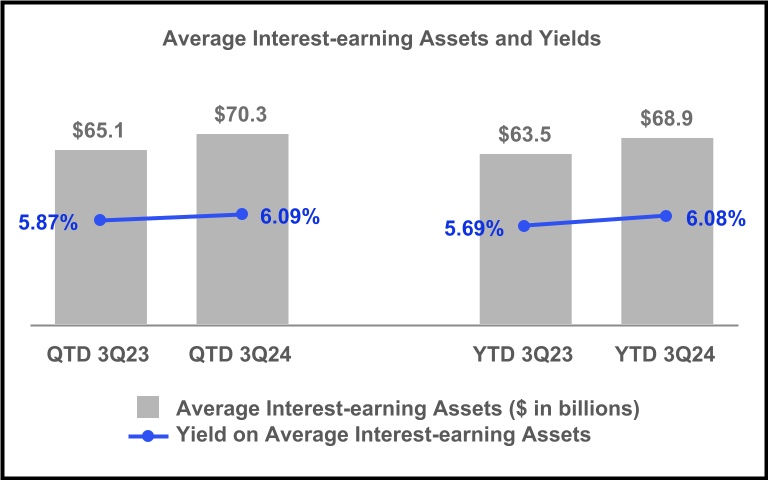
Average interest-earning assets were $70.3 billion for the third quarter of 2024, an increase of $5.2 billion or 8% from $65.1 billion for the third quarter of 2023. For the first nine months of 2024, average interest-earning assets were $68.9 billion, an increase of $5.4 billion or 8% from $63.5 billion for the first nine months of 2023. The year-over-year increases in average interest-earning assets primarily reflected loan growth and an increase in AFS debt securities.
The yield on average interest-earning assets for the third quarter of 2024 was 6.09%, an increase of 22 bps from 5.87% for the third quarter of 2023. The yield on average interest-earning assets for the first nine months of 2024 was 6.08%, an increase of 39 bps from 5.69% for the first nine months of 2023. The year-over-year increases in the yield on average interest-earning assets primarily reflected loan growth, an increase in AFS debt securities and higher benchmark interest rates.
The average loan yield for the third quarter of 2024 was 6.73%, an increase of 22 bps from 6.51% for the third quarter of 2023. The average loan yield for the first nine months of 2024 was 6.72%, an increase of 39 bps from 6.33% for the first nine months of 2023. The year-over-year increases in the average loan yield reflected the loan portfolio’s sensitivity to higher benchmark interest rates and loan growth. Approximately 58% of loans held-for-investment were variable rate as of both September 30, 2024 and 2023.
Deposits are an important source of funding for the Company. Average deposits were $60.6 billion for the third quarter of 2024, which increased $5.4 billion or 10% from $55.2 billion for the third quarter of 2023. For the first nine months of 2024, average deposits were $58.9 billion, which increased $4.1 billion or 7% from $54.8 billion for the first nine months of 2023.
Average noninterest-bearing deposits were $14.6 billion for the third quarter of 2024, a decrease of $1.7 billion or 10% from $16.3 billion for the third quarter of 2023. For the first nine months of 2024, average noninterest-bearing deposits were $14.7 billion, a decrease of $2.9 billion or 16% from $17.6 billion for the first nine months of 2023. The year-over-year decreases in noninterest-bearing deposits reflected the deposit mix shift to time and money market deposits. Average noninterest-bearing deposits made up 24% and 30% of average deposits for the third quarters of 2024 and 2023, respectively, and 25% and 32% for the first nine months of 2024 and 2023, respectively.
During the third quarter and first nine months of 2024, the average cost of deposits increased 55 bps and 87 bps, respectively; while the average cost of interest-bearing deposits increased 48 bps and 88 bps, respectively. These year-over-year increases primarily reflected shifts in the deposit mix to time and money market deposits, and rising deposit costs in response to the higher interest rate environment.
The average cost of funds calculation includes deposits, BTFP, short-term borrowings and federal funds purchased, FHLB advances, securities sold under repurchase agreements (“repurchase agreements”), and long-term debt and finance lease liabilities. For the third quarter of 2024, the average cost of funds was 3.12%, a 53 bp increase from 2.59% for the third quarter of 2023. For the first nine months of 2024, the average cost of funds was 3.07%, an 86 bp increase from 2.21% for the first nine months of 2023. The year-over year increases were mainly driven by the increased cost of deposits as discussed above.
The Company utilizes various tools to manage interest rate risk. Refer to the Interest Rate Risk Management section of Item 2. MD&A — Risk Management — Market Risk Management in this Form 10-Q.
The following table presents the interest spread, net interest margin, average balances, interest income and expense, and the average yield/rate by asset and liability component for the third quarters of 2024 and 2023:
| | | | | | | | | | | | | | | | | | | | | | | | | | | | | | | | | | | | | | |
|
| | Three Months Ended September 30, |
| | 2024 | | 2023 |
| ($ in thousands) | | Average Balance | | Interest | | Average Yield/Rate (1) | | Average Balance | | Interest | | Average Yield/Rate (1) |
| ASSETS | | | | | | | | | | | | |
| Interest-earning assets: | | | | | | | | | | | | |
| Interest-bearing cash and deposits with banks | | $ | 4,987,191 | | | $ | 60,060 | | | 4.79 | % | | $ | 5,392,795 | | | $ | 67,751 | | | 4.98 | % |
Securities purchased under resale agreements | | 443,261 | | | 1,663 | | | 1.49 | % | | 648,587 | | | 4,460 | | | 2.73 | % |
| Debt securities: | | | | | | | | | | | | |
AFS (2) (3) | | 9,316,232 | | | 111,552 | | | 4.76 | % | | 6,074,119 | | | 57,177 | | | 3.73 | % |
Held-to-maturity (“HTM”) (2) | | 2,931,033 | | | 12,431 | | | 1.69 | % | | 2,967,703 | | | 12,601 | | | 1.68 | % |
Total debt securities (2) | | 12,247,265 | | | 123,983 | | | 4.03 | % | | 9,041,822 | | | 69,778 | | | 3.06 | % |
| Loans: | | | | | | | | | | | | |
Commercial and industrial (“C&I”) (2) | | 16,492,589 | | | 328,619 | | | 7.93 | % | | 15,400,172 | | | 306,542 | | | 7.90 | % |
CRE (2) | | 20,272,662 | | | 328,254 | | | 6.44 | % | | 20,059,280 | | | 317,416 | | | 6.28 | % |
| Residential mortgage | | 15,601,307 | | | 229,727 | | | 5.86 | % | | 14,365,493 | | | 193,913 | | | 5.36 | % |
| Other consumer | | 53,958 | | | 753 | | | 5.55 | % | | 63,917 | | | 848 | | | 5.26 | % |
Total loans (2) (4) (5) | | 52,420,516 | | | 887,353 | | | 6.73 | % | | 49,888,862 | | | 818,719 | | | 6.51 | % |
| | | | | | | | |
| | | | | | | | |
| | | | | | | | |
| | | | | | | | |
| | | | | | | | |
| | | | | | | | |
| | | | | | | | |
| Restricted equity securities | | 165,262 | | | 2,840 | | | 6.84 | % | | 79,395 | | | 1,079 | | | 5.39 | % |
| Total interest-earning assets | | $ | 70,263,495 | | | $ | 1,075,899 | | | 6.09 | % | | $ | 65,051,461 | | | $ | 961,787 | | | 5.87 | % |
| | | | | | | | |
| Noninterest-earning assets: | | | | | | | | | | | | |
| Cash and due from banks | | 341,856 | | | | | | | 544,939 | | | | | |
| Allowance for loan losses | | (691,399) | | | | | | | (629,229) | | | | | |
| Other assets | | 3,354,206 | | | | | | | 3,969,615 | | | | | |
| Total assets | | $ | 73,268,158 | | | | | | | $ | 68,936,786 | | | | | |
| | | | | | | | | | | | |
| LIABILITIES AND STOCKHOLDERS’ EQUITY | | | | | | | | | | | | |
| Interest-bearing liabilities: | | | | | | | | | | | | |
| Checking deposits | | $ | 7,762,719 | | | $ | 58,226 | | | 2.98 | % | | $ | 8,080,025 | | | $ | 54,285 | | | 2.67 | % |
| Money market deposits | | 14,201,258 | | | 136,384 | | | 3.82 | % | | 12,180,806 | | | 113,217 | | | 3.69 | % |
| Savings deposits | | 1,744,644 | | | 4,811 | | | 1.10 | % | | 2,013,246 | | | 4,047 | | | 0.80 | % |
| Time deposits | | 22,270,124 | | | 254,650 | | | 4.55 | % | | 16,621,683 | | | 166,747 | | | 3.98 | % |
Total interest-bearing deposits | | 45,978,745 | | | 454,071 | | | 3.93 | % | | 38,895,760 | | | 338,296 | | | 3.45 | % |
| BTFP, short-term borrowings and federal funds purchased | | 1,170 | | | 16 | | | 5.44 | % | | 4,501,327 | | | 49,575 | | | 4.37 | % |
| Short-term repurchase agreements | | 3,455 | | | 49 | | | 5.64 | % | | 13,897 | | | 193 | | | 5.51 | % |
| FHLB advances | | 3,440,219 | | | 48,261 | | | 5.58 | % | | 1 | | | — | | | 0.00 | % |
| Long-term debt and finance lease liabilities | | 36,084 | | | 780 | | | 8.60 | % | | 152,962 | | | 2,910 | | | 7.55 | % |
| Total interest-bearing liabilities | | $ | 49,459,673 | | | $ | 503,177 | | | 4.05 | % | | $ | 43,563,947 | | | $ | 390,974 | | | 3.56 | % |
| | | | | | | | |
| Noninterest-bearing liabilities and stockholders’ equity: | | | | | | | | | | | | |
| Demand deposits | | 14,606,511 | | | | | | | 16,302,296 | | | | | |
| Accrued expenses and other liabilities | | 1,758,641 | | | | | | | 2,465,745 | | | | | |
| Stockholders’ equity | | 7,443,333 | | | | | | | 6,604,798 | | | | | |
| Total liabilities and stockholders’ equity | | $ | 73,268,158 | | | | | | | $ | 68,936,786 | | | | | |
| | | | | | | | | | | | |
| | | | | | | | |
| | | | | | | | |
| Interest rate spread | | | | | | 2.04 | % | | | | | | 2.31 | % |
| Net interest income and net interest margin | | | | $ | 572,722 | | | 3.24 | % | | | | $ | 570,813 | | | 3.48 | % |
|
(1)Annualized.
(2)Yields on tax-exempt securities and loans are not presented on a tax-equivalent basis.
(3)Includes the amortization of net premiums on AFS debt securities of $9 million and $8 million for the third quarters of 2024 and 2023, respectively.
(4)Average balances include nonperforming loans and loans held-for-sale.
(5)Loans include the accretion of net deferred loan fees and amortization of net premiums, which totaled $12 million and $13 million for the third quarters of 2024 and 2023, respectively.
The following table presents the interest spread, net interest margin, average balances, interest income and expense, and the average yield/rate by asset and liability component for the first nine months of 2024 and 2023:
| | | | | | | | | | | | | | | | | | | | | | | | | | | | | | | | | | | | | | | | | | | | | | |
| | | | | | | | |
| | Nine Months Ended September 30, | | | | | | | | |
| | 2024 | | 2023 | | | | | | | | |
| ($ in thousands) | | Average Balance | | Interest | | Average Yield/Rate (1) | | Average Balance | | Interest | | Average Yield/Rate (1) | | | | | | | | |
| ASSETS | | | | | | | | | | | | | | | | | | | | |
| Interest-earning assets: | | | | | | | | | | | | | | | | | | | | |
| Interest-bearing cash and deposits with banks | | $ | 5,054,542 | | | $ | 183,848 | | | 4.86 | % | | $ | 4,703,843 | | | $ | 164,393 | | | 4.67 | % | | | | | | | | |
Assets purchased under resale agreements (2) | | 550,913 | | | 9,663 | | | 2.34 | % | | 659,621 | | | 12,932 | | | 2.62 | % | | | | | | | | |
| Debt securities: | | | | | | | | | | | | | | | | | | | | |
AFS (3) (4) | | 8,125,876 | | | 273,652 | | | 4.50 | % | | 6,146,653 | | | 166,666 | | | 3.63 | % | | | | | | | | |
HTM (3) | | 2,940,920 | | | 37,455 | | | 1.70 | % | | 2,982,284 | | | 38,013 | | | 1.70 | % | | | | | | | | |
Total debt securities (3) | | 11,066,796 | | | 311,107 | | | 3.76 | % | | 9,128,937 | | | 204,679 | | | 3.00 | % | | | | | | | | |
| Loans: | | | | | | | | | | | | | | | | | | | | |
C&I (3) | | 16,318,594 | | | 977,077 | | | 8.00 | % | | 15,348,662 | | | 869,914 | | | 7.58 | % | | | | | | | | |
CRE (3) | | 20,318,851 | | | 975,447 | | | 6.41 | % | | 19,625,224 | | | 900,601 | | | 6.14 | % | | | | | | | | |
| Residential mortgage | | 15,397,583 | | | 667,367 | | | 5.79 | % | | 13,928,776 | | | 545,442 | | | 5.24 | % | | | | | | | | |
| | | | | | | | | | | | | | | | | | | | |
| | | | | | | | | | | | | | | | | | | | |
| | | | | | | | | | | | | | | | | | | | |
| Other consumer | | 54,233 | | | 2,292 | | | 5.65 | % | | 67,181 | | | 2,412 | | | 4.80 | % | | | | | | | | |
Total loans (3) (5) (6) | | 52,089,261 | | | 2,622,183 | | | 6.72 | % | | 48,969,843 | | | 2,318,369 | | | 6.33 | % | | | | | | | | |
| Restricted equity securities | | 141,051 | | | 7,129 | | | 6.75 | % | | 83,013 | | | 3,054 | | | 4.92 | % | | | | | | | | |
| Total interest-earning assets | | $ | 68,902,563 | | | $ | 3,133,930 | | | 6.08 | % | | $ | 63,545,257 | | | $ | 2,703,427 | | | 5.69 | % | | | | | | | | |
| | | | | | | | | | | | | | | | | | | | |
| Noninterest-earning assets: | | | | | | | | | | | | | | | | | | | | |
| Cash and due from banks | | 332,983 | | | | | | | 578,144 | | | | | | | | | | | | | |
| Allowance for loan losses | | (681,988) | | | | | | | (617,381) | | | | | | | | | | | | | |
| Other assets | | 3,496,156 | | | | | | | 3,690,570 | | | | | | | | | | | | | |
| Total assets | | $ | 72,049,714 | | | | | | | $ | 67,196,590 | | | | | | | | | | | | | |
| | | | | | | | | | | | | | | | | | | | |
| LIABILITIES AND STOCKHOLDERS’ EQUITY | | | | | | | | | | | | | | | | | | | | |
| Interest-bearing liabilities: | | | | | | | | | | | | | | | | | | | | |
| Checking deposits | | $ | 7,642,423 | | | $ | 164,727 | | | 2.88 | % | | $ | 7,675,325 | | | $ | 127,030 | | | 2.21 | % | | | | | | | | |
| Money market deposits | | 13,855,167 | | | 406,450 | | | 3.92 | % | | 11,295,157 | | | 275,738 | | | 3.26 | % | | | | | | | | |
| Savings deposits | | 1,783,011 | | | 13,935 | | | 1.04 | % | | 2,215,102 | | | 11,679 | | | 0.70 | % | | | | | | | | |
| Time deposits | | 20,886,769 | | | 706,640 | | | 4.52 | % | | 15,993,669 | | | 428,120 | | | 3.58 | % | | | | | | | | |
Total interest-bearing deposits | | 44,167,370 | | | 1,291,752 | | | 3.91 | % | | 37,179,253 | | | 842,567 | | | 3.03 | % | | | | | | | | |
| BTFP, short-term borrowings and federal funds purchased | | 1,284,826 | | | 42,154 | | | 4.38 | % | | 3,284,663 | | | 107,432 | | | 4.37 | % | | | | | | | | |
| FHLB advances | | 2,501,826 | | | 104,840 | | | 5.60 | % | | 164,836 | | | 6,430 | | | 5.22 | % | | | | | | | | |
| Repurchase agreements | | 3,370 | | | 142 | | | 5.63 | % | | 45,080 | | | 1,456 | | | 4.32 | % | | | | | | | | |
| Long-term debt and finance lease liabilities | | 65,969 | | | 3,952 | | | 8.00 | % | | 152,716 | | | 8,122 | | | 7.11 | % | | | | | | | | |
| Total interest-bearing liabilities | | $ | 48,023,361 | | | $ | 1,442,840 | | | 4.01 | % | | $ | 40,826,548 | | | $ | 966,007 | | | 3.16 | % | | | | | | | | |
| | | | | | | | | | | | | | | | | | | | |
| Noninterest-bearing liabilities and stockholders’ equity: | | | | | | | | | | | | | | | | | | | | |
| Demand deposits | | 14,741,590 | | | | | | | 17,633,922 | | | | | | | | | | | | | |
| Accrued expenses and other liabilities | | 2,109,318 | | | | | | | 2,324,870 | | | | | | | | | | | | | |
| Stockholders’ equity | | 7,175,445 | | | | | | | 6,411,250 | | | | | | | | | | | | | |
| Total liabilities and stockholders’ equity | | $ | 72,049,714 | | | | | | | $ | 67,196,590 | | | | | | | | | | | | | |
| | | | | | | | | | | | | | | | | | | | |
| | | | | | | | | | | | | | | | | | | | |
| | | | | | | | | | | | | | | | | | | | |
| Interest rate spread | | | | | | 2.07 | % | | | | | | 2.53 | % | | | | | | | | |
| Net interest income and net interest margin | | | | $ | 1,691,090 | | | 3.28 | % | | | | $ | 1,737,420 | | | 3.66 | % | | | | | | | | |
| | | | | | | | |
(1)Annualized.
(2)Includes the average balances and interest income for securities and loans purchased under resale agreements for the first nine months of 2023. There were no loans purchased under resale agreements for the first nine months of 2024.
(3)Yields on tax-exempt securities and loans are not presented on a tax-equivalent basis.
(4)Includes the amortization of net premiums on AFS debt securities of $26 million and $24 million for the first nine months of 2024 and 2023, respectively.
(5)Average balances include nonperforming loans and loans held-for-sale.
(6)Loans include the accretion of net deferred loan fees and amortization of net premiums, which totaled $40 million for each of the first nine months of 2024 and 2023.
The following table summarizes the extent to which changes in (1) interest rates, and (2) volume of average interest-earning assets and average interest-bearing liabilities affected the Company’s net interest income for the periods presented. The total change for each category of interest-earning assets and interest-bearing liabilities is segmented into changes attributable to variations in volume and yield/rate. Changes that are not solely due to either volume or yield/rate are allocated proportionally based on the absolute value of the change related to average volume and average yield/rate.
| | | | | | | | | | | | | | | | | | | | | | | | | | | | | | | | | | | | | | | | | | | | | | |
| | | | | | | | | | | | | | | | | | | | |
| | Three Months Ended September 30, | | Nine Months Ended September 30, | | | | |
| | 2024 vs. 2023 | | 2024 vs. 2023 |
| | | | Changes Due to | | | | Changes Due to | | | | |
| ($ in thousands) | | Total Change | | Volume | | Yield/Rate | | Total Change | | Volume | | Yield/Rate | | | | | | |
| Interest-earning assets: | | | | | | | | | | | | | | | | | | | | |
| Interest-bearing cash and deposits with banks | | $ | (7,691) | | | $ | (5,074) | | | $ | (2,617) | | | $ | 19,455 | | | $ | 12,685 | | | $ | 6,770 | | | | | | | | | |
Assets purchased under resale agreements (1) | | (2,797) | | | (1,151) | | | (1,646) | | | (3,269) | | | (1,988) | | | (1,281) | | | | | | | | | |
| Debt securities: | | | | | | | | | | | | | | | | | | | | |
AFS | | 54,375 | | | 35,863 | | | 18,512 | | | 106,986 | | | 61,205 | | | 45,781 | | | | | | | | | |
HTM | | (170) | | | (186) | | | 16 | | | (558) | | | (496) | | | (62) | | | | | | | | | |
| Total debt securities | | 54,205 | | | 35,677 | | | 18,528 | | | 106,428 | | | 60,709 | | | 45,719 | | | | | | | | | |
| Loans: | | | | | | | | | | | | | | | | | | | | |
| C&I | | 22,077 | | | 20,967 | | | 1,110 | | | 107,163 | | | 57,075 | | | 50,088 | | | | | | | | | |
| CRE | | 10,838 | | | 3,141 | | | 7,697 | | | 74,846 | | | 32,856 | | | 41,990 | | | | | | | | | |
| Residential mortgage | | 35,814 | | | 17,129 | | | 18,685 | | | 121,925 | | | 60,862 | | | 61,063 | | | | | | | | | |
| Other consumer | | (95) | | | (139) | | | 44 | | | (120) | | | (507) | | | 387 | | | | | | | | | |
| Total loans | | 68,634 | | | 41,098 | | | 27,536 | | | 303,814 | | | 150,286 | | | 153,528 | | | | | | | | | |
| Restricted equity securities | | 1,761 | | | 1,411 | | | 350 | | | 4,075 | | | 2,658 | | | 1,417 | | | | | | | | | |
| Total interest and dividend income | | $ | 114,112 | | | $ | 71,961 | | | $ | 42,151 | | | $ | 430,503 | | | $ | 224,350 | | | $ | 206,153 | | | | | | | | | |
| Interest-bearing liabilities: | | | | | | | | | | | | | | | | | | | | |
| Checking deposits | | $ | 3,941 | | | $ | (2,225) | | | $ | 6,166 | | | $ | 37,697 | | | $ | (546) | | | $ | 38,243 | | | | | | | | | |
| Money market deposits | | 23,167 | | | 19,029 | | | 4,138 | | | 130,712 | | | 69,344 | | | 61,368 | | | | | | | | | |
| Savings deposits | | 764 | | | (594) | | | 1,358 | | | 2,256 | | | (2,594) | | | 4,850 | | | | | | | | | |
| Time deposits | | 87,903 | | | 61,875 | | | 26,028 | | | 278,520 | | | 149,842 | | | 128,678 | | | | | | | | | |
Total interest-bearing deposits | | 115,775 | | | 78,085 | | | 37,690 | | | 449,185 | | | 216,046 | | | 233,139 | | | | | | | | | |
BTFP, short-term borrowings and federal funds purchased | | (49,559) | | | (49,569) | | | 10 | | | (65,278) | | | (65,514) | | | 236 | | | | | | | | | |
| FHLB advances | | 48,261 | | | 48,261 | | | — | | | 98,410 | | | 97,904 | | | 506 | | | | | | | | | |
| Repurchase agreements | | (144) | | | (148) | | | 4 | | | (1,314) | | | (1,655) | | | 341 | | | | | | | | | |
| Long-term debt and finance lease liabilities | | (2,130) | | | (2,486) | | | 356 | | | (4,170) | | | (5,086) | | | 916 | | | | | | | | | |
| Total interest expense | | $ | 112,203 | | | $ | 74,143 | | | $ | 38,060 | | | $ | 476,833 | | | $ | 241,695 | | | $ | 235,138 | | | | | | | | | |
| Change in net interest income | | $ | 1,909 | | | $ | (2,182) | | | $ | 4,091 | | | $ | (46,330) | | | $ | (17,345) | | | $ | (28,985) | | | | | | | | | |
| | | | | | | | | | | | | | | | | | | | |
(1)Includes the impact of securities purchased under resale agreements for the third quarters of 2024 and 2023, and first nine months of 2024. Includes the impacts of securities and loans purchased under resale agreements for the first nine months of 2023.
Noninterest Income
The following table presents the components of noninterest income for the third quarters and first nine months of 2024 and 2023:
| | | | | | | | | | | | | | | | | | | | | | | | | | | | | | | | | | | | | | | | | | |
| | | | | | | | | | | | | | | | |
| 2024 | | 2023 | | % Change | | |
| % | | $ | 77,412 | | | $ | 69,983 | | | 11 | % | | |
| % | | 73,718 | | | 61,799 | | | 19 | % | | |
| % | | 37,962 | | | 34,872 | | | 9 | % | | |
| % | | 28,798 | | | 19,213 | | | 50 | % | | |
| 8,808 | | | 21,145 | | | (58) | % | | |
| 36 | | | (41) | | | NM | | |
| % | | 1,979 | | | (10,000) | | | NM | | |
| | | | | | | | | | | | | | | | |
| | | | | | | | | | | | | | | | |
| % | | 6,201 | | | 7,675 | | | (19) | % | | |
| % | | 13,508 | | | 10,715 | | | 26 | % | | |
| % | | $ | 248,422 | | | $ | 215,361 | | | 15 | % | | |
|
NM — Not meaningful.
Noninterest income comprised 13% of total revenue for both the third quarter and first nine months of 2024, compared with 12% and 11% for the third quarter and first nine months of 2023, respectively. The $8 million or 10% increase in noninterest income to $85 million for the third quarter of 2024, compared with the same prior year period, was primarily due to increases in lending, wealth management and deposit account fees, other income and foreign exchange income, partially offset by customer derivative losses. The $33 million or 15% increase in noninterest income to $248 million for the first nine months of 2024, compared with the same prior year period, was primarily due to $2 million in net gains on AFS debt securities, compared with a $10 million write-down in securities in the same prior year period, increases in lending, wealth management and deposit account fees, partially offset by lower customer derivative income.
Deposit account fees were $27 million for the third quarter of 2024, an increase of $3 million or 14%, compared with $24 million for the third quarter of 2023. For the first nine months of 2024, deposit account fees were $77 million, an increase of $7 million or 11%, compared with $70 million for the same period in 2023. The increases were primarily related to analysis service fees, which reflected fee increases and customer growth.
Lending fees were $26 million for the third quarter of 2024, an increase of $6 million or 30%, compared with $20 million for the third quarter of 2023. For the first nine months of 2024, lending fees were $74 million, an increase of $12 million or 19%, compared with $62 million for the same period in 2023. The increases were primarily due to higher trade finance and commitment fees driven by customer growth, and higher syndication loan fee income.
Foreign exchange income was $14 million for the third quarter of 2024, an increase of approximately $2 million or 19%, compared with $11 million for the third quarter of 2023. For the first nine months of 2024, foreign exchange income was $38 million, an increase of $3 million or 9%, compared with $35 million for the same period in 2023. The increases primarily reflected the favorable valuation of certain foreign currency denominated balance sheet items, partially offset by losses on foreign exchange trades.
Wealth management fees were $11 million for the third quarter of 2024, an increase of $5 million or 80%, compared with $6 million for the third quarter of 2023. For the first nine months of 2024, wealth management fees were $29 million, an increase of $10 million or 50%, compared with $19 million for the same period in 2023. The increases reflected customer demand for higher-yielding products in response to the interest rate environment.
Customer derivative losses were $1 million for the third quarter of 2024, compared with an $11 million gain for the same period in 2023. For the first nine months of 2024, customer derivative income was $9 million, a decrease of $12 million or 58%, compared with $21 million for the same period in 2023. The decreases primarily reflected unfavorable credit valuation adjustments and lower fee income due to decreased customer activity.
Net gains on AFS debt securities were $145 thousand and $2 million for the third quarter and first nine months of 2024, respectively, which primarily reflected sales of U.S. government agency residential mortgage-backed securities. In comparison, net losses on AFS debt securities were $10 million for the first nine months of 2023, due to the write-off of an impaired subordinated debt security during the first quarter of 2023.
Other income was $5 million for the third quarter of 2024, an increase of $2 million or 90%, compared with $3 million for the same period in 2023. For the first nine months of 2024, other income was $14 million, an increase of $3 million or 26%, compared with $11 million for the same period in 2023. The year-over-year increases were primarily due to higher income from bank-owned life insurance policies.
Noninterest Expense
The following table presents the components of noninterest expense for the third quarters and first nine months of 2024 and 2023:
| | | | | | | | | | | | | | | | | | | | | | | | | | | | | | | | | | | | | | | | | | |
| | | | | | | | | | | | | | | |
| 2024 | | 2023 | | % Change | | |
| % | | $ | 410,864 | | | $ | 377,744 | | | 9 | % | | |
| % | | 46,499 | | | 47,028 | | | (1) | % | | |
| % | | 36,467 | | | 31,753 | | | 15 | % | | |
| % | | 34,172 | | | 33,160 | | | 3 | % | | |
| % | | 39,535 | | | 24,755 | | | 60 | % | | |
| | | | | | | | | | | | | | | | |
| | | | | | | | | | | | | | | | |
| % | | 107,079 | | | 102,092 | | | 5 | % | | |
| % | | 34,859 | | | 115,718 | | | (70) | % | | |
| | | | | | | | | | | | | | | | |
| | | | | | | | | | | | | | | | |
| % | | $ | 709,475 | | | $ | 732,250 | | | (3) | % | | |
|
Third quarter 2024 noninterest expense of $226 million decreased $26 million or 10%, compared with $252 million for the third quarter of 2023. The decrease was primarily due to a decrease in amortization of tax credit and CRA investments, partially offset by increases in compensation and employee benefits and other operating expense. For the first nine months of 2024, noninterest expense of $709 million decreased $23 million or 3%, compared with $732 million for the same period in 2023, primarily due to a decrease in amortization of tax credit and CRA investments, partially offset by increases in compensation and employee benefits, deposit insurance premiums and regulatory assessments, other operating and deposit account expense.
Compensation and employee benefits were $135 million for the third quarter of 2024, an increase of $12 million or 10%, compared with $123 million for the third quarter of 2023. For the first nine months of 2024, compensation and employee benefits were $411 million, an increase of $33 million or 9%, compared with $378 million for the same period in 2023. The increases were primarily driven by annual merit increases and staffing growth.
Deposit account expense was $12 million for the third quarter of 2024, an increase of $1 million or 6%, compared with the third quarter of 2023, primarily due to increased commercial vendor service and processing charges, primarily driven by higher commercial deposit balances. For the first nine months of 2024, deposit account expense was $36 million, an increase of $5 million or 15%, compared with the same period in 2023, primarily due to higher deposit referral fees, insured cash sweep product fees and commercial vendor service and processing charges, primarily driven by higher deposit balances.
For the third quarter of 2024, deposit insurance premiums and regulatory assessments were $9 million, an increase of approximately $1 million or 7%, compared with the same period in 2023. This increase was primarily due to a higher assessment base from growth in the Company’s total average assets. For the first nine months of 2024, deposit insurance premiums and regulatory assessments were $40 million, an increase of $15 million or 60%, compared with $25 million for the same period in 2023. This increase was primarily due to an additional FDIC charge of $12 million recorded during the first nine months of 2024. For additional information about the FDIC special assessment, refer to Item 2. MD&A — Overview — Current Developments in this Form 10-Q.
Other operating expense was $36 million for the third quarter of 2024, an increase of $4 million or 13%, compared with $32 million for the third quarter of 2023, primarily due to increased legal and consulting expenses. For the first nine months of 2024, other operating expense was $107 million, an increase of $5 million or 5%, compared with $102 million for the same period in 2023, primarily due to increased other real estate owned (“OREO”) and legal expenses.
Amortization of tax credit and CRA investments was $6 million for the third quarter of 2024, a decrease of $44 million or 89%, compared with $50 million for the third quarter of 2023. For the first nine months of 2024, amortization of tax credit and CRA investments was $35 million, a decrease of $81 million or 70%, compared with $116 million for the same period in 2023. The decreases were primarily due to the impacts related to the expanded application of proportional amortization method (“PAM”) since the adoption of Accounting Standards Update (“ASU”) 2023-02, Investments — Equity Method and Joint Ventures on January 1, 2024, and the timing of tax credit investments that closed in a given period. For additional information on the PAM, see Note 2 — Current Accounting Developments and Summary of Significant Accounting Policies and Note 8 — Affordable Housing Partnership, Tax Credit and Community Reinvestment Act Investments, Net to the Consolidated Financial Statements in this Form 10-Q.
Income Taxes
| | | | | | | | | | | | | | | | | | | | | | | | | | | | | | | | | | | | | | | | | | | | | | |
|
| | Three Months Ended September 30, | | Nine Months Ended September 30, |
| ($ in thousands) | | 2024 | | 2023 | | % Change | | 2024 | | 2023 | | % Change | | | | | | | | |
| Income before income taxes | | $ | 389,317 | | | $ | 353,551 | | | 10 | % | | $ | 1,126,037 | | | $ | 1,132,531 | | | (1) | % | | | | | | | | |
| Income tax expense | | $ | 90,151 | | | $ | 65,813 | | | 37 | % | | $ | 253,566 | | | $ | 210,323 | | | 21 | % | | | | | | | | |
| Effective tax rate | | 23.2 | % | | 18.6 | % | | | | 22.5 | % | | 18.6 | % | | | | | | | | | | |
|
Third quarter 2024 income tax expense was $90 million and the effective tax rate was 23.2%, compared with third quarter 2023 income tax expense of $66 million and an effective tax rate of 18.6%. For the first nine months of 2024, income tax expense was $254 million and the effective tax rate was 22.5%, compared with income tax expense of $210 million and an effective tax rate of 18.6% for the same period in 2023. The year-over-year increases in income tax expense and effective tax rate were primarily due to the impacts related to the expanded application of PAM on the Company’s tax credit investments since the adoption of ASU 2023-02 on January 1, 2024 and the timing of tax credit investments that closed in a given period. $22 million and $65 million of investment amortization was recognized as a component of income tax expense during the three and nine months ended September 30, 2024, respectively, which is related to the expanded application of PAM. For additional information on the PAM, see Note 2 — Current Accounting Developments and Summary of Significant Accounting Policies and Note 8 — Affordable Housing Partnership, Tax Credit and Community Reinvestment Act Investments, Net.
Operating Segment Results
The Company organizes its operations into three reportable operating segments: (1) Consumer and Business Banking; (2) Commercial Banking; and (3) Treasury and Other. These segments are defined by the type of customers served and the related products and services provided. For a description of the Company’s internal management reporting process, including the segment cost allocation methodology, see Note 15 — Business Segments to the Consolidated Financial Statements in this Form 10-Q.
Segment net interest income represents the difference between actual interest earned on assets and interest incurred on liabilities of the segment, adjusted for funding charges or credits through the Company’s internal funds transfer pricing (“FTP”) process.
During the third quarter of 2024, the Company refined its segment allocation methodology and reclassified certain deposits and their related income or expenses from the “Consumer and Business Banking” segment to the “Commercial Banking” or “Treasury and Other” segments, and certain loan balances and their related income or expenses from the “Commercial Banking” segment to the “Treasury and Other” segment. Balances for the prior year periods have been reclassified for comparability.
The following tables present the results by operating segment for the periods indicated:
| | | | | | | | | | | | | | | | | | | | | | | | | | | | | | | | | | | | | | |
|
| | Three Months Ended September 30, |
| | Consumer and Business Banking | | Commercial Banking | | Treasury and Other |
| ($ in thousands) | | 2024 | | 2023 | | 2024 | | 2023 | | 2024 | | 2023 |
Total revenue (loss) | | $ | 318,854 | | | $ | 339,640 | | | $ | 334,281 | | | $ | 326,953 | | | $ | 4,348 | | | $ | (19,028) | |
Provision for (reversal of) credit losses | | 5,927 | | | 2,563 | | | 36,934 | | | 35,506 | | | (861) | | | 3,931 | |
| | | | | | | | |
| | | | | | | | |
| | | | | | | | |
| | | | | | | | |
| | | | | | | | |
| | | | | | | | |
| | | | | | | | |
| | | | | | | | |
| | | | | | | | |
| | | | | | | | |
| | | | | | | | |
| | | | | | | | |
| | | | | | | | |
| | | | | | | | |
| | | | | | | | |
| | | | | | | | |
| | | | | | | | |
| | | | | | | | |
| | | | | | | | |
| | | | | | | | |
| | | | | | | | |
| | | | | | | | |
| | | | | | | | |
| Noninterest expense | | 112,006 | | | 105,557 | | | 93,602 | | | 86,613 | | | 20,558 | | | 59,844 | |
| Segment income (loss) before income taxes | | 200,921 | | | 231,520 | | | 203,745 | | | 204,834 | | | (15,349) | | | (82,803) | |
| | | | | | | | |
|
|
|
|
|
|
| | | | | | | | | | | |
| | | | | | | | | | | |
| | | | | | | | | | | |
| | | | | | | | | | | |
| | | | | | | | | | | |
| | | | | | | | | | | |
| | | | | | | | | | | |
| | | | | | | | | | | |
| | | | | | | | | | | |
| | | | | | | | | | | |
| | | | | | | | | | | |
| | | | | | | | | | | |
| | | | | | | | | | | |
| | | | | | | | | | | |
| | | | | | | | | | | |
| | | | | | | | | | | |
| | | | | | | | | | | |
| | | | | | | | | | | |
| | | | | | | | | | | |
| | | | | | | | | | | |
| | | | | | | | | | | |
| | | | | | | | | | | |
| | | | | | | | | | | |
|
|
| | | | | | | | | | | |
|
|
|
|
|
|
|
|
|
|
|
|
|
|
| | | | | | | | | | | | | | | | | | | | | | | | | |
|
|
|
|
|
|
(1)Credit ratings express opinions about the credit quality of a debt security. The Company determines the credit rating of a security according to the lowest credit rating made available by nationally recognized statistical rating organizations (“NRSROs”). Debt securities rated investment grade, which are those with ratings similar to BBB- or above (as defined by NRSROs), are generally considered by the rating agencies and market participants to be low credit risk. Ratings percentages are allocated based on fair value.
(2)For debt securities not rated by NRSROs, the Company uses other factors which include but are not limited to the priority in collections within the securitization structure, and whether the contractual payments have historically been on time.
(3)Includes Government National Mortgage Association (“GNMA”) AFS debt securities totaling $6.4 billion of amortized cost and $6.3 billion of fair value as of September 30, 2024, and $1.3 billion of amortized cost and $1.2 billion of fair value as of December 31, 2023.
(4)Includes GNMA HTM debt securities totaling $88 million of amortized cost and $72 million of fair value as of September 30, 2024, and $92 million of amortized cost and $75 million of fair value of as of December 31, 2023.
As of September 30, 2024, the Company’s AFS and HTM debt securities portfolios had an effective duration (defined as the sensitivity of the value of the portfolio to interest rate changes) of 2.4 and 7.0, respectively, compared with 3.6 and 7.5, respectively, as of December 31, 2023. The decrease in the AFS effective duration was primarily due to the purchases of floating rate GNMA securities. The decrease in the HTM effective duration was due to the portfolio seasoning. The Company estimated that the effective duration of its AFS debt securities was 2.9 for an instantaneous 100 bp parallel increase and 2.2 for an instantaneous 100 bp parallel decrease as of September 30, 2024.
Available-for-Sale Debt Securities
The fair value of AFS debt securities totaled $10.1 billion as of September 30, 2024, an increase of $3.9 billion or 64% from $6.2 billion as of December 31, 2023. The increase was primarily due to the purchases of GNMA securities, which were mainly funded by an increase in deposits. The Company’s AFS debt securities are carried at fair value with non-credit related unrealized gains and losses, net of tax, reported in Other comprehensive income (loss) on the Consolidated Statement of Comprehensive Income. Pre-tax net unrealized losses on AFS debt securities were $533 million as of September 30, 2024, compared with $728 million as of December 31, 2023.
As of September 30, 2024 and December 31, 2023, 99% and 97%, respectively, of the carrying value of the AFS debt securities portfolio was rated investment grade by NRSROs. Of the AFS debt securities with gross unrealized losses, substantially all were rated investment grade as of both September 30, 2024 and December 31, 2023. There was no allowance for credit losses provided against the AFS debt securities as of both September 30, 2024 and December 31, 2023. Additionally, there were no credit losses recognized in earnings for the three and nine months ended September 30, 2024 and 2023.
Held-to-Maturity Debt Securities
All HTM debt securities were issued, guaranteed, or supported by the U.S. government or government-sponsored enterprises. Accordingly, the Company applied a zero credit loss assumption for these securities and no allowance for credit loss was recorded as of both September 30, 2024 and December 31, 2023.
For additional information on AFS and HTM securities, see Note 1 — Summary of Significant Accounting Policies to the Consolidated Financial Statements in the Company’s 2023 Form 10-K and Note 3 — Fair Value Measurement and Fair Value of Financial Instruments and Note 5 — Securities to the Consolidated Financial Statements in this Form 10-Q.
Loan Portfolio
The Company offers a broad range of financial products designed to meet the credit needs of its borrowers. The Company’s loan portfolio segments include commercial loans, which consist of C&I, CRE, multifamily residential, and construction and land loans, as well as consumer loans, which consist of single-family residential, home equity lines of credit (“HELOCs”) and other consumer loans. Loans held-for-investment totaled $53.3 billion and $52.2 billion as of September 30, 2024 and December 31, 2023, respectively. The composition of the loan portfolio was similar as of both September 30, 2024 and December 31, 2023.
The following table presents the composition of the Company’s total loan portfolio by loan type as of September 30, 2024 and December 31, 2023:
| | | | | | | | | | | | | | | | | | | | | | | | | | |
| ($ in thousands) | | Amount | | % | | Amount | | % |
| Commercial: | | | | | | | | |
C&I | | $ | 17,068,002 | | | 32 | % | | $ | 16,581,079 | | | 32 | % |
| CRE: | | | | | | | | |
| CRE | | 14,568,209 | | | 27 | % | | 14,777,081 | | | 28 | % |
| Multifamily residential | | 5,141,481 | | | 10 | % | | 5,023,163 | | | 10 | % |
| Construction and land | | 693,775 | | | 1 | % | | 663,868 | | | 1 | % |
| Total CRE | | 20,403,465 | | | 38 | % | | 20,464,112 | | | 39 | % |
| Total commercial | | 37,471,467 | | | 70 | % | | 37,045,191 | | | 71 | % |
| Consumer: | | | | | | | | |
| Residential mortgage: | | | | | | | | |
| Single-family residential | | 13,963,097 | | | 26 | % | | 13,383,060 | | | 26 | % |
| HELOCs | | 1,760,716 | | | 4 | % | | 1,722,204 | | | 3 | % |
| Total residential mortgage | | 15,723,813 | | | 30 | % | | 15,105,264 | | | 29 | % |
| Other consumer | | 57,901 | | | 0 | % | | 60,327 | | | 0 | % |
| Total consumer | | 15,781,714 | | | 30 | % | | 15,165,591 | | | 29 | % |
Total loans held-for-investment (1) | | 53,253,181 | | | 100 | % | | 52,210,782 | | | 100 | % |
| Allowance for loan losses | | (696,485) | | | | | (668,743) | | | |
Loans held-for-sale (2) | | — | | | | | 116 | | | |
| Total loans, net | | $ | 52,556,696 | | | | | $ | 51,542,155 | | | |
|
(1)Includes $52 million and $71 million of net deferred loan fees and net unamortized premiums as of September 30, 2024 and December 31, 2023, respectively.
(2)Consists of a single-family residential loan as of December 31, 2023.
Commercial
The commercial loan portfolio comprised 70% and 71% of total loans as of September 30, 2024 and December 31, 2023, respectively. The Company actively monitors the commercial lending portfolio for credit risk and reviews credit exposures for sensitivity to changing economic conditions.
Commercial — Commercial and Industrial Loans. Total C&I loan commitments were $25.3 billion and $24.6 billion as of September 30, 2024 and December 31, 2023, respectively, with a utilization rate of 67% as of both September 30, 2024 and December 31, 2023. Total C&I loans were $17.1 billion as of September 30, 2024, an increase of $487 million or 3% from $16.6 billion as of December 31, 2023. Total C&I loans made up 32% of total loans held-for-investment as of both September 30, 2024 and December 31, 2023. The C&I loan portfolio includes loans and financing for businesses across a wide spectrum of industries. The Company offers a variety of C&I products, including commercial business lending, working capital lines of credit, trade finance, letters of credit, asset-based lending, asset-backed finance, project finance and equipment financing. Additionally, the Company has a portfolio of broadly syndicated C&I loans, which represent revolving or term loan facilities that are marketed and sold primarily to institutional investors. This portfolio totaled $760 million and $645 million as of September 30, 2024 and December 31, 2023, respectively. The majority of the C&I loans had variable interest rates as of both September 30, 2024 and December 31, 2023.
The C&I portfolio is well-diversified by industry. The Company monitors concentrations within the C&I loan portfolio by industry and customer exposure, and has exposure limits by industry and loan product. The following table presents the industry mix within the Company’s C&I loan portfolio as of September 30, 2024 and December 31, 2023:
| | | | | | | | | | | | | | | | | | | | | | | | | | | | | | | | |
| | | | | | | | | | |
| | September 30, 2024 | | | | December 31, 2023 (1) |
| ($ in thousands) | | Amount | | % | | ($ in thousands) | | Amount | | % |
| Industry: | | | | | | Industry: | | | | |
| Real estate investment & management | | $ | 2,154,202 | | | 13 | % | | Capital call lending | | $ | 2,171,367 | | | 13 | % |
| Media & entertainment | | 2,113,633 | | | 12 | % | | Real estate investment & management | | 1,970,713 | | | 12 | % |
| Capital call lending | | 2,100,309 | | | 12 | % | | Media & entertainment | | 1,891,199 | | | 11 | % |
| Financial services | | 1,055,143 | | | 6 | % | | Financial services | | 1,136,731 | | | 7 | % |
| Infrastructure & clean energy | | 1,022,189 | | | 6 | % | | Manufacturing & wholesale | | 1,110,544 | | | 7 | % |
| Manufacturing & wholesale | | 1,017,715 | | | 6 | % | | Infrastructure & clean energy | | 1,023,662 | | | 6 | % |
| Food production & distribution | | 730,981 | | | 4 | % | | Tech & telecom | | 729,922 | | | 4 | % |
| Tech & telecom | | 724,718 | | | 4 | % | | Food production & distribution | | 655,340 | | | 4 | % |
| Healthcare | | 709,793 | | | 4 | % | | Consumer finance | | 586,468 | | | 4 | % |
| Hospitality & leisure | | 586,878 | | | 4 | % | | Hospitality & leisure | | 576,328 | | | 3 | % |
| Other | | 4,852,441 | | | 29 | % | | Other | | 4,728,805 | | | 29 | % |
| Total C&I | | $ | 17,068,002 | | | 100 | % | | Total C&I | | $ | 16,581,079 | | | 100 | % |
| | | | | | | | | | |
(1)Revised segmentation to conform with the current presentation.
Commercial — Total Commercial Real Estate Loans. Total CRE loans totaled $20.4 billion and $20.5 billion, and accounted for 38% and 39% of total loans held-for-investment as of September 30, 2024 and December 31, 2023, respectively. The total CRE portfolio consists of CRE, multifamily residential, and construction and land loans, and affordable housing lending. The Company’s underwriting parameters for CRE loans are established in compliance with supervisory guidance, including property type, geography and loan-to-value (“LTV”).
The Company’s total CRE loan portfolio is well-diversified by property type with an average CRE loan size of $3 million as of both September 30, 2024 and December 31, 2023. The following table summarizes the Company’s total CRE loans by property type as of September 30, 2024 and December 31, 2023:
| | | | | | | | | | | | | | | | | | | | | | | | | | |
|
| | September 30, 2024 | | December 31, 2023 |
| ($ in thousands) | | Amount | | % | | Amount | | % |
| Property types: | | | | | | | | |
| Multifamily | | $ | 5,141,481 | | | 25 | % | | $ | 5,023,164 | | | 25 | % |
Retail (1) | | 4,273,634 | | | 21 | % | | 4,297,569 | | | 21 | % |
Industrial (1) | | 3,921,621 | | | 19 | % | | 3,997,764 | | | 20 | % |
Hotel (1) | | 2,466,281 | | | 12 | % | | 2,446,504 | | | 12 | % |
Office (1) | | 2,142,154 | | | 11 | % | | 2,271,508 | | | 11 | % |
Healthcare (1) | | 738,395 | | | 4 | % | | 852,362 | | | 4 | % |
| Construction and land | | 693,775 | | | 3 | % | | 663,868 | | | 3 | % |
Other (1) | | 1,026,124 | | | 5 | % | | 911,373 | | | 4 | % |
| Total CRE loans | | $ | 20,403,465 | | | 100 | % | | $ | 20,464,112 | | | 100 | % |
|
(1)Included in CRE loans, which is a subset of Total CRE loans.
The weighted-average LTV ratio of the total CRE loan portfolio was 50% as of both September 30, 2024 and December 31, 2023. Weighted-average LTV is based on the most recent LTV, which considers the latest available appraisal and current loan commitment. Approximately 91% of total CRE loan commitments had an LTV ratio of 65% or lower as of both September 30, 2024 and December 31, 2023.
The following tables provide a summary of the Company’s CRE, multifamily residential, and construction and land loans by geography as of September 30, 2024 and December 31, 2023. The distribution of the total CRE loan portfolio largely reflects the Company’s geographical branch footprint, which is primarily concentrated in California.
| | | | | | | | | | | | | | | | | | | | | | | | | | | | | | | | | | | | | | | | | | | | | | | | | | |
|
| | September 30, 2024 |
| ($ in thousands) | | CRE | | % | | Multifamily Residential | | % | | Construction and Land | | % | | Total CRE | | % |
| Geographic markets: | | | | | | | | | | | | | | | | |
| Southern California | | $ | 7,492,595 | | | 51 | % | | $ | 2,322,222 | | | 45 | % | | $ | 247,191 | | | 36 | % | | $ | 10,062,008 | | | 50 | % |
| Northern California | | 2,693,298 | | | 19 | % | | 1,098,320 | | | 22 | % | | 149,046 | | | 21 | % | | 3,940,664 | | | 19 | % |
| California | | 10,185,893 | | | 70 | % | | 3,420,542 | | | 67 | % | | 396,237 | | | 57 | % | | 14,002,672 | | | 69 | % |
| Texas | | 1,073,586 | | | 7 | % | | 468,695 | | | 9 | % | | 114,540 | | | 17 | % | | 1,656,821 | | | 8 | % |
| New York | | 737,766 | | | 5 | % | | 253,527 | | | 5 | % | | 37,133 | | | 5 | % | | 1,028,426 | | | 5 | % |
| Washington | | 494,096 | | | 3 | % | | 165,886 | | | 3 | % | | 10,397 | | | 1 | % | | 670,379 | | | 3 | % |
| Arizona | | 368,230 | | | 3 | % | | 220,613 | | | 4 | % | | 20,288 | | | 3 | % | | 609,131 | | | 3 | % |
| Nevada | | 269,368 | | | 2 | % | | 159,162 | | | 3 | % | | 18,246 | | | 3 | % | | 446,776 | | | 2 | % |
| Other markets | | 1,439,270 | | | 10 | % | | 453,056 | | | 9 | % | | 96,934 | | | 14 | % | | 1,989,260 | | | 10 | % |
| Total loans | | $ | 14,568,209 | | | 100 | % | | $ | 5,141,481 | | | 100 | % | | $ | 693,775 | | | 100 | % | | $ | 20,403,465 | | | 100 | % |
|
| | | | | | | | | | | | | | | | | | | | | | | | | | | | | | | | | | | | | | | | | | | | | | | | | | |
|
| | December 31, 2023 |
| ($ in thousands) | | CRE | | % | | Multifamily Residential | | % | | Construction and Land | | % | | Total CRE | | % |
| Geographic markets: | | | | | | | | | | | | | | | | |
| Southern California | | $ | 7,604,053 | | | 51 | % | | $ | 2,295,592 | | | 46 | % | | $ | 294,879 | | | 44 | % | | $ | 10,194,524 | | | 50 | % |
| Northern California | | 2,737,635 | | | 19 | % | | 1,055,852 | | | 21 | % | | 147,031 | | | 22 | % | | 3,940,518 | | | 19 | % |
| California | | 10,341,688 | | | 70 | % | | 3,351,444 | | | 67 | % | | 441,910 | | | 66 | % | | 14,135,042 | | | 69 | % |
| Texas | | 1,122,428 | | | 8 | % | | 445,391 | | | 9 | % | | 41,768 | | | 6 | % | | 1,609,587 | | | 8 | % |
| New York | | 696,950 | | | 5 | % | | 287,961 | | | 6 | % | | 43,227 | | | 7 | % | | 1,028,138 | | | 5 | % |
| Washington | | 495,577 | | | 3 | % | | 173,367 | | | 3 | % | | 10,375 | | | 2 | % | | 679,319 | | | 3 | % |
| Arizona | | 355,047 | | | 2 | % | | 148,970 | | | 3 | % | | 38,897 | | | 6 | % | | 542,914 | | | 3 | % |
| Nevada | | 257,105 | | | 2 | % | | 142,133 | | | 3 | % | | 6,325 | | | 1 | % | | 405,563 | | | 2 | % |
| Other markets | | 1,508,286 | | | 10 | % | | 473,897 | | | 9 | % | | 81,366 | | | 12 | % | | 2,063,549 | | | 10 | % |
| Total loans | | $ | 14,777,081 | | | 100 | % | | $ | 5,023,163 | | | 100 | % | | $ | 663,868 | | | 100 | % | | $ | 20,464,112 | | | 100 | % |
|
As of both September 30, 2024 and December 31, 2023, 69% of total CRE loans were concentrated in California. Changes in California’s economy and real estate values could have a significant impact on the collectability of these loans and the required level of allowance for loan losses. For additional information related to the higher degree of risk from a downturn in the California economic and real estate markets, see Item 1A. Risk Factors — Risks Related to Geopolitical Uncertainties to the Company’s 2023 Form 10-K.
Commercial — Commercial Real Estate Loans. The Company focuses on providing financing to experienced real estate investors and developers who have moderate levels of leverage, many of whom are long-time customers of the Bank. CRE loans totaled $14.6 billion or 27% of total loans held-for-investment as of September 30, 2024, compared with $14.8 billion or 28% of total loans held-for-investment as of December 31, 2023. Interest rates on CRE loans may be fixed, variable or hybrid. As of September 30, 2024, 57% of our CRE portfolio had variable rates, of which 52% had customer-level interest rate derivative contracts in place. These were hedging contracts offered by the Company to help our customers manage their interest rate risk while the Bank’s exposure remained variable rate. In comparison, as of December 31, 2023, 58% of our CRE portfolio had variable rates, of which 50% had customer-level interest rate derivative contracts in place. The Company seeks to underwrite loans with conservative standards for cash flows, debt service coverage and LTV.
Owner-occupied properties comprised 20% of the CRE loans as of both September 30, 2024 and December 31, 2023. The remainder were non-owner-occupied properties, where 50% or more of the debt service for the loan is typically provided by rental income from an unaffiliated third party.
Commercial — Multifamily Residential Loans. The multifamily residential loan portfolio is largely comprised of loans secured by residential properties with five or more units. Multifamily residential loans totaled $5.1 billion and $5.0 billion as of September 30, 2024 and December 31, 2023, respectively, and accounted for 10% of total loans held-for-investment as of both dates. The Company offers a variety of first lien mortgages, including fixed- and variable-rate loans, as well as hybrid loans with interest rates that adjust annually after an initial fixed rate period of three to ten years. As of September 30, 2024, 50% of our multifamily residential portfolio had variable rates, of which 45% had customer-level interest rate derivative contracts in place. In comparison, as of December 31, 2023, 48% of our multifamily residential portfolio had variable rates, of which 40% had customer-level interest rate derivative contracts in place. These were hedging contracts offered by the Company to help our customers manage their interest rate risk while the Bank’s own exposure remained variable rate.
Commercial — Construction and Land Loans. Construction and land loans provide financing for a portfolio of projects diversified by real estate property type. Construction and land loans totaled $694 million as of September 30, 2024, compared with $664 million as of December 31, 2023, and accounted for 1% of total loans held-for-investment as of both dates. Construction loan exposure was made up of $540 million in loans outstanding, plus $466 million in unfunded commitments as of September 30, 2024, compared with $526 million in loans outstanding, plus $672 million in unfunded commitments as of December 31, 2023. Land loans totaled $154 million as of September 30, 2024, compared with $138 million as of December 31, 2023.
Consumer
Residential mortgage loans are primarily originated through the Bank’s branch network. The average total residential loan size was $437 thousand and $436 thousand as of September 30, 2024 and December 31, 2023, respectively. The following tables summarize the Company’s single-family residential and HELOC loan portfolios by geography as of September 30, 2024 and December 31, 2023:
| | | | | | | | | | | | | | | | | | | | | | | | | | | | | | | | | | | | | | |
|
| | September 30, 2024 |
| ($ in thousands) | | Single-Family Residential | | % | | HELOCs | | % | | Total Residential Mortgage | | % |
| Geographic markets: | | | | | | | | | | | | |
| Southern California | | $ | 5,313,574 | | | 38 | % | | $ | 826,527 | | | 47 | % | | $ | 6,140,101 | | | 39 | % |
| Northern California | | 1,772,854 | | | 13 | % | | 364,860 | | | 21 | % | | 2,137,714 | | | 14 | % |
| California | | 7,086,428 | | | 51 | % | | 1,191,387 | | | 68 | % | | 8,277,815 | | | 53 | % |
| New York | | 4,341,868 | | | 31 | % | | 258,739 | | | 15 | % | | 4,600,607 | | | 29 | % |
| Washington | | 705,764 | | | 5 | % | | 187,418 | | | 10 | % | | 893,182 | | | 6 | % |
| Massachusetts | | 446,166 | | | 3 | % | | 64,999 | | | 4 | % | | 511,165 | | | 3 | % |
| Georgia | | 459,017 | | | 3 | % | | 18,961 | | | 1 | % | | 477,978 | | | 3 | % |
| Nevada | | 441,341 | | | 3 | % | | 33,675 | | | 2 | % | | 475,016 | | | 3 | % |
| Texas | | 467,025 | | | 4 | % | | — | | | — | % | | 467,025 | | | 3 | % |
| Other markets | | 15,488 | | | 0 | % | | 5,537 | | | 0 | % | | 21,025 | | | 0 | % |
| Total | | $ | 13,963,097 | | | 100 | % | | $ | 1,760,716 | | | 100 | % | | $ | 15,723,813 | | | 100 | % |
| Lien priority: | | | | | | | | | | | | |
| First mortgage | | $ | 13,963,097 | | | 100 | % | | $ | 1,317,799 | | | 75 | % | | $ | 15,280,896 | | | 97 | % |
| Junior lien mortgage | | — | | | — | % | | 442,917 | | | 25 | % | | 442,917 | | | 3 | % |
| Total | | $ | 13,963,097 | | | 100 | % | | $ | 1,760,716 | | | 100 | % | | $ | 15,723,813 | | | 100 | % |
|
| | | | | | | | | | | | | | | | | | | | | | | | | | | | | | | | | | | | | | |
|
| | December 31, 2023 |
| ($ in thousands) | | Single-Family Residential | | % | | HELOCs | | % | | Total Residential Mortgage | | % |
| Geographic markets: | | | | | | | | | | | | |
| Southern California | | $ | 4,990,848 | | | 37 | % | | $ | 799,571 | | | 46 | % | | $ | 5,790,419 | | | 38 | % |
| Northern California | | 1,650,905 | | | 13 | % | | 370,989 | | | 22 | % | | 2,021,894 | | | 13 | % |
| California | | 6,641,753 | | | 50 | % | | 1,170,560 | | | 68 | % | | 7,812,313 | | | 51 | % |
| New York | | 4,376,416 | | | 33 | % | | 247,202 | | | 14 | % | | 4,623,618 | | | 31 | % |
| Washington | | 696,028 | | | 5 | % | | 184,843 | | | 11 | % | | 880,871 | | | 6 | % |
| Massachusetts | | 391,666 | | | 3 | % | | 67,016 | | | 4 | % | | 458,682 | | | 3 | % |
| Georgia | | 432,258 | | | 3 | % | | 17,123 | | | 1 | % | | 449,381 | | | 3 | % |
| Nevada | | 404,837 | | | 3 | % | | 33,959 | | | 2 | % | | 438,796 | | | 3 | % |
| Texas | | 423,972 | | | 3 | % | | — | | | — | % | | 423,972 | | | 3 | % |
| Other markets | | 16,130 | | | 0 | % | | 1,501 | | | 0 | % | | 17,631 | | | 0 | % |
| Total | | $ | 13,383,060 | | | 100 | % | | $ | 1,722,204 | | | 100 | % | | $ | 15,105,264 | | | 100 | % |
| Lien priority: | | | | | | | | | | | | |
| First mortgage | | $ | 13,383,060 | | | 100 | % | | $ | 1,331,509 | | | 77 | % | | $ | 14,714,569 | | | 97 | % |
| Junior lien mortgage | | — | | | — | % | | 390,695 | | | 23 | % | | 390,695 | | | 3 | % |
| Total | | $ | 13,383,060 | | | 100 | % | | $ | 1,722,204 | | | 100 | % | | $ | 15,105,264 | | | 100 | % |
|
Consumer — Single-Family Residential Loans. Single-family residential loans totaled $14.0 billion as of September 30, 2024, compared with $13.4 billion as of December 31, 2023, and accounted for 26% of total loans held-for-investment as of both dates. The Company was in a first lien position for all of its single-family residential loans as of both September 30, 2024 and December 31, 2023. Many of these loans are reduced documentation loans, for which a substantial down payment is required, resulting in a low LTV ratio at origination, typically 65% or less. The weighted-average LTV ratio was 52% and 53% as of September 30, 2024 and December 31, 2023, respectively. These loans have historically experienced low delinquency and loss rates. The Company offers a variety of single-family residential first lien mortgage loan programs, including fixed- and variable-rate loans, as well as hybrid loans with interest rates that adjust on a regular basis, typically annually, after an initial fixed rate period.
Consumer — Home Equity Lines of Credit. Total HELOC commitments were $5.3 billion and $5.2 billion as of September 30, 2024 and December 31, 2023, respectively, with a utilization rate of 33% as of both dates. Substantially all of the Company’s unfunded HELOC commitments are unconditionally cancellable. HELOCs outstanding totaled $1.8 billion as of September 30, 2024, compared with $1.7 billion as of December 31, 2023, and accounted for 4% and 3% of total loans held-for-investment as of September 30, 2024 and December 31, 2023, respectively. The Company was in a first lien position for 75% and 77% of total outstanding HELOCs as of September 30, 2024 and December 31, 2023, respectively. First lien HELOC LTV ratios are obtained by dividing the first lien HELOC against the value of the property securing the HELOC. Junior lien HELOCs are evaluated using combined LTV, which measures the carrying value of the Bank’s loan and available line of credit combined with any outstanding senior liens against the value of the property securing the loan. The weighted-average LTV ratio was 47% and 48% as of September 30, 2024 and December 31, 2023, respectively. Many of these loans are reduced documentation loans, resulting in a low LTV ratio at origination, typically 65% or less. As a result, these loans have historically experienced low delinquency and loss rates. Substantially all of the Company’s HELOCs were variable-rate loans as of both September 30, 2024 and December 31, 2023.
All originated commercial and consumer loans are subject to the Company’s conservative underwriting guidelines and loan origination standards. Management believes that the Company’s underwriting criteria and procedures adequately consider the unique risks associated with these products. The Company conducts quality control procedures and periodic audits, including the review of lending and legal requirements, to ensure that the Company is in compliance with these requirements.
Foreign Outstandings
The Company’s overseas offices, which include the branch in Hong Kong and the subsidiary bank in China, are subject to the general risks inherent in conducting business in foreign countries, such as regulatory, economic and political uncertainties. As such, the Company’s international operation risk exposure is largely concentrated in China and Hong Kong. In addition, the Company’s financial assets held in the Hong Kong branch and the subsidiary bank in China may be affected by fluctuations in currency exchange rates or other factors. The following table presents the major financial assets held in the Company’s overseas offices as of September 30, 2024 and December 31, 2023:
| | | | | | | | | | | | | | | | | | | | | | | | | | |
|
| | September 30, 2024 | | December 31, 2023 |
| ($ in thousands) | | Amount | | % of Total Consolidated Assets | | Amount | | % of Total Consolidated Assets |
| Hong Kong branch: | | | | | | | | |
| Cash and cash equivalents | | $ | 375,633 | | | 1 | % | | $ | 631,487 | | | 1 | % |
| | | | |
AFS debt securities (1) | | $ | 781,355 | | | 1 | % | | $ | 546,495 | | | 1 | % |
Loans held-for-investment (2) | | $ | 920,190 | | | 1 | % | | $ | 934,734 | | | 1 | % |
| Total assets | | $ | 2,091,286 | | | 3 | % | | $ | 2,115,857 | | | 3 | % |
| Subsidiary bank in China: | | | | | | | | |
| Cash and cash equivalents | | $ | 583,236 | | | 1 | % | | $ | 719,058 | | | 1 | % |
| Interest-bearing deposits with banks | | $ | 108,049 | | | 0 | % | | $ | — | | | — | % |
AFS debt securities (3) | | $ | 130,461 | | | 0 | % | | $ | 120,167 | | | 0 | % |
Loans held-for-investment (2) | | $ | 1,140,046 | | | 2 | % | | $ | 1,328,383 | | | 2 | % |
| Total assets | | $ | 1,956,471 | | | 3 | % | | $ | 2,156,548 | | | 3 | % |
|
(1)Comprised of U.S. government agency and U.S. government-sponsored enterprise mortgage-backed securities, U.S. Treasury securities, and foreign government bonds as of September 30, 2024; comprised of foreign government bonds and U.S. Treasury securities as of December 31, 2023.
(2)Primarily comprised of C&I loans as of both September 30, 2024 and December 31, 2023.
(3)Comprised of foreign government bonds as of both September 30, 2024 and December 31, 2023.
The following table presents the total revenue generated by the Company’s overseas offices for the third quarters and first nine months of 2024 and 2023:
| | | | | | | | | | | | | | | | | | | | | | | | | | | | | | | | | | | | | | | | | | | | | | | | | | |
|
| | Three Months Ended September 30, | | Nine Months Ended September 30, |
| | 2024 | | 2023 | | 2024 | | 2023 |
| ($ in thousands) | | Amount | | % of Total Consolidated Revenue | | Amount | | % of Total Consolidated Revenue | | Amount | | % of Total Consolidated Revenue | | Amount | | % of Total Consolidated Revenue |
| Hong Kong Branch: | | | | | | | | | | | | | | | | |
| Total revenue | | $ | 17,692 | | | 3 | % | | $ | 13,906 | | | 2 | % | | $ | 51,205 | | | 3 | % | | $ | 41,479 | | | 2 | % |
| Subsidiary Bank in China: | | | | | | | | | | | | | | | | |
| Total revenue | | $ | 6,287 | | | 1 | % | | $ | 6,788 | | | 1 | % | | $ | 21,051 | | | 1 | % | | $ | 26,098 | | | 1 | % |
|
Capital
The Company maintains a strong capital base to support its anticipated asset growth, operating needs, and credit risks, and to ensure that the Company and the Bank are in compliance with all regulatory capital guidelines. The Company engages in regular capital planning processes on at least an annual basis to optimize the use of available capital and to appropriately plan for future capital needs, allocating capital to existing and future business activities. Furthermore, the Company conducts capital stress tests as part of its capital planning process. The stress tests enable the Company to assess the impact of adverse changes in the economy and interest rates on its capital base.
On March 3, 2020, the Company’s Board of Directors authorized the repurchase of $500 million of the Company’s common stock. During the first nine months of 2024, the Company repurchased 1,742,496 shares at an average price of $70.72 per share at $123 million. The Company did not repurchase any shares during the first nine months of 2023. The total remaining available capital authorized for repurchase as of September 30, 2024 was $49 million.
The Company’s stockholders’ equity was $7.7 billion as of September 30, 2024, an increase of $714 million or 10% from $7.0 billion as of December 31, 2023. The increase in the Company’s stockholders’ equity was primarily due to $872 million of net income and $183 million of other comprehensive income, partially offset by $233 million of cash dividends declared and $123 million of common stock repurchases. For other factors that contributed to the changes in stockholders’ equity, refer to Item 1. Consolidated Financial Statements — Consolidated Statement of Changes in Stockholders’ Equity in this Form 10-Q.
Book value per share was $55.30 as of September 30, 2024, an increase of 11% from $49.64 per share as of December 31, 2023, a result of the increase in the Company’s stockholders’ equity as described above. Tangible book value per share was $51.90 as of September 30, 2024, compared with $46.27 as of December 31, 2023. For additional details, see the reconciliation of non-GAAP measures presented under Item 2. MD&A — Reconciliation of GAAP to Non-GAAP Financial Measures in this Form 10-Q.
The Company paid a quarterly common stock cash dividend of $0.55 and $0.48 per share during the third quarters of 2024 and 2023, respectively. In October 2024, the Company’s Board of Directors declared a fourth quarter 2024 cash dividend of $0.55 per share. The dividend is payable on November 15, 2024, to stockholders of record as of November 4, 2024.
Deposits and Other Sources of Funding
Deposits are the Company’s primary source of funding, the cost of which has a significant impact on the Company’s net interest income and net interest margin. Additional funding is provided by short- and long-term borrowings, and long-term debt. See Item 2. MD&A — Risk Management — Liquidity Risk Management in this Form 10-Q for a discussion of the Company’s liquidity management. The following table summarizes the Company’s sources of funds as of September 30, 2024 and December 31, 2023:
| | | | | | | | | | | | | | | | | | | | | | | | | | | | | | | | | | | | | | |
|
| | September 30, 2024 | | December 31, 2023 | | Change |
| ($ in thousands) | | Amount | | % | | Amount | | % | | $ | | % |
| Deposits: | | | | | | | | | | | | |
| | | | | | | | |
| Noninterest-bearing demand | | $ | 14,690,864 | | | 24 | % | | $ | 15,539,872 | | | 28 | % | | $ | (849,008) | | | (5) | % |
| Interest-bearing checking | | 8,052,720 | | | 13 | % | | 7,558,908 | | | 14 | % | | 493,812 | | | 7 | % |
| Money market | | 14,021,042 | | | 23 | % | | 13,108,727 | | | 23 | % | | 912,315 | | | 7 | % |
| Savings | | 1,718,378 | | | 3 | % | | 1,841,467 | | | 3 | % | | (123,089) | | | (7) | % |
| | | | | | | | |
| | | | | | | | |
| | | | | | | | |
| | | | | | | | |
| Time deposits | | 23,217,111 | | | 37 | % | | 18,043,464 | | | 32 | % | | 5,173,647 | | | 29 | % |
| Total deposits | | $ | 61,700,115 | | | 100 | % | | $ | 56,092,438 | | | 100 | % | | $ | 5,607,677 | | | 10 | % |
| | | | | | | | |
| | | | | | | | |
| | | | | | | | |
| | | | | | | | |
| | | | | | | | |
| Other Funds: | | | | | | | | | | | | |
| | | | | | | | |
| BTFP borrowings | | $ | — | | | — | % | | $ | 4,500,000 | | | 97 | % | | $ | (4,500,000) | | | (100) | % |
| | | | | | | | |
| FHLB advances | | 3,500,000 | | | 99 | % | | — | | | — | % | | 3,500,000 | | | 100 | % |
| | | | | | | | |
|
|
|
|
|
|
|
|
|
(1)The Common Equity Tier 1 capital and Tier 1 leverage well-capitalized requirements apply to the Bank only. There is no requirement on Common Equity Tier 1 capital ratio or Tier 1 leverage ratio for a well-capitalized bank holding company.
(2)The well-capitalized Tier 1 capital ratio requirements for the Company and the Bank are 6.0% and 8.0%, respectively.
The Company is committed to maintaining strong capital levels to assure its investors, customers and regulators that the Company and the Bank are financially sound. As of both September 30, 2024 and December 31, 2023, the Company and the Bank continued to exceed all “well-capitalized” capital requirements and the minimum capital requirements under the Basel III Capital Rules. Total risk-weighted assets were $54.3 billion as of September 30, 2024, an increase of $628 million from $53.7 billion as of December 31, 2023. The increase in the risk-weighted assets was mainly due to loan growth.
Risk Management
Overview
In the normal course of business, the Company is exposed to a variety of risks, some of which are inherent to the financial services industry and others of which are more specific to the Company’s business. The Company operates under a Board-approved enterprise risk management (“ERM”) framework, which outlines the company-wide approach to risk management and oversight, and describes the structures and practices employed to manage the current and emerging risks inherent to the Company. The Company’s ERM program incorporates risk management throughout the organization in identifying, managing, monitoring, and reporting risks. It identifies the Company’s major risk categories as: credit, liquidity, market, operational, reputational, legal, compliance, capital, strategic, and technology risk.
The Risk Oversight Committee (“ROC”) of the Board of Directors monitors the ERM program through such identified risk categories and provides oversight of the Company’s risk appetite and control environment. The ROC provides focused oversight of the Company’s identified enterprise risk categories on behalf of the full Board of Directors. Under the authority of the ROC, management committees apply targeted strategies to manage the risks to which the Company’s operations are exposed.
The Company’s ERM program is executed along the three lines of defense model, which provides for a consistent and standardized risk management control environment across the enterprise. The first line of defense is comprised of production, operational and support units. The second line of defense is comprised of various risk management and control functions charged with monitoring and managing major risk categories and/or risk subcategories. The third line of defense is comprised of the Internal Audit and Independent Asset Review (“IAR”) functions. Internal Audit reports to the Chief Audit Executive (“CAE”) who reports to the Board’s Audit Committee. Internal Audit provides assurance and evaluates the effectiveness of risk management, control, and governance processes as established by the Company. IAR serves as an internal loan review and independent credit risk monitoring function within the Bank that works under the direction of the CAE and reports to the Audit Committee. IAR provides management and the Audit Committee with an objective and independent assessment of the Bank’s credit profile and credit risk management processes. Further discussion and analysis of selected primary risk areas are discussed in the following subsections of Risk Management.
Credit Risk Management
Credit risk is the risk that a borrower or a counterparty will fail to perform according to the terms and conditions of a loan, investment or derivative and expose the Company to loss. Credit risk exists with many of the Company’s assets and exposures such as loans, debt securities and certain derivatives. The majority of the Company’s credit risk is associated with lending activities.
The ROC has primary oversight responsibility for the identified enterprise risk categories including credit risk. The ROC monitors management’s assessment of asset quality, credit risk trends, credit quality administration, underwriting standards, and portfolio credit risk management strategies and processes, such as diversification and liquidity, all of which enable management to control credit risk. At the management level, the Credit Risk Management Committee has primary oversight responsibility for credit risk. The Senior Credit Supervision function manages credit policy for the line of business transactional credit risk, assuring that all exposure is risk-rated according to the requirements of the credit risk rating policy. The Senior Credit Supervision function also evaluates and reports the overall credit risk exposure to senior management and the ROC. Reporting directly to the Board’s Audit Committee, the IAR function provides additional validation of the Company’s robust credit risk management culture by performing an independent and objective assessment of underwriting and documentation quality. A key focus of our credit risk management is adherence to a well-controlled underwriting and loan monitoring process.
The Company assesses the overall performance and credit quality of the loans held-for-investment portfolio through an integrated analysis of specific performance ratios. This approach forms the basis of the discussion in the sections immediately following: Credit Quality, Nonperforming Assets and Allowance for Credit Losses.
Credit Quality
The Company utilizes a credit risk rating system to assist in monitoring credit quality. Loans are evaluated using the Company’s internal credit risk rating of 1 through 10. For more information on the Company’s credit quality indicators and internal credit risk ratings, refer to Note 7 — Loans Receivable and Allowance for Credit Losses to the Consolidated Financial Statements in this Form 10-Q.
The following table presents the Company’s criticized loans as of September 30, 2024 and December 31, 2023:
| | | | | | | | | | | | | | | | | | | | | | | | | | |
|
| | | | | | Change |
| ($ in thousands) | | September 30, 2024 | | December 31, 2023 | | $ | | % |
| Criticized loans: | | | | | | | | |
| | | | |
| | | | |
| | | | |
| | | | |
| | | | |
| | | | |
| | | | |
| | | | |
| | | | |
| | | | |
| | | | |
| | | | |
| | | | |
| | | | |
| | | | |
| | | | |
| | | | |
| | | | |
| | | | |
| | | | |
| | | | |
| | | | |
| | | | |
| | | | |
| | | | |
| | | | |
| | | | |
| | | | |
| | | | |
| | | | |
| | | | |
| | | | |
| | | | |
| | | | |
| | | | |
| | | | |
| Special mention loans | | $ | 468,593 | | | $ | 404,241 | | | $ | 64,352 | | | 16 | % |
Classified loans (1) | | 641,642 | | | 573,969 | | | 67,673 | | | 12 | % |
Total criticized loans (2) | | $ | 1,110,235 | | | $ | 978,210 | | | $ | 132,025 | | | 13 | % |
| | | | | | | | |
| Special mention loans to loans held-for-investment | | 0.88 | % | | 0.77 | % | | | | |
| Classified loans to loans held-for-investment | | 1.20 | % | | 1.10 | % | | | | |
| Criticized loans to loans held-for-investment | | 2.08 | % | | 1.87 | % | | | | |
|
(1)Consists of loans rated as substandard, doubtful and loss categories.
(2)Excludes loans held-for-sale.
Criticized loans were $1.1 billion as of September 30, 2024, an increase of $132 million or 13%, compared with $978 million as of December 31, 2023. The increase was primarily driven by higher criticized CRE loans.
Nonperforming Assets
Nonperforming assets are comprised of nonaccrual loans, OREO and other nonperforming assets. Other nonperforming assets and OREO are repossessed assets and properties, respectively, acquired through foreclosure, or through full or partial satisfaction of loans held-for-investment. Nonperforming assets were $195 million or 0.26% of total assets as of September 30, 2024, an increase of $81 million or 71%, compared with $114 million or 0.16% of total assets as of December 31, 2023.
The following table presents nonperforming assets information as of September 30, 2024 and December 31, 2023:
| | | | | | | | | | | | | | | | | | | | | | | | | | |
|
| | | | | | Change |
| ($ in thousands) | | September 30, 2024 | | December 31, 2023 | | $ | | % |
| Commercial: | | | | | | | | |
| C&I | | $ | 75,272 | | | $ | 37,036 | | | $ | 38,236 | | | 103 | % |
| CRE: | | | | | | | | |
| CRE | | 3,273 | | | 23,249 | | | (19,976) | | | (86) | % |
| Multifamily residential | | 4,586 | | | 4,669 | | | (83) | | | (2) | % |
| Construction and land | | 11,316 | | | — | | | 11,316 | | | 100 | % |
| Total CRE | | 19,175 | | | 27,918 | | | (8,743) | | | (31) | % |
| Consumer: | | | | | | | | |
| Residential mortgage: | | | | | | | | |
| Single-family residential | | 35,735 | | | 24,377 | | | 11,358 | | | 47 | % |
| HELOCs | | 16,576 | | | 13,411 | | | 3,165 | | | 24 | % |
| Total residential mortgage | | 52,311 | | | 37,788 | | | 14,523 | | | 38 | % |
| Other consumer | | 102 | | | 132 | | | (30) | | | (23) | % |
| Total nonaccrual loans | | 146,860 | | | 102,874 | | | 43,986 | | | 43 | % |
| OREO, net | | 41,248 | | | 11,141 | | | 30,107 | | | 270 | % |
| Other nonperforming assets | | 7,358 | | | — | | | 7,358 | | | 100 | % |
| | | | |
| Total nonperforming assets | | $ | 195,466 | | | $ | 114,015 | | | $ | 81,451 | | | 71 | % |
Nonperforming assets to total assets | | 0.26 | % | | 0.16 | % | | | | |
| Nonaccrual loans to loans held-for-investment | | 0.28 | % | | 0.20 | % | | | | |
| Allowance for loan losses to nonaccrual loans | | 474.25 | % | | 650.06 | % | | | | |
| | | | |
| | | | |
|
|
|
| 94,142 | | | $ | 122,999 | | | $ | (28,857) | | | (23) | % | | 0.18 | % | | 0.24 | % |
|
(1)There were no accruing loans past due 90 days or more as of both September 30, 2024 and December 31, 2023.
Allowance for Credit Losses
The Company maintains its allowance for credit losses at a level it believes is sufficient to provide appropriate reserves to absorb estimated future credit losses in accordance with GAAP. For additional information on the policies, methodologies and judgments used to determine the allowance for credit losses, see Item 7. MD&A — Critical Accounting Estimates and Item 8. Financial Statements — Note 1 — Summary of Significant Accounting Policies to the Consolidated Financial Statements in the Company’s 2023 Form 10-K, and Note 7 — Loans Receivable and Allowance for Credit Losses to the Consolidated Financial Statements in this Form 10-Q.
The following table presents an allocation of the allowance for loan losses by loan portfolio segments and unfunded credit commitments as of September 30, 2024 and December 31, 2023:
| | | | | | | | | | | | | | | | | | | | | | | | | | |
|
| | September 30, 2024 | | December 31, 2023 |
| ($ in thousands) | | Allowance Allocation | | % of Loan Type to Total Loans | | Allowance Allocation | | % of Loan Type to Total Loans |
| Allowance for loan losses | | | | | | | | |
| Commercial: | | | | | | | | |
| C&I | | $ | 378,315 | | | 32 | % | | $ | 392,685 | | | 32 | % |
| CRE: | | | | | | | | |
| CRE | | 221,244 | | | 27 | % | | 170,592 | | | 28 | % |
| Multifamily residential | | 31,782 | | | 10 | % | | 34,375 | | | 10 | % |
| Construction and land | | 12,208 | | | 1 | % | | 10,469 | | | 1 | % |
| Total CRE | | 265,234 | | | 38 | % | | 215,436 | | | 39 | % |
| Total commercial | | 643,549 | | | 70 | % | | 608,121 | | | 71 | % |
| Consumer: | | | | | | | | |
| Residential mortgage: | | | | | | | | |
| Single-family residential | | 48,231 | | | 26 | % | | 55,018 | | | 26 | % |
| HELOCs | | 3,210 | | | 4 | % | | 3,947 | | | 3 | % |
| Total residential mortgage | | 51,441 | | | 30 | % | | 58,965 | | | 29 | % |
| Other consumer | | 1,495 | | | 0 | % | | 1,657 | | | 0 | % |
| Total consumer | | 52,936 | | | 30 | % | | 60,622 | | | 29 | % |
| Total allowance for loan losses | | $ | 696,485 | | | 100 | % | | $ | 668,743 | | | 100 | % |
| Allowance for unfunded credit commitments | | $ | 39,062 | | | | | $ | 37,699 | | | |
| Total allowance for credit losses | | $ | 735,547 | | | | | $ | 706,442 | | | |
| | | | | | | | |
| Loans held-for-investment | | $ | 53,253,181 | | | | | $ | 52,210,782 | | | |
| Allowance for loan losses to loans held-for-investment | | 1.31 | % | | | | 1.28 | % | | |
| | | | | | | | |
| | Three Months Ended September 30, | | Nine Months Ended September 30, |
| | 2024 | | 2023 | | 2024 | | 2023 |
| Average loans held-for-investment | | $ | 52,414,179 | | | $ | 49,888,205 | | | $ | 52,086,143 | | | $ | 48,966,981 | |
Net charge-offs | | $ | 29,363 | | | $ | 18,146 | | | $ | 75,075 | | | $ | 26,292 | |
| Annualized net charge-offs to average loans held-for-investment | | 0.22 | % | | 0.14 | % | | 0.19 | % | | 0.07 | % |
| | | | | | | | |
|
The increases in the net charge-offs presented in the table above were primarily driven by higher losses in the C&I portfolio, partially offset by lower losses in the construction and land portfolio.
Liquidity Risk Management
Liquidity. Liquidity risk arises from the Company’s inability to meet its customer deposit withdrawals and obligations to other counterparties as they come due, or to obtain adequate funding at a reasonable cost to meet those obligations. Liquidity risk also considers the stability of deposits. The objective of liquidity management is to manage the potential mismatch of asset and liability cash flows. Maintaining an adequate level of liquidity depends on the institution’s ability to efficiently meet both expected and unexpected cash flow and collateral needs without adversely affecting daily operations or the financial condition of the institution. To achieve this objective, the Company analyzes its liquidity risk, maintains readily available liquid assets, and utilizes diverse funding sources including its stable core deposit base.
The ROC has primary oversight responsibility over liquidity risk management. At the management level, the Company’s Asset/Liability Committee (“ALCO”) establishes the liquidity guidelines that govern the day-to-day active management of the Company’s liquidity position by requiring sufficient asset-based liquidity to cover potential funding requirements and avoid over-dependence on volatile, less reliable funding markets. These guidelines are established and monitored for both the Bank and East West on a stand-alone basis to ensure that East West can serve as a source of strength for its subsidiaries. The ALCO regularly monitors the Company’s liquidity status and related management processes, and provides regular reports on the Company’s liquidity position relative to policy limits and guidelines to the Board of Directors. The Company believes its liquidity management practices have been effective under normal operating and stressed market conditions.
The Company also maintains a Contingency Funding Plan that provides an early-warning methodology to detect liquidity problems and provide a timely response. The Contingency Funding Plan describes the procedures, roles and responsibilities, and communication protocols for managing any identified liquidity problem. Management monitors the early-warning indicators defined in the Contingency Funding Plan, which include metrics for measuring the Company’s internal liquidity status as well as company-specific and market-wide external factors. When early-warning signals are detected, the ALCO is informed, and the problem is evaluated for severity. The ALCO will approve the course of action and appropriate contingency funding sources, if any, that are needed.
Liquidity Sources. The Company’s primary source of funding is from deposits, generated by its banking business, which we believe is a relatively stable and low-cost source of funding. Our loans are funded by deposits, which amounted to $61.7 billion as of September 30, 2024, compared with $56.1 billion as of December 31, 2023. The Company’s loan-to-deposit ratio was 86% as of September 30, 2024, compared with 93% as of December 31, 2023.
In addition to deposits, the Company has access to various sources of wholesale financing, including borrowing capacity with the FHLB and Federal Reserve Bank (“FRB”), and several master repurchase agreements with major brokerage companies to sustain an adequate liquid asset portfolio, meet daily cash demands and allow management flexibility to execute its business strategy. However, general financial market and economic conditions could impact our access and cost of external funding. Additionally, the Company’s access to capital markets is affected by the ratings received from various credit rating agencies.
Unencumbered loans and/or debt securities were pledged to the FHLB and the FRB discount window as collateral. The Company has established operational procedures to enable borrowing against these assets, including regular monitoring of the total pool of loans and debt securities eligible as collateral. Eligibility of collateral is defined in guidelines from the FHLB and FRB and is subject to change at their discretion. See Item 2 — MD&A — Balance Sheet Analysis — Deposits and Other Sources of Funding in this Form 10-Q for further details related to the Company’s funding sources. The Company believes its cash and cash equivalents, and available borrowing capacity described below provide sufficient liquidity above its expected cash needs.
The Company maintains its source of liquidity in the form of cash and cash equivalents and borrowing capacity with its eligible loans and debt securities as collateral. The following table presents the Company’s total cash and cash equivalents and collateralized borrowing capacity as of September 30, 2024 and December 31, 2023:
| | | | | | | | | | | | | | | | | | | | | | | | | | |
| | | | |
| | | | | | Change |
| ($ in thousands) | | September 30, 2024 | | December 31, 2023 | | $ | | % |
| Cash and cash equivalents | | $ | 4,860,073 | | | $ | 4,614,984 | | | $ | 245,089 | | | 5 | % |
| Interest-bearing deposits with banks | | 116,101 | | | 10,498 | | | 105,603 | | | NM |
| Collateralized borrowing capacity: | | | | | | | | |
| FHLB | | 8,853,526 | | | 12,373,002 | | | (3,519,476) | | | (28) | % |
FRB | | 12,398,422 | | | 9,830,769 | | | 2,567,653 | | | 26 | % |
| Unpledged available securities | | 6,843,863 | | | 1,988,526 | | | 4,855,337 | | | 244 | % |
| Total | | $ | 33,071,985 | | | $ | 28,817,779 | | | $ | 4,254,206 | | | 15 | % |
| | | | |
NM — Not meaningful.
The Company’s cash and cash equivalents and collateralized borrowing capacity totaled $33.1 billion as of September 30, 2024, compared with $28.8 billion as of December 31, 2023. The increase was primarily related to an increase in unpledged available securities and an increase in available borrowing capacity at the FRB due to the repayment of BTFP borrowings. This increase was partially offset by a decrease in available borrowing capacity at the FHLB, primarily due to the increase in FHLB advances during the first quarter of 2024.
Cash Requirements. In the ordinary course of business, the Company enters into contractual obligations that require future cash payments, including funding for customer deposit withdrawals, repayments for short- and long-term borrowings, and other cash commitments. For additional information on these obligations, see Note 9 — Deposits to the Consolidated Financial Statements in the Company’s 2023 Form 10-K, and Note 8 — Affordable Housing Partnership, Tax Credit and Community Reinvestment Act Investments, Net and Note 10 — Short-Term Borrowings and Long-Term Debt to the Consolidated Financial Statements in this Form 10-Q.
The Company also has off-balance sheet arrangements which represent transactions that are not recorded on the Consolidated Balance Sheet. The Company’s off-balance sheet arrangements include (1) commitments to extend credit, such as loan commitments, commercial letters of credit for foreign and domestic trade, standby letters of credit (“SBLCs”), and financial guarantees, to meet the financing needs of its customers, (2) future interest obligations related to customer deposits and the Company’s borrowings, and (3) transactions with unconsolidated entities that provide financing, liquidity, market risk or credit risk support to the Company, or engage in leasing, hedging or research and development services with the Company. Because many of these commitments are expected to expire without being drawn upon, the total commitment amounts do not necessarily represent future funding requirements. The Company does not expect the total commitment amounts as of September 30, 2024 to have a material current or future impact on the Company’s financial conditions or results of operations. Additional information about the Company’s loan commitments, commercial letters of credit and SBLCs is provided in Note 11 — Commitments and Contingencies to the Consolidated Financial Statements in this Form 10-Q.
The Consolidated Statement of Cash Flows summarizes the Company’s sources and uses of cash by type of activity for the nine months ended September 30, 2024 and 2023. Excess cash generated by operating and investing activities may be used to repay outstanding debt or invest in liquid assets.
Liquidity for East West. In addition to bank level liquidity management, the Company manages liquidity at the parent company level for various operating needs including payment of dividends, repurchases of common stock, principal and interest payments on its borrowings, acquisitions and additional investments in its subsidiaries. East West’s primary source of liquidity is from cash dividends distributed by its subsidiary, East West Bank. The Bank is subject to various statutory and regulatory restrictions on its ability to pay dividends as discussed in Item 1. Business — Supervision and Regulation — Dividends and Other Transfers of Funds in the Company’s 2023 Form 10-K. East West held $358 million and $446 million in cash and cash equivalents as of September 30, 2024 and December 31, 2023, respectively. Management believes that East West has sufficient cash and cash equivalents to meet the projected cash obligations for the coming year.
Liquidity Stress Testing. The Company utilizes liquidity stress analysis to determine the appropriate amounts of liquidity to maintain at the Company, foreign subsidiary and foreign branch to meet contractual and contingent cash outflows under a range of scenarios. Scenario analyses include assumptions about significant changes in key funding sources, market triggers, potential uses of funding and economic conditions in certain countries. In addition, Company specific events are incorporated into the stress testing. Liquidity stress tests are conducted to ascertain potential mismatches between liquidity sources and uses over various time horizons and under a variety of stressed conditions. Given the range of potential stresses, the Company maintains contingency funding plans on a consolidated basis and for individual entities.
As of September 30, 2024, the Company believes it has adequate liquidity resources to conduct operations and meet other needs in the ordinary course of business, and is not aware of any events that are reasonably likely to have a material adverse effect on its liquidity, capital resources or operations. Given the changing market and economic conditions, the Company will continue to actively evaluate the impact on its business and financial position. For more details on how economic conditions may impact our liquidity, see Item 1A. Risk Factors in the Company’s 2023 Form 10-K.
Market Risk Management
Market risk refers to the risk of potential loss due to adverse movements in market risk factors, including interest rates, foreign exchange rates, commodity prices, and credit spreads. The Company is primarily exposed to interest rate risk through its core business activities of extending loans and acquiring deposits. There have been no significant changes in our risk management practices as described in Item 7. MD&A — Market Risk Management in the Company’s 2023 Form 10-K.
Interest Rate Risk Management
Interest rate risk is the risk that market fluctuations in interest rates can have a negative impact on the Company’s earnings and capital stemming from mismatches in the Company’s asset and liability cash flows primarily arising from customer-related activities such as lending and deposit-taking. The Company is subject to interest rate risk because:
•Assets and liabilities may mature or reprice at different times. If assets reprice faster than liabilities and interest rates are generally rising, earnings will initially increase;
•Assets and liabilities may reprice at the same time but by different amounts;
•Short- and long-term market interest rates may change by different amounts. For example, the shape of the yield curve may affect the yield of new loans and funding costs differently;
•The remaining maturity of various assets or liabilities may shorten or lengthen as interest rates change. For example, if long-term mortgage interest rates increase sharply, mortgage-related products may pay down at a slower rate than anticipated, which could impact portfolio income and valuation; or
•Interest rates may have a direct or indirect effect on loan demand, collateral values, mortgage origination volume, and the fair value of other financial instruments.
The ALCO coordinates the overall management of the Company’s interest rate risk, meets regularly to review the Company’s open market positions and establishes policies to monitor and limit exposure to market risk. Interest rate risk management is carried out primarily through strategies involving the Company’s loan portfolio, debt securities portfolio, available funding channels and capital market activities. In addition, the Company’s policies permit the use of derivative instruments to assist in managing interest rate risk.
We measure and monitor interest rate risk exposure through various risk management tools, which include a simulation model that performs interest rate sensitivity analyses under multiple interest rate scenarios against a baseline. The simulation model incorporates the market’s forward rate expectations and the Company’s earning assets and liabilities. The Company uses a dynamic balance sheet, incorporating expected forward growth and/or deposit product mix shift to perform the interest rate sensitivity analyses. The simulated interest rate scenarios include an instantaneous parallel shift in the yield curve and a gradual parallel shift in the yield curve (“linear rate ramp”). In addition, the Company also performs simulations using other alternative interest rate scenarios, including various permutations of the yield curve flattening, steepening or inverting. The Company uses the results of these simulations to formulate and gauge strategies to achieve a desired risk profile within its capital and liquidity guidelines.
In the third quarter of 2024, the Company transitioned its net interest income volatility simulations from a static to a dynamic balance sheet approach and adopted market forward rates instead of flat forward rates. This change better reflects the interest rate risk on the Company’s financial statements. Furthermore, the Company standardized its simulation scenarios by shifting from non-parallel to parallel shocks for both instantaneous and gradual net interest income simulations, as well as for economic value of equity (“EVE”) simulations. This alignment with industry-standard scenario definitions is intended to enhance interpretability and comparability.
The net interest income simulation model is based on the maturity and repricing characteristics of the Company’s interest rate sensitive assets, liabilities, and related derivative contracts. This model also incorporates various assumptions, which management believes to be reasonable but that may have a significant impact on the results. These key assumptions include the timing and magnitude of changes in interest rates, the yield curve evolution and shape, the correlation between various interest rate indices, financial instruments’ future repricing characteristics and spread relative to benchmark rates, and the effect of interest rate floors and caps. The modeled results are highly sensitive to deposit mix and deposit beta assumptions, which we derive from a regression analysis of the Company’s historical deposit data.
Simulation results are highly dependent on modeled behaviors and input assumptions. To the extent that actual behaviors are different from the assumptions used in the models, there could be material changes to the interest rate sensitivity results. The key behavioral models impacting interest rate sensitivity simulations include deposit repricing, deposit balance forecasts, and mortgage prepayments. These models and assumptions are documented, supported, and periodically back-tested to assess the reasonableness and effectiveness. The Company also regularly monitors the sensitivity of the other important modeling assumptions, such as loan and security prepayments and early withdrawal on fixed-rate customer liabilities. The Company makes appropriate calibrations to the model as needed and continually validates the model, methodology and results. Changes to key model assumptions are reviewed by the Technical ALCO, a subcommittee of ALCO. Scenario results do not reflect strategies that the management could employ to limit the impact of changing interest rate expectations. The simulation does not represent a forecast of the Company’s net interest income but is a tool utilized to assess the risk of the impact of changing market interest rates across a range of interest rate environments.
The Company employs a variety of quantitative and qualitative approaches to capture historical deposit repricing and balance behaviors. These historical observations are performed at a granular level based on key product characteristics, including distinctions for brokered, public, and large commercial deposits, which are then combined with forward-looking market expectations and the competitive landscape to generate the deposit repricing and balance forecasting models. The Company uses these deposit repricing models to forecast deposit interest expense. The repricing models provide sufficient granularity to reflect key behavioral differences across product and customer types. The deposit beta is a key parameter of the deposit rate forecast. The deposit beta defines the sensitivity of deposit rates to changes in the Effective Fed Funds Rate. In September 2024, the Company assumed a weighted-average beta of 53.5% for total deposits, an increase of approximately 2.8% from December 31, 2023, which was due to updates of deposit beta assumptions and deposit product mix changes.
As loan and security prepayment assumptions are key components of the Company’s model, the Company incorporates third-party vendor models to forecast prepayment behavior on mortgage loans and securities, which have mortgage loans as underlying collateral. These third-party vendor models have access to more comprehensive industry-level data that can capture specific borrower and collateral characteristics over a variety of interest rate cycles. The Company will periodically assess and adjust the vendor models when appropriate to include its own available observations and expectations.
Twelve-Month Net Interest Income Simulation
Net interest income simulation modeling measures interest rate risk through earnings volatility. The simulation projects the cash flow changes in interest rate sensitive assets and liabilities, expressed in terms of net interest income, over a specified time horizon for defined interest rate scenarios. Net interest income simulations provide insight into the impact of market rate changes on earnings, which help guide risk management decisions. The Company assesses interest rate risk by comparing the changes of net interest income in different interest rate scenarios.
The following table presents the Company’s net interest income sensitivity related to an instantaneous and sustained parallel shift in market interest rates by 100 and 200 bps as of September 30, 2024 and December 31, 2023, on a balance sheet assuming market implied forward rates and a dynamic balance sheet with forecasted loan and deposit growth on the date of analysis.
| | | | | | | | | | | | | | |
| Change in Interest Rates (in bps) | | September 30, 2024 | | December 31, 2023 |
| +200 | | 6.4 | % | | 4.6 | % |
| +100 | | 3.9 | % | | 2.7 | % |
| -100 | | (4.1) | % | | (3.3) | % |
| -200 | | (7.5) | % | | (6.7) | % |
|
|
|
|
|
|
| | | | |
|
|
|
|
|
| 2.09 | | | $ | 2.02 | | | $ | 6.22 | | | $ | 6.53 | |
| | | | | | | | | |
| | | | | | | | | | | | | | | | | | | | | | | | | | | | | |
| | | | | | | | | |
|
| ($ in thousands) | | | 2024 | | 2023 | | 2024 | | 2023 |
| Net income | (a) | | $ | 299,166 | | | $ | 287,738 | | | $ | 872,471 | | | $ | 922,208 | |
| Add: Amortization of core deposit intangibles | | | — | | | 441 | | | — | | | 1,322 | |
| Amortization of mortgage servicing assets | | | 348 | | | 328 | | | 988 | | | 1,026 | |
Tax effect of amortization adjustments (5) | | | (103) | | | (225) | | | (292) | | | (688) | |
| Tangible net income (non-GAAP) | (b) | | $ | 299,411 | | | $ | 288,282 | | | $ | 873,167 | | | $ | 923,868 | |
| | | | | | | | | |
| Average stockholders’ equity | (c) | | $ | 7,443,333 | | | $ | 6,604,798 | | | $ | 7,175,445 | | | $ | 6,411,250 | |
| Less: Average goodwill | | | (465,697) | | | (465,697) | | | (465,697) | | | (465,697) | |
Average other intangible assets (6) | | | (5,790) | | | (6,148) | | | (6,123) | | | (6,916) | |
| Average tangible book value (non-GAAP) | (d) | | $ | 6,971,846 | | | $ | 6,132,953 | | | $ | 6,703,625 | | | $ | 5,938,637 | |
| | | | | | | | | |
ROE (7) | (a)/(c) | | 15.99 | % | | 17.28 | % | | 16.24 | % | | 19.23 | % |
Return on average TCE (7) (non-GAAP) | (b)/(d) | | 17.08 | % | | 18.65 | % | | 17.40 | % | | 20.80 | % |
| | | | | | | | | |
| | | | | | | | | |
Refer to footnotes on the following page.
| | | | | | | | | | | | | | | | | | | | | | | | | | | | | |
|
| ($ in thousands) | | | 2024 | | 2023 | | 2024 | | 2023 |
| Net interest income before provision for credit losses | (a) | | $ | 572,722 | | | $ | 570,813 | | | $ | 1,691,090 | | | $ | 1,737,420 | |
FTE adjustment | (b) | | 411 | | | 433 | | | 3,491 | | | 1,288 | |
FTE net interest income before provision for credit losses | (c)=(a)+(b) | | 573,133 | | | 571,246 | | | 1,694,581 | | | 1,738,708 | |
| Total noninterest income | (d) | | 84,761 | | | 76,752 | | | 248,422 | | | 215,361 | |
| Total revenue | (e)=(a)+(d) | | $ | 657,483 | | | $ | 647,565 | | | $ | 1,939,512 | | | $ | 1,952,781 | |
FTE total revenue (8) (non-GAAP) | (f)=(c)+(d) | | 657,894 | | | 647,998 | | | 1,943,003 | | | 1,954,069 | |
| | | | | | | | | |
| | | | | | | | | |
| | | | | | | | | |
| | | | | | | | | |
| | | | | | | | | |
Total noninterest expense | (g) | | $ | 226,166 | | | $ | 252,014 | | | $ | 709,475 | | | $ | 732,250 | |
| | | | | | | | | |
| | | | | | | | | |
| | | | | | | | | |
| | | | | | | | | |
| | | | | | | | | |
| | | | | | | | | |
| Efficiency ratio | (g)/(e) | | 34.40 | % | | 38.92 | % | | 36.58 | % | | 37.50 | % |
FTE efficiency ratio (non-GAAP) | (g)/(f) | | 34.38 | % | | 38.89 | % | | 36.51 | % | | 37.47 | % |
| | | | | | | | | |
|
|
|
|
|
| | | |
| | | |
| | | |
| | | |
| | | |
| | | |
| | | |
| | | |
|
|
|
|
|
|
|
|
|
|
|
|
|
|
|
|
| 31.1 | | |
| | |
| 31.2 | | |
| | |
| 32.1 | | |
| | |
| 32.2 | | |
| | |
| 101.INS | | The instance document does not appear in the interactive data file because its XBRL tags are embedded within the inline XBRL document. |
| | |
| 101.SCH | | Inline XBRL Taxonomy Extension Schema Document. Filed herewith. |
| | |
| 101.CAL | | Inline XBRL Taxonomy Extension Calculation Linkbase Document. Filed herewith. |
| | |
| 101.DEF | | Inline XBRL Taxonomy Extension Definition Linkbase Document. Filed herewith. |
| | |
| 101.LAB | | Inline XBRL Taxonomy Extension Label Linkbase Document. Filed herewith. |
| | |
| 101.PRE | | Inline XBRL Taxonomy Extension Presentation Linkbase Document. Filed herewith. |
| | |
| 104 | | Cover Page Interactive Data (formatted as Inline XBRL and contained in Exhibit 101 filed herewith). Filed herewith. |
|
|
|
GLOSSARY OF ACRONYMS
| | | | | | | | | | | |
| AFS | Available-for-sale | GNMA | Government National Mortgage Association |
| ALCO | Asset/Liability Committee | HELOC | Home equity lines of credit |
| AOCI | Accumulated other comprehensive (loss) income | HTM | Held-to-maturity |
| ASC | Accounting Standards Codification | IAR | Independent Asset Review |
| ASU | Accounting Standards Update | IDI | Insured deposit institution |
| BTFP | Bank Term Funding Program | LCH | London Clearing House |
| C&I | Commercial and industrial | LGD | Loss given default |
| CARB | California Air Resources Board | LTV | Loan-to-value |
| CCDAA | Climate Corporate Data Accountability Act | MD&A | Management’s Discussion and Analysis of Financial Condition and Results of Operations |
| CECL | Current expected credit Losses | MMBTU | Million British thermal unit |
| CLO | Collateralized loan obligation | NAV | Net asset value |
| CME | Chicago Mercantile Exchange | NRSRO | Nationally recognized statistical rating organizations |
| CRA | Community Reinvestment Act | OREO | Other real estate owned |
| CRE | Commercial real estate | PAM | Proportionate amortization method |
| CRFRA | Climate-Related Financial Risk Act | PD | Probability of default |
| DIF | Deposit Insurance Fund | RMB | Chinese Renminbi |
| DOJ | The U.S. Department of Justice | ROA | Return on average assets |
| EPS | Earnings per share | ROC | Risk Oversight Committee |
| ERM | Enterprise risk management | ROE | Return on average common equity |
| EVE | Economic value of equity | RPA | Credit risk participation agreement |
| FDIC | Federal Deposit Insurance Corporation | RSU | Restricted stock unit |
| FHLB | Federal Home Loan Bank | SBLC | Standby letter of credit |
| FRB | Federal Reserve Bank | SEC | U.S. Securities and Exchange Commission |
| FTE | Fully taxable equivalent | SOFR | Secured Overnight Financing Rate |
| FTP | Funds transfer pricing | TCE | Tangible Common Equity |
| GAAP | Generally accepted accounting principles | U.S. | United States |
| GDP | Gross Domestic Product | USD | U.S. dollar |
SIGNATURE
Pursuant to the requirements of the Securities Exchange Act of 1934, the registrant has duly caused this report to be signed on its behalf by the undersigned thereunto duly authorized.
| | | | | | | | | | | | | | |
| Dated: | November 8, 2024 | |
| | |
| | EAST WEST BANCORP, INC.
(Registrant) |
| | |
| | By | /s/ Christopher J. Del Moral-Niles | |
| | | Christopher J. Del Moral-Niles |
| | | Executive Vice President and
Chief Financial Officer |

Similar companies
See also BANK OF NOVA SCOTIA
See also Itau Unibanco Holding S.A.
See also Bank of New York Mellon Corp -
Annual report 2022 (10-K 2022-12-31)
Annual report 2023 (10-Q 2023-09-30)
See also BANK BRADESCO
See also STATE STREET CORP -
Annual report 2022 (10-K 2022-12-31)
Annual report 2023 (10-Q 2023-09-30)
 Open main menu


