|
|
|
|
|
Securities registered pursuant to Section 12 (g) of the Act: None
Indicate by check mark if the registrant is a well-known seasoned issuer, as defined in Rule 405 of the Securities Act. ☑ No ☐
Indicate by check mark if the registrant is not required to file reports pursuant to Section 13 or Section 15(d) of the Act. Yes ☐ ☑
Indicate by check mark whether the registrant (1) has filed all reports required to be filed by Section 13 or 15(d) of the Securities Exchange Act of 1934 during the preceding 12 months (or for such shorter period that the registrant was required to file such reports), and (2) has been subject to such filing requirements for the past 90 days. ☑ No ☐
Indicate by check mark whether the registrant has submitted electronically every Interactive Data File required to be submitted pursuant to Rule 405 of Regulation S-T (§ 232.405 of this chapter) during the preceding 12 months (or for such shorter period that the registrant was required to submit such files). ☑ No ☐
Indicate by check mark whether the registrant is a large accelerated filer, an accelerated filer, a non-accelerated filer, a smaller reporting company or an emerging growth company. See the definitions of “large accelerated filer,” “accelerated filer,” “smaller reporting company” and "emerging growth company" in Rule 12b-2 of the Exchange Act.
☑ Accelerated filer ☐ Non-accelerated filer ☐ Smaller reporting company Emerging growth company
If an emerging growth company, indicate by check mark if the registrant has elected not to use the extended transition period for complying with any new or revised financial accounting standards provided pursuant to Section 13(a) of the Exchange Act. ☐
Indicate by check mark whether the registrant has filed a report on and attestation to its management's assessment of the effectiveness of its internal control over financial reporting under Section 404(b) of the Sarbanes-Oxley Act (15 U.S.C.7262(b)) by the registered public accounting firm that prepared or issued its audit report.
If securities are registered pursuant to Section 12(b) of the Act, indicate by check mark whether the financial statements of the registrant included in the filing reflect the correction of an error to previously issued financial statements.
Indicate by check mark whether any of those error corrections are restatements that required a recovery analysis of incentive-based compensation received by any of the registrant's executive officers during the relevant recovery period pursuant to §240.10D-1(b). ☐
Indicate by check mark whether the registrant is a shell company (as defined in Rule 12b-2 of the Act). Yes ☐ No
The aggregate market value of the voting stock held by non-affiliates of the registrant (assuming only for purposes of this computation that directors and executive officers may be affiliates) was approximately $ billion as of June 30, 2023.
As of January 16, 2024 there were shares of common stock outstanding.
DOCUMENTS INCORPORATED BY REFERENCE
INDEX
| | | | | | | | | | | |
| | | | Page |
| PART I |
| Item 1. | Business | |
| Item 1A. | Risk Factors | |
| Item 1B. | Unresolved Staff Comments | |
| Item 1C. | Cybersecurity | |
| Item 2. | Properties | |
| Item 3. | Legal Proceedings | |
| Item 4. | Mine Safety Disclosures | |
| PART II |
| Item 5. | Market for Registrant’s Common Equity, Related Stockholder Matters and Issuer Purchases of Equity Securities | |
| Item 6. | [Reserved] | |
| Item 7. | Management’s Discussion and Analysis of Financial Condition and Results of Operations | |
| Item 7A. | Quantitative and Qualitative Disclosures About Market Risk | |
| Item 8. | Financial Statements and Supplementary Data | |
| Consolidated Income Statements | |
| Consolidated Statements of Comprehensive Income | |
| Consolidated Balance Sheets | |
| Consolidated Statements of Cash Flows | |
| Consolidated Statements of Equity | |
| Notes to Consolidated Financial Statements | |
| Note 1. | Nature of Operations and Basis of Presentation | |
| Note 2. | Significant Accounting Policies | |
| Note 3. | Revenue | |
| Note 4. | Marketable and Other Securities | |
| Note 5. | GM Financial Receivables and Transactions | |
| Note 6. | Inventories | |
| Note 7. | Operating Leases | |
| Note 8. | Equity in Net Assets of Nonconsolidated Affiliates | |
| Note 9. | Property | |
| Note 10. | Goodwill and Intangible Assets | |
| Note 11. | Variable Interest Entities | |
| Note 12. | Accrued and Other Liabilities | |
| Note 13. | Debt | |
| Note 14. | Derivative Financial Instruments | |
| Note 15. | Pensions and Other Postretirement Benefits | |
| Note 16. | Commitments and Contingencies | |
| Note 17. | Income Taxes | |
| Note 18. | Restructuring and Other Initiatives | |
| Note 19. | Interest Income and Other Non-Operating Income | |
| Note 20. | Stockholders’ Equity and Noncontrolling Interests | |
| Note 21. | Earnings Per Share | |
| Note 22. | Stock Incentive Plans | |
| Note 23. | Segment Reporting | |
| Note 24. | Supplemental Information for the Consolidated Statements of Cash Flows | |
| | | | | | | | | | | |
| | | | Page |
| Item 9. | Changes in and Disagreements with Accountants on Accounting and Financial Disclosure | |
| Item 9A. | Controls and Procedures | |
| Item 9B. | Other Information | |
| Item 9C. | Disclosure Regarding Foreign Jurisdictions that Prevent Inspections | |
| PART III |
| Item 10. | Directors, Executive Officers and Corporate Governance | |
| Item 11. | Executive Compensation | |
| Item 12. | Security Ownership of Certain Beneficial Owners and Management and Related Stockholder Matters | |
| Item 13. | Certain Relationships and Related Transactions, and Director Independence | |
| Item 14. | Principal Accountant Fees and Services | |
| PART IV |
| Item 15. | Exhibit and Financial Statement Schedules | |
| Item 16. | Form 10-K Summary | |
| Signatures | | |
GENERAL MOTORS COMPANY AND SUBSIDIARIES
PART I
Item 1. Business
General Motors Company (sometimes referred to as we, our, us, ourselves, the Company, General Motors, or GM) was incorporated as a Delaware corporation in 2009. We design, build and sell trucks, crossovers, cars and automobile parts and provide software-enabled services and subscriptions worldwide. Our automotive operations meet the demands of our customers through our automotive segments: GM North America (GMNA) and GM International (GMI) with vehicles developed, manufactured and/or marketed under the Buick, Cadillac, Chevrolet and GMC brands. We also have equity ownership stakes in entities that meet the demands of customers in other countries, primarily in China, with vehicles developed, manufactured and/or marketed under the Baojun, Buick, Cadillac, Chevrolet and Wuling brands. Cruise is our global segment responsible for the development and commercialization of autonomous vehicle (AV) technology. We provide automotive financing services through our General Motors Financial Company, Inc. (GM Financial) segment. Refer to Part II, Item 7. Management's Discussion and Analysis of Financial Condition and Results of Operations (MD&A) and Note 23 to our consolidated financial statements for financial information about our segments. Except for per share amounts or as otherwise specified, amounts presented within tables are stated in millions. Certain columns and rows may not add due to rounding. Forward-looking statements in this Business section are not guarantees of future performance and may involve risks and uncertainties that could cause actual results to differ materially from those projected. Refer to Item 1A. Risk Factors and the "Forward-Looking Statements" section of Part II, Item 7. MD&A for a discussion of these risks and uncertainties.
Our vision for the future is a world with zero crashes, zero emissions and zero congestion, which guides our growth-focused strategy to invest in electric vehicles (EVs) and AVs, software-enabled services and subscriptions and new business opportunities, while strengthening our market position in profitable internal combustion engine (ICE) vehicles, such as trucks and sport utility vehicles (SUVs).
We have an opportunity to grow our vehicle and financing revenue by continuing to capitalize on the strength of our established vehicle franchises and customer base and scaling our EV production through this decade. We also have the potential of growing our revenue through our software-enabled services and subscriptions, including OnStar, our advanced driver-assistance systems (ADAS), including Super Cruise driver assistance technology, and our end-to-end software platform. Additionally, we are incubating several new businesses that we believe will enable us to attract new customers and generate revenues in new areas, like GM Defense which is helping global defense and government customers transition to a more electric, autonomous and connected future.
Electric Vehicles We plan to have annual EV capacity of one million units in North America as we exit 2025. A key element in our EV strategy is Ultium, our dedicated EV propulsion architecture. This platform is flexible and will be deployed across multiple brands and vehicle sizes, styles and drive configurations, allowing for quick response to customer preferences and a shorter design and development lead time compared to our ICE vehicles. We plan to leverage Ultium to expand our EV portfolio over a wide variety of segments and price points with multiple launches planned in 2024 and additional EV entries planned for 2025 and beyond.
In 2021, we began production at GM’s Factory ZERO Detroit-Hamtramck Assembly Center (Factory ZERO), which was re-tooled into a fully dedicated EV facility to produce a variety of vehicles, including the GMC HUMMER EV Pickup and SUV, the Chevrolet Silverado EV and the upcoming Cadillac ESCALADE IQ. In January 2022, we announced that we will convert Orion Assembly in Orion Township, Michigan to build electric pickups, with the plant slated to begin production in 2025. GM is also investing in our propulsion stamping and components plants to support EV production. GM’s CAMI Assembly – Canada’s first full-scale EV manufacturing facility – is the global production home of BrightDrop's Zevo 600 and Zevo 400. Additionally, we have announced plans to mass-produce battery cells for these and other future EVs through Ultium Cells Holdings LLC (an equally owned joint venture with LG Energy Solution) in Warren, Ohio; Spring Hill, Tennessee; and Lansing, Michigan.
GM’s commitment to an all-electric future is focused not only on delivering a world-class portfolio of EVs, but investing in an ecosystem that will help enable mass EV adoption, including the development of turn-key charging solutions as well as fleet and facility energy management services. To support this goal, we are working to help ensure that our customers will have access to comprehensive energy management and fast, reliable charging solutions at home, at the workplace and in public locations. Currently, GM has integration relationships with 12 EV charging networks and GM EV drivers have access to over 174,000 chargers throughout the U.S. and Canada. Beginning in early 2024, GM’s EV drivers will gain access to 15,000 Tesla Superchargers, and growing, throughout North America. The first GM EVs will be built with the North American Charging
GENERAL MOTORS COMPANY AND SUBSIDIARIES
Standard (NACS) hardware on the vehicles beginning in 2025. In July 2023, GM also announced that it is collaborating with six other major automakers as part of a joint venture that will seek to create a high-powered charging network with a targeted installation of at least 30,000 chargers in urban and highway locations throughout North America.
Software-Enabled Services and Subscriptions Our vehicles are equipped with a suite of software-enabled services, including OnStar services, Super Cruise and others. With more than 25 years of experience, OnStar is a global leader in safety and digital services. OnStar is currently available in 15 markets globally and growing. As GM introduces more software-defined vehicles, OnStar is playing a key role as an enabler of active safety, infotainment, connectivity and driver assistance features. OnStar provides one ecosystem for retail and fleet customers to use, engage and shop through a broader set of digital technology offerings available at and after vehicle purchase. Our end-to-end software platform provides customers with software-defined features, apps and services over-the-air and will empower customers to update their ownership experiences with desirable features, software services, vehicle performance and Super Cruise. Super Cruise enables drivers of properly equipped vehicles to travel hands-free on more than 400,000 miles of compatible roads in the U.S. and Canada. Additional software-enabled features will be available later including security features, climate and comfort options, personal themes and EV ownership experience elements. Select vehicles, including the 2024 Cadillac LYRIQ and Chevrolet Silverado EV, are already employing this software platform as it begins its rollout across most products in the coming years.
Cruise GM Cruise Holdings LLC (Cruise Holdings), our majority-owned subsidiary, is pursuing the development and commercialization of AV technology. In October 2023, a hit-and-run accident involving a pedestrian and a third-party vehicle occurred, which resulted in the pedestrian being thrown into the path of a Cruise AV. During the resulting investigation, regulators perceived that Cruise representatives were not explicit about a secondary movement of the Cruise AV and, as a result, the California Department of Motor Vehicles (DMV) suspended Cruise’s permits to operate AVs in California without a safety driver. Shortly thereafter, Cruise voluntarily paused all of its driverless, supervised and manual AV operations in the U.S. while it examines its processes, systems and tools. This orderly pause is designed to rebuild public trust while Cruise undertakes a comprehensive safety review. Refer to Item 1A. Risk Factors for a further discussion of the risks associated with our AV strategy.
Competitive Position and Vehicle Sales The principal factors that determine consumer vehicle preferences in the markets in which we operate include overall vehicle design, price, quality, available options, safety, reliability, fuel economy or range and functionality. Market leadership in individual countries in which we compete varies widely.
We present both wholesale and total vehicle sales data to assist in the analysis of our revenue and market share. Wholesale vehicle sales data consists of sales to GM's dealers and distributors, as well as sales to the U.S. government, and excludes vehicles sold by our joint ventures. Wholesale vehicle sales data correlates to our revenue recognized from the sale of vehicles, which is the largest component of Automotive net sales and revenue. In the year ended December 31, 2023, 29.4% of our wholesale vehicle sales volume was generated outside the U.S. The following table summarizes wholesale vehicle sales by automotive segment (vehicles in thousands):
| | | | | | | | | | | | | | | | | | | | | | | | | | | | | | | | | | | |
| Years Ended December 31, |
| 2023 | | 2022 | | 2021 |
| GMNA | 3,147 | | | 83.5 | % | | 2,926 | | | 81.8 | % | | 2,308 | | | 80.7 | % |
| GMI | 621 | | | 16.5 | % | | 653 | | | 18.2 | % | | 551 | | | 19.3 | % |
| Total | 3,768 | | | 100.0 | % | | 3,579 | | | 100.0 | % | | 2,859 | | | 100.0 | % |
Total vehicle sales data represents: (1) retail sales (i.e., sales to consumers who purchase new vehicles from dealers or distributors); (2) fleet sales (i.e., sales to large and small businesses, governments and daily rental car companies); and (3) certain vehicles used by dealers in their business. Total vehicle sales data for periods presented prior to 2022 reflect courtesy transportation vehicles used by U.S. dealers in their business. Beginning in 2022, we stopped including such dealership courtesy transportation vehicles in total vehicle sales until such time as those vehicles were sold to the end customer. Total vehicle sales data includes all sales by joint ventures on a total vehicle basis, not based on our percentage ownership interest in the joint venture. Certain joint venture agreements in China allow for the contractual right to report vehicle sales of non-GM trademarked vehicles by those joint ventures, which are included in the total vehicle sales we report for China. While total vehicle sales data does not correlate directly to the revenue we recognize during a particular period, we believe it is indicative of the underlying demand for our vehicles. Total vehicle sales data represents management's good faith estimate based on sales reported by our dealers, distributors and joint ventures; commercially available data sources such as registration and insurance data; and internal estimates and forecasts when other data is not available.
GENERAL MOTORS COMPANY AND SUBSIDIARIES
The following table summarizes industry and GM total vehicle sales and our related competitive position by geographic region (vehicles in thousands):
| | | | | | | | | | | | | | | | | | | | | | | | | | | | | | | | | | | | | | | | | | | | | | | | | | | | | |
| | Years Ended December 31, |
| | 2023 | | 2022 | | 2021 |
| | Industry | | GM | | Market Share | | Industry | | GM | | Market Share | | Industry | | GM | | Market Share |
| North America | | | | | | | | | | | | | | | | | |
| United States | 15,981 | | | 2,595 | | | 16.2 | % | | 14,242 | | | 2,274 | | | 16.0 | % | | 15,410 | | | 2,218 | | | 14.4 | % |
| Other | 3,592 | | | 460 | | | 12.8 | % | | 3,066 | | | 406 | | | 13.2 | % | | 3,081 | | | 355 | | | 11.5 | % |
| Total North America | 19,573 | | | 3,055 | | | 15.6 | % | | 17,307 | | | 2,680 | | | 15.5 | % | | 18,491 | | | 2,574 | | | 13.9 | % |
| Asia/Pacific, Middle East and Africa | | | | | | | | | | | | | | | | | |
| China(a) | 24,976 | | | 2,099 | | | 8.4 | % | | 23,489 | | | 2,303 | | | 9.8 | % | | 25,843 | | | 2,892 | | | 11.2 | % |
| Other | 21,941 | | | 576 | | | 2.6 | % | | 20,253 | | | 505 | | | 2.5 | % | | 19,783 | | | 435 | | | 2.2 | % |
| Total Asia/Pacific, Middle East and Africa | 46,917 | | | 2,675 | | | 5.7 | % | | 43,741 | | | 2,808 | | | 6.4 | % | | 45,626 | | | 3,326 | | | 7.3 | % |
| South America | | | | | | | | | | | | | | | | | |
| Brazil | 2,307 | | | 328 | | | 14.2 | % | | 2,103 | | | 291 | | | 13.8 | % | | 2,119 | | | 242 | | | 11.4 | % |
| Other | 1,418 | | | 128 | | | 9.0 | % | | 1,563 | | | 160 | | | 10.3 | % | | 1,490 | | | 152 | | | 10.2 | % |
| Total South America | 3,725 | | | 456 | | | 12.2 | % | | 3,666 | | | 451 | | | 12.3 | % | | 3,609 | | | 394 | | | 10.9 | % |
| Total in GM markets | 70,215 | | | 6,186 | | | 8.8 | % | | 64,715 | | | 5,939 | | | 9.2 | % | | 67,726 | | | 6,294 | | | 9.3 | % |
| Total Europe | 16,384 | | | 2 | | | — | % | | 14,234 | | | 2 | | | — | % | | 15,108 | | | 2 | | | — | % |
| Total Worldwide(b)(c) | 86,600 | | | 6,188 | | | 7.1 | % | | 78,949 | | | 5,941 | | | 7.5 | % | | 82,834 | | | 6,296 | | | 7.6 | % |
| United States | | | | | | | | | | | | | | | | | |
| Cars | 3,054 | | | 224 | | | 7.3 | % | | 2,814 | | | 214 | | | 7.6 | % | | 3,277 | | | 138 | | | 4.2 | % |
| Trucks | 4,249 | | | 1,303 | | | 30.7 | % | | 3,974 | | | 1,246 | | | 31.4 | % | | 4,038 | | | 1,223 | | | 30.3 | % |
| Crossovers | 8,678 | | | 1,068 | | | 12.3 | % | | 7,454 | | | 814 | | | 10.9 | % | | 8,095 | | | 857 | | | 10.6 | % |
| Total United States | 15,981 | | | 2,595 | | | 16.2 | % | | 14,242 | | | 2,274 | | | 16.0 | % | | 15,410 | | | 2,218 | | | 14.4 | % |
| China(a) | | | | | | | | | | | | | | | | | |
| SGMS | | | 870 | | | | | | | 1,037 | | | | | | | 1,277 | | | |
| SGMW | | | 1,229 | | | | | | | 1,266 | | | | | | | 1,615 | | | |
| Total China | 24,976 | | | 2,099 | | | 8.4 | % | | 23,489 | | | 2,303 | | | 9.8 | % | | 25,843 | | | 2,892 | | | 11.2 | % |
__________
(a) Includes sales by the Automotive China Joint Ventures (Automotive China JVs): SAIC General Motors Sales Co., Ltd. (SGMS) and SAIC GM Wuling Automobile Co., Ltd. (SGMW).
(b) Cuba, Iran, North Korea, Sudan and Syria are subject to broad economic sanctions. Accordingly, these countries are excluded from industry sales data and corresponding calculation of market share.
(c) As of March 2022, GM is no longer importing vehicles or parts to Russia, Belarus and other sanctioned provinces in Ukraine.
GENERAL MOTORS COMPANY AND SUBSIDIARIES
As discussed above, total vehicle sales and market share data provided in the table above includes fleet vehicles. We sell vehicles directly or through our dealer network to fleet customers, including daily rental car companies, commercial fleet customers, leasing companies and governments. Certain fleet transactions, particularly sales to daily rental car companies, are generally less profitable than retail sales to end customers. The following table summarizes estimated fleet sales and those sales as a percentage of total vehicle sales (vehicles in thousands):
| | | | | | | | | | | | | | | | | |
| Years Ended December 31, |
| 2023 | | 2022 | | 2021 |
| GMNA | 679 | | | 564 | | | 399 | |
| GMI | 506 | | | 426 | | | 311 | |
| Total fleet sales | 1,185 | | | 990 | | | 710 | |
| | | | | |
| Fleet sales as a percentage of total vehicle sales | 19.2 | % | | 16.7 | % | | 11.3 | % |
Product Pricing Several methods are used to promote our products, including the use of dealer, retail and fleet incentives, such as customer rebates and finance rate support. The level of incentives is dependent upon the level of competition in the markets in which we operate and the level of demand for our products.
Cyclical and Seasonal Nature of Business The market for vehicles is cyclical and depends in part on general economic conditions, credit availability and consumer spending. Vehicle markets are also seasonal. Production varies from month to month. Vehicle model changeovers occur throughout the year as a result of new market entries.
Relationship with Dealers We market vehicles and automotive parts primarily through a network of independent authorized retail dealers. These outlets include distributors, dealers and authorized sales, service and parts outlets. Our customers can obtain a wide range of after-sale vehicle services and products through our dealer network, such as maintenance, light repairs, collision repairs, vehicle accessories and extended service warranties. The number of authorized dealerships and other agents performing similar functions were 4,618 in GMNA and 7,050 in GMI at December 31, 2023.
We, and our joint ventures, enter into a contract with each authorized dealer agreeing to sell to the dealer one or more specified product lines at wholesale prices and granting the dealer the right to sell those products to customers from an approved location. Our dealers often offer more than one GM brand at a single dealership in a number of our markets. Authorized dealers offer parts, accessories, service and repairs for GM vehicles in the product lines that they sell using GM parts and accessories. Our dealers are authorized to service GM vehicles under our limited warranty, and those repairs are made almost exclusively with GM parts. Our dealers generally provide their customers with access to credit or lease financing, vehicle insurance and extended service contracts, which may be provided by GM Financial and other financial institutions.
The quality of GM dealerships and our relationship with our dealers are critical to our success, now, and as we transition to our all-electric future, given that they maintain the primary sales and service interface with the end consumer of our products. In addition to the terms of our contracts with our dealers, we are regulated by various country and state franchise laws and regulations that may supersede those contractual terms and impose specific regulatory requirements and standards for initiating dealer network changes, pursuing terminations for cause and other contractual matters.
Research, Product Development and Intellectual Property Costs for research, manufacturing engineering, software engineering, product engineering and design and development activities primarily relate to developing new products or services or improving existing products or services, including activities related to vehicle and greenhouse gas (GHG) emissions control, improved fuel economy, EVs, AVs and the safety of drivers and passengers. Research and development expenses were $9.9 billion, $9.8 billion and $7.9 billion in the years ended December 31, 2023, 2022 and 2021.
Product Development The Global Product Development organization is responsible for designing, developing, validating and integrating all global products, services and their components while aiming to maximize part sharing across multiple vehicle segments. Our global vehicle architecture development is headquartered at our Global Technical Center in Warren, Michigan, where our global teams in Design, Program Management & Execution, Hardware, Systems & Integration, Product Safety, Systems & Certification, Software Defined Vehicle Embedded Platforms, Electrification & Battery Systems, Technology Acceleration & Commercialization and Purchasing & Supply Chain collaborate to meet customer requirements and maximize global economies of scale.
GENERAL MOTORS COMPANY AND SUBSIDIARIES
We continue to invest in key ICE segments, which are critical to fund our all-electric future. Cross-segment part sharing is an essential enabler to optimize our vehicle portfolio profitability, with more than 75% of our global internal combustion vehicle sales volume expected to come from five internal combustion vehicle architectures through this decade. We will continue to leverage our ICE portfolio to accommodate our customers around the world while achieving our financial goals.
Software & Services The newly created Software & Services organization, with a presence in Silicon Valley, California and globally, is bringing together all of GM's software capabilities and assets under one team for the first time at GM. The team is developing and implementing an integrated strategy, working closely with the Global Product Development organization and others across the enterprise to deliver an end-to-end integrated software and services strategy that will make the driver experience even more compelling and seamless.
Intellectual Property We are constantly innovating and hold a significant number of patents, copyrights, trade secrets and other intellectual property that protect those innovations in numerous countries. While no single piece of intellectual property is individually material to our business as a whole, our intellectual property is important to our operations and continued technological development. Additionally, we hold a number of trademarks and service marks that are very important to our identity and recognition in the marketplace.
Raw Materials, Services and Supplies We purchase a wide variety of raw materials, systems, components, parts, supplies, energy, freight, transportation and other services from numerous suppliers to manufacture our products. The raw materials primarily include steel, aluminum, resins, copper, lead, precious metals and raw materials used in EVs. We do not normally carry substantial inventories of these raw materials in excess of levels reasonably required to meet our production requirements, and while we have not experienced any significant shortages of raw materials, we have recently experienced supply disruptions resulting in temporary production stoppages. Processing of certain EV raw materials required for production of EVs are currently concentrated in China and may be subject to import or export restrictions. In addition, our transition to EVs will require developing a more resilient, scalable and sustainable North America-focused EV supply chain, which includes advancing our strategic sourcing initiatives to secure supply through investments in raw materials suppliers and the execution of strategic, multi-year supply agreements with suppliers throughout the value chain. This includes securing supply through offtake agreements for EV raw materials and derivatives thereof, such as lithium, cathode active material, manganese, synthetic and natural graphite, nickel, cobalt, rare earth elements and permanent motor magnets. These EV-related agreements may require us to hold higher than normal levels of EV raw materials inventory and to make long-term commitments to purchase raw materials. Expected demand for these raw materials currently exceeds the capacity of the existing supply chain and our raw material sourcing strategy aims to secure raw material supply to support our EV transition.
Commodity costs are reflecting greater variability and are expected to remain elevated due to the macro-economic environment and the continuing existence of government policies. Furthermore, an increased demand for EV critical minerals is increasing scrutiny of the sustainability and human rights implications of these supply chains.
In some instances, we purchase systems, components, parts and supplies from a single source, which may increase risk to supply disruptions. The inability or unwillingness of these sources to provide us with parts and supplies could have a material adverse effect on our production. Combined purchases from our two largest suppliers were approximately 11% of our total purchases in each of the years ended December 31, 2023 and 2022, and approximately 12% of our total purchases in the year ended December 31, 2021. Refer to Item 1A. Risk Factors for further discussion of these risks.
Automotive Financing - GM Financial GM Financial is our global captive automotive finance company and our global provider of automobile finance solutions. GM Financial conducts its business in North America, South America and through joint ventures in China.
GM Financial provides retail loan and lease lending across the credit spectrum to support vehicle sales. Additionally, GM Financial offers commercial lending products to dealers including floorplan financing, which is lending to finance new and used vehicle inventory; and dealer loans, which are loans to finance improvements to dealership facilities, to provide working capital, or to purchase and/or finance dealership real estate. GM Financial provides lending products to commercial vehicle upfitters and advances to certain GM subsidiaries.
In North America, GM Financial offers a sub-prime lending program. The program is primarily offered to consumers with a FICO score or its equivalent of less than 620 who have limited access to automobile financing through banks and credit unions and is expected to sustain a higher level of credit losses than prime lending.
GENERAL MOTORS COMPANY AND SUBSIDIARIES
GM Financial generally seeks to fund its operations in each country through local sources of funding to minimize currency and country risk. GM Financial primarily finances its loan, lease and commercial origination volume through the use of secured and unsecured credit facilities, securitization transactions and the issuance of unsecured debt in the capital markets.
Human Capital
The foundation of GM’s business is our Purpose: We pioneer the innovations that move and connect people to what matters. It is why we exist. Our Purpose, growth strategy and culture all help us on our path towards achieving our vision of a world with zero crashes, zero emissions and zero congestion. Our people are our most valuable asset, and we must continue to attract and retain the best talent in the world in order to achieve this vision. As a result, we strive to create a Workplace of Choice to attract, retain and develop top talent by adhering to a responsible employer philosophy, which includes, among other things, commitments to create job opportunities, pay workers fairly, ensure safety and well-being and promote diversity, equity and inclusion (DEI). Fundamental to these commitments are our company values.
GENERAL MOTORS COMPANY AND SUBSIDIARIES
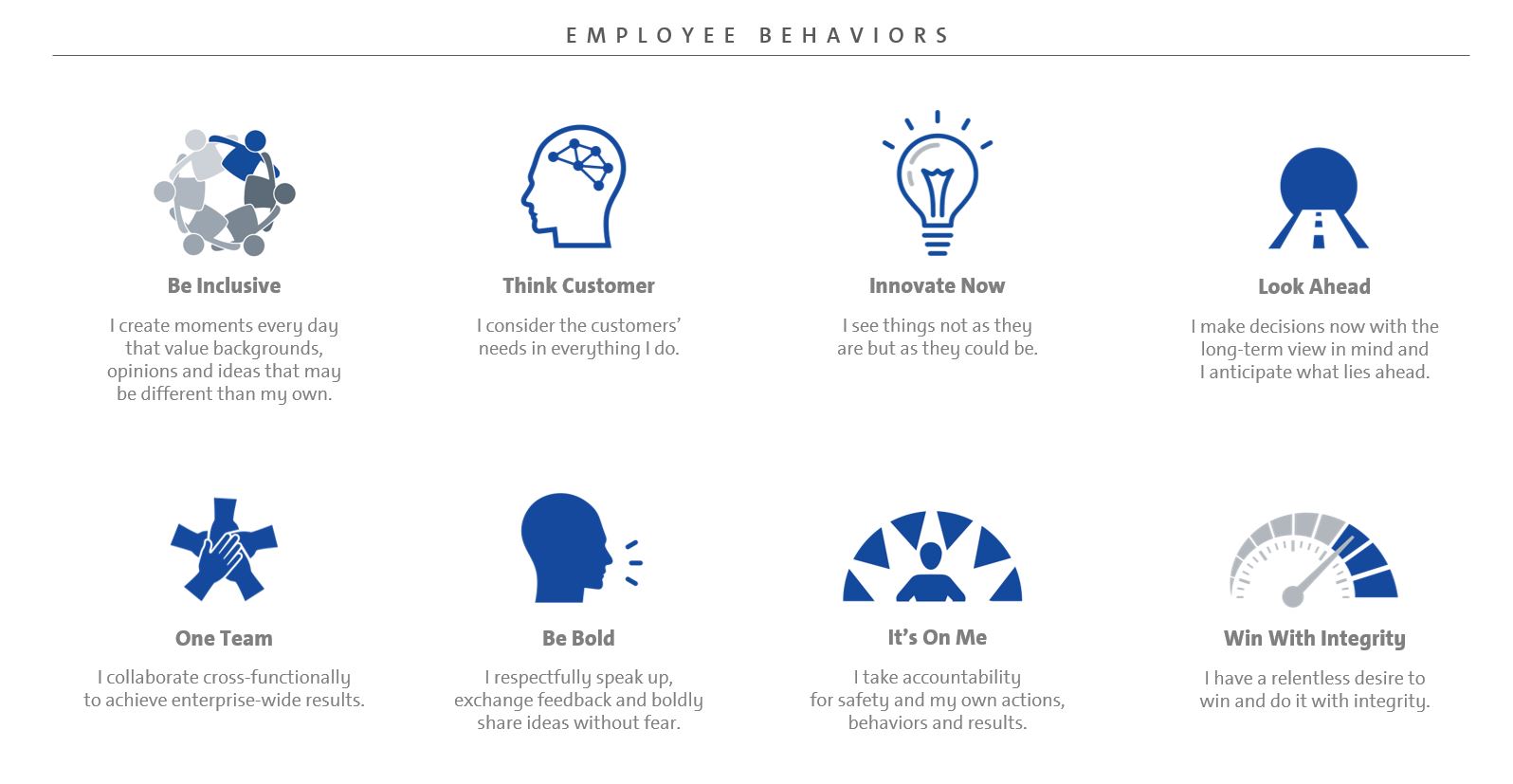
Our eight GM behaviors are the foundation of our culture; and how we behave encompasses key measures of our performance, including the ways we conduct ourselves as we work with one another.
Diversity, Equity and Inclusion At GM, we are committed to fostering a culture of diversity, equity and inclusion for our workforce, business partners, customers and communities as we aspire to be the most inclusive company in the world. We believe these strengths will allow us to not only lead the industry but to impact communities around the world as we transition to an all-electric future. This unwavering commitment includes taking steps to ensure that all areas of our business are supportive of a world-class inclusive, equitable and diverse organization. Our ability to meet the needs of a diverse and global customer base is tied closely to the behaviors of the people within our Company, which is why we are committed to fostering a culture that celebrates our differences. This commitment is embraced at all levels of the organization, including our diverse Board of Directors, which is currently made up of almost 50% women (6 out of 13 members) and is more than 30% racially or ethnically diverse (4 out of 13 members).
Based on these longstanding values, we have a number of programs and partnerships aimed at enhancing our culture of inclusion throughout the Company. For example, we have 12 voluntary, employee-led resource groups that provide a forum for diverse employees and allies from a variety of different backgrounds to share experiences and contribute to our collective cultural intelligence and growth. Each group also works to attract and retain new talent and offers employees opportunities to support our Company’s diversity initiatives within the community.
GM continues to align DEI efforts with business objectives, including investing in talent pipelines to support current and future workforce needs, bolstering inclusive and accessible solutions across all key stakeholders and fostering meaningful community partnerships to enable GM’s all-electric future. These investments are designed to help increase overall DEI maturity throughout our enterprise, increasing pathways for talent entry and development in the Company and foster partnerships that improve equity inside and outside of GM.
Develop and Retain Talented People Today, we compete for talent against other automotive companies and against businesses in other sectors, such as technology. To win and keep top talent, we must provide a workplace culture that encourages employee behaviors aligned with our values, fulfills employees' long-term individual aspirations and provides experiences that make individuals feel valued, included and engaged. In furtherance of this goal, we invest significant resources to retain and develop our talent. In addition to mentoring and networking opportunities, we offer a vast array of career development resources to help develop, grow and enable employees to make the most of their careers at GM. Formal resources include, among other things, the Technical Education Program, which offers our employees an opportunity to complete corporate strategically aligned degrees and certificate programs at leading universities, and our Degreed Learning Platform, which brings forth a variety of external and in-house content in learning pathways and other micro learnings. It is also tied to our GM competency and skills model. Employees in some of our technical roles also have the opportunity to participate in the
GENERAL MOTORS COMPANY AND SUBSIDIARIES
GM Technical Learning University — a training and upskilling program designed to expand and update the technical prowess of our workforce.
GM recognizes that leadership effectiveness is a critical business need. All new managers in the Company are entered into a three-month immersive learning program and all new executives come together for an upskilling and targeted development program designed around the GM leadership profile.
Safety and Well-Being The safety and well-being of our employees is also a critical component of our ability to transform the future of personal mobility. At GM, we pride ourselves on our commitment to live values that return people home safely — Every Person, Every Site, Every Day. Our unwavering commitment to safety is manifested through empowering employees to “Speak Up for Safety” and the Employee Safety Concern Process. These resources make it easier for salaried, hourly or represented and contract employees to report potential vehicle or workplace safety issues, or to suggest safety related improvements without fear of retaliation. The well-being of our employees is equally as important to entice and stimulate creativity and innovation.
Our award-winning Total Rewards package includes support for physical, emotional and financial wellness. We provide a comprehensive, competitive offering that includes compensation, a 401(k) company contribution and matching program, paid time off for holidays and vacations, a high-quality health care plan, and GM Family First savings on GM vehicles, parts, and services. We are committed to creating spaces where people can show up and thrive as their authentic selves at work as well as at home. GM encourages and supports healthy behaviors, attitudes and actions in our workplaces to improve health outcomes for team members and their families and to contribute to the success of our business.
Employees At December 31, 2023, we employed approximately 87,000 (54%) hourly employees and approximately 76,000 (46%) salaried employees. At December 31, 2023, approximately 46,000 (46%) of our U.S. employees were represented by unions, a majority of which were represented by the International Union, United Automobile, Aerospace and Agricultural Implement Workers of America (UAW). The following table summarizes worldwide employment (in thousands):
| | | | | |
| December 31, 2023 |
| GMNA(a) | 123 | |
| GMI | 31 | |
| GM Financial | 9 | |
| Total Worldwide | 163 | |
| |
| U.S. - Salaried | 53 | |
| U.S. - Hourly | 46 | |
__________
(a)Includes Cruise.
GENERAL MOTORS COMPANY AND SUBSIDIARIES
Information About our Executive Officers As of January 30, 2024, the names and ages of our executive officers and their positions with GM are as follows:
| | | | | | | | | | | | | | |
| Name (Age) | | Present GM Position (Effective Date) | | Positions Held During the Past Five Years (Effective Date) |
| Michael Abbott (51) | | Executive Vice President, Software (2023) | | Apple, Vice President of Engineering, Cloud Services Division (2018) |
| Mary T. Barra (62) | | Chair and Chief Executive Officer (2016) | |
|
| Julian Blissett (57) | | Executive Vice President and President, GM China (2020) | | Senior Vice President, International Operations (2019)
Vice President, Executive Shanghai GM (2014) |
| Craig B. Glidden (66) | | Executive Vice President, Legal, Policy, Cybersecurity, and Corporate Secretary (2021) | | Executive Vice President and General Counsel (2015) |
| Rory V. Harvey (56) | | Executive Vice President and President, Global Markets (2024) | | Executive Vice President and President, North America (2023) Vice President, Global Cadillac (2020)
Vice President, Cadillac North America Sales, Service and Marketing (2018)
|
| Christopher T. Hatto (53) | | Vice President, Global Business Solutions and Chief Accounting Officer (2020) | | Vice President, Controller and Chief Accounting Officer (2018) |
| Paul A. Jacobson (52) | | Executive Vice President and Chief Financial Officer (2020) | | Delta Air Lines, Executive Vice President — Chief Financial Officer (2013) |
| Gerald Johnson (61) | | Executive Vice President, Global Manufacturing and Sustainability (2019) | | Vice President, North America Manufacturing and Labor Relations (2017)
|
| |
|
|
|
|
|
For the year ending December 31, 2024, we expect EPS-diluted and EPS-diluted-adjusted of between $8.50 and $9.50, Net income attributable to stockholders of between $9.8 billion and $11.2 billion and EBIT-adjusted of between $12.0 billion and $14.0 billion. These expected financial results do not include the potential impact of future adjustments related to special items. Refer to the "Non-GAAP Measures" section of this MD&A for additional information.
GENERAL MOTORS COMPANY AND SUBSIDIARIES
The following table reconciles expected Net income attributable to stockholders under U.S. generally accepted accounting principles (GAAP) to expected EBIT-adjusted (dollars in billions):
| | | | | |
| Year Ending December 31, 2024 |
| Net income attributable to stockholders | $ 9.8-11.2 |
| Income tax expense | 2.1-2.7 |
|
| Automotive interest expense, net | 0.1 |
|
| EBIT-adjusted(a) | $ 12.0-14.0 |
__________
(a)We do not consider the potential future impact of adjustments on our expected financial results.
|
|
|
|
|
|
|
Refer to the regional sections of this MD&A for additional information on Volume, Mix, Price and Other.
GENERAL MOTORS COMPANY AND SUBSIDIARIES
Automotive and Other Cost of Sales
| | | | | | | | | | | | | | | | | | | | | | | | | | | | | | | | | | | | | | | | | | | | | | | | | | |
| Years Ended December 31, | | Favorable/ (Unfavorable) | | | | | Variance Due To |
| 2023 | | 2022 | | | % | | | Volume | | Mix | | Cost | | Other |
| | | | | | (Dollars in billions) |
| GMNA | $ | 123,577 | | | $ | 109,651 | | | $ | (13,926) | | | (12.7) | % | | | $ | (6.1) | | | $ | (1.6) | | | $ | (6.2) | | | $ | — | |
| GMI | 14,164 | | | 14,166 | | | 2 | | | — | % | | | $ | 0.5 | | | $ | (0.3) | | | $ | (0.3) | | | $ | 0.1 | |
| Corporate | 513 | | | 500 | | | (13) | | | (2.6) | % | | | | | $ | — | | | $ | (0.1) | | | $ | 0.1 | |
| Cruise | 3,088 | | | 2,576 | | | (512) | | | (19.9) | % | | | | | $ | — | | | $ | (0.5) | | | |
| Eliminations | (12) | | | (2) | | | 10 | | | n.m. | | | | | $ | — | | | $ | — | | | |
| Total automotive and other cost of sales | $ | 141,330 | | | $ | 126,892 | | | $ | (14,438) | | | (11.4) | % | | | $ | (5.6) | | | $ | (2.0) | | | $ | (7.0) | | | $ | 0.2 | |
| | | | | | | | | | | | | |
| | | | | | | | | | | | | |
__________
n.m. = not meaningful
The most significant element of our Automotive and other cost of sales is material cost, which makes up approximately two-thirds of the total amount. The remaining portion includes labor costs, depreciation and amortization, engineering, freight and product warranty and recall campaigns.
Factors that most significantly influence a region's profitability are industry volume, market share and the relative mix of vehicles (trucks, crossovers, cars) sold. Variable profit is a key indicator of product profitability. Variable profit is defined as revenue less material cost, freight, the variable component of manufacturing expense and warranty and recall-related costs. Vehicles with higher selling prices generally have higher variable profit. Refer to the regional sections of this MD&A for additional information on Volume and Mix.
In the year ended December 31, 2023, increased Cost was primarily due to: (1) increased campaigns and other warranty-related costs of $2.1 billion; (2) increased EV-related charges of $2.0 billion, primarily due to $1.7 billion in inventory adjustments to reflect the net realizable value at period end; (3) increased manufacturing costs of $0.9 billion; (4) charges of $0.7 billion related to the VSP; (5) increased engineering costs of $0.5 billion, driven primarily by $0.8 billion increase in AV engineering costs; partially offset by $0.4 billion decrease in Automotive engineering cost (6) charges of $0.5 billion related to Cruise restructuring; and (7) increased material and freight costs of $0.3 billion; partially offset by (8) decrease of $0.8 billion due to absence of the charge for the modification of Cruise stock incentive awards in 2022. In the year ended December 31, 2023, favorable Other was due to the weakening of the Canadian dollar and other currencies against the U.S. dollar, partially offset by the strengthening of the Mexican peso and other currencies against the U.S. dollar.
Automotive and Other Selling, General and Administrative Expense
| | | | | | | | | | | | | | | | | | | | | | | | | | | | | | |
| Years Ended December 31, | | Year Ended
2023 vs. 2022 Change |
| 2023 | | 2022 | | 2021 | | Favorable/ (Unfavorable) | | % | |
| Automotive and other selling, general and administrative expense | $ | 9,840 | | | $ | 10,667 | | | $ | 8,554 | | | $ | 827 | | | 7.8 | % | |
In the year ended December 31, 2023, Automotive and other selling, general and administrative expense decreased primarily due to: (1) decreased advertising, selling, and administrative costs of $0.7 billion; and (2) decrease of $0.3 billion due to the absence of the charge for the modification of Cruise stock incentive awards in 2022; partially offset by (3) charges of $0.2 billion related to the VSP.
GENERAL MOTORS COMPANY AND SUBSIDIARIES
Interest Income and Other Non-operating Income, net
| | | | | | | | | | | | | | | | | | | | | | | | | | | | | |
| Years Ended December 31, | | Year Ended
2023 vs. 2022 Change |
| |
| 2023 | | 2022 | | 2021 | | Favorable/ (Unfavorable) | | % |
| Interest income and other non-operating income, net | $ | 1,537 | | | $ | 1,432 | | | $ | 3,041 | | | $ | 105 | | | 7.3 | % |
In the year ended December 31, 2023, Interest income and other non-operating income, net increased primarily due to: (1) the absence of $0.7 billion loss related to the shutdown of our Russia business; (2) $0.6 billion increase in interest income; and (3) the absence of $0.4 billion in losses related to Stellantis N.V. (Stellantis) warrants; partially offset by (4) $1.3 billion decrease in non-service pension income primarily due to higher interest cost and lower expected return on assets (ROA); and (5) the absence of $0.3 billion in gains related to revaluation of investments.
Income Tax Expense
| | | | | | | | | | | | | | | | | | | | | | | | | | | | | |
| Years Ended December 31, | | Year Ended
2023 vs. 2022 Change |
| |
| 2023 | | 2022 | | 2021 | | Favorable/ (Unfavorable) | | % |
| Income tax expense | $ | 563 | | | $ | 1,888 | | | $ | 2,771 | | | $ | 1,325 | | | 70.2 | % |
In the year ended December 31, 2023, Income tax expense decreased primarily due to jurisdictional mix of earnings, valuation allowance adjustments and lower pre-tax income.
For the year ended December 31, 2023 our ETR-adjusted was 15.7%. We expect our adjusted effective tax rate to be between 18% and 20% for the year ending December 31, 2024.
Refer to Note 17 to our consolidated financial statements for additional information related to Income tax expense.
GM North America
| | | | | | | | | | | | | | | | | | | | | | | | | | | | | | | | | | | | | | | | | | | | | | | | | | | | | | | | |
| Years Ended December 31, | | Favorable/ (Unfavorable) | | | | | Variance Due To |
| 2023 | | 2022 | | | % | | | Volume | | Mix | | Price | | Cost | | Other |
| | | | | | (Dollars in billions) |
| Total net sales and revenue | $ | 141,445 | | | $ | 128,378 | | | $ | 13,067 | | | 10.2 | % | | | $ | 8.5 | | | $ | 0.7 | | | $ | 3.2 | | | | | $ | 0.7 | |
| EBIT-adjusted | $ | 12,306 | | | $ | 12,988 | | | $ | (682) | | | (5.3) | % | | | $ | 2.3 | | | $ | (0.9) | | | $ | 3.2 | | | $ | (5.1) | | | $ | (0.2) | |
| EBIT-adjusted margin | 8.7 | % | | 10.1 | % | | (1.4) | % | | | | | | | | | | | | | |
| (Vehicles in thousands) | | | | | | | | | | | | | |
| Wholesale vehicle sales | 3,147 | | | 2,926 | | | 221 | | | 7.6 | % | | | | | | | | | | | |
GMNA Total Net Sales and Revenue In the year ended December 31, 2023, Total net sales and revenue increased primarily due to: (1) increased net wholesale volumes primarily due to increased sales of crossover vehicles and full-size pickup trucks, partially offset by decreased sales of mid-size pickup trucks; (2) favorable Price as a result of low dealer inventory levels and strong demand for our products; (3) favorable Mix associated with increased sales of full-size pickup trucks and full-size SUVs and decreased sales of vans, passenger cars and mid-size pickup trucks, partially offset by increased sales of crossover vehicles; and (4) favorable Other due to increased sales of parts and accessories.
GMNA EBIT-Adjusted The most significant factors that influence profitability are industry volume and market share. While not as significant as industry volume and market share, another factor affecting profitability is the relative mix of vehicles sold. Trucks, crossovers and cars sold currently have a variable profit of approximately 170%, 40% and 50% of our GMNA portfolio on a weighted-average basis.
In the year ended December 31, 2023, EBIT-adjusted decreased primarily due to: (1) increased Cost primarily due to increased campaigns and other warranty-related costs of $2.0 billion, increased EV-related charges of $1.9 billion primarily due to $1.6 billion in inventory adjustments to reflect the net realizable value at period end, decreased non-service pension income of $1.1 billion and increased manufacturing costs of $0.9 billion, partially offset by decreased advertising, selling and administrative costs of $1.1 billion; and (2) unfavorable Mix associated with increased sales of crossover vehicles partially
GENERAL MOTORS COMPANY AND SUBSIDIARIES
offset by decreased sales of mid-size pickup trucks and passengers cars and increased sales of full-size SUVs; partially offset by (3) favorable Price; and (4) favorable Volume.
GM International
| | | | | | | | | | | | | | | | | | | | | | | | | | | | | | | | | | | | | | | | | | | | | | | | | | | | | | | | |
| Years Ended December 31, | | Favorable/ (Unfavorable) | | | | | Variance Due To |
| 2023 | | 2022 | | | % | | | Volume | | Mix | | Price | | Cost | | Other |
| | | | | | (Dollars in billions) |
Total net sales and revenue | $ | 15,949 | | | $ | 15,420 | | | $ | 529 | | | 3.4 | % | | | $ | (0.6) | | | $ | 0.4 | | | $ | 1.2 | | | | | $ | (0.4) | |
| EBIT-adjusted | $ | 1,210 | | | $ | 1,143 | | | $ | 67 | | | 5.9 | % | | | $ | (0.1) | | | $ | 0.1 | | | $ | 1.2 | | | $ | (0.3) | | | $ | (0.7) | |
| EBIT-adjusted margin | 7.6 | % | | 7.4 | % | | 0.2 | % | | | | | | | | | | | | | |
Equity income — Automotive China | $ | 446 | | | $ | 677 | | | $ | (231) | | | (34.1) | % | | | | | | | | | | | |
| EBIT-adjusted — excluding Equity income | $ | 764 | | | $ | 466 | | | $ | 298 | | | 63.9 | % | | | | | | | | | | | |
| (Vehicles in thousands) | | | | | | | | | | | | | |
| Wholesale vehicle sales | 621 | | | 653 | | | (32) | | | (4.9) | % | | | | | | | | | | | |
The vehicle sales of our Automotive China JVs are not recorded in Total net sales and revenue. The results of our joint ventures are recorded in Equity income, which is included in EBIT-adjusted above.
GMI Total Net Sales and Revenue In the year ended December 31, 2023, Total net sales and revenue increased primarily due to: (1) favorable pricing across multiple vehicle lines in Argentina, Brazil and the Middle East; and (2) favorable Mix primarily in Asia/Pacific and the Middle East; partially offset by (3) decreased net wholesale volumes in Egypt, Colombia and Chile primarily due to industry downturn, partially offset by increased volumes in Brazil due to a new vehicle launch; and (4) unfavorable Other primarily due to the foreign currency effect resulting from the weakening of the Argentine peso against the U.S. dollar, partially offset by increased components, parts and accessories sales.
GMI EBIT-Adjusted In the year ended December 31, 2023, EBIT-adjusted increased primarily due to: (1) favorable Price; and (2) favorable Mix; partially offset by (3) unfavorable Cost primarily due to increased material, logistic and warranty-related costs and other costs to support a new vehicle launch in South America, partially offset by favorable impact due to an asset sale in Korea; (4) decreased net wholesale volumes; and (5) unfavorable Other primarily due to foreign currency effect resulting from the weakening of Argentine peso against the U.S. dollar and decreased equity income.
We view the Chinese market as important to our global growth strategy and are employing a multi-brand strategy. In the coming years, we plan to leverage our global architectures to introduce a number of new product offerings under the Buick, Chevrolet and Cadillac brands in China and continue to grow our business under the local Baojun and Wuling brands while we are accelerating the development and rollout of EVs across our brands in China as part of our commitment to an all-electric future. We operate in the Chinese market through a number of joint ventures and maintaining strong relationships with our joint venture partners is an important part of our China growth strategy.
The following table summarizes certain key operational and financial data for the Automotive China JVs (vehicles in thousands):
| | | | | | | | | | | | | | | | | |
| Years Ended December 31, |
| 2023 | | 2022 | | 2021 |
| Wholesale vehicle sales including vehicles exported to markets outside of China | 2,334 | | | 2,639 | | | 3,007 | |
| Total net sales and revenue | $ | 31,435 | | | $ | 35,857 | | | $ | 42,776 | |
| Net income | $ | 1,122 | | | $ | 1,407 | | | $ | 2,109 | |
| | | | | | | | | | | |
| December 31, 2023 | | December 31, 2022 |
| Cash and cash equivalents | $ | 6,875 | | | $ | 8,552 | |
| Debt | $ | 202 | | | $ | 197 | |
GENERAL MOTORS COMPANY AND SUBSIDIARIES
Cruise
| | | | | | | | | | | | | | | | | | | | | | | | | | | | | | |
| Years Ended December 31, | | 2023 vs. 2022 Change |
| 2023 | | 2022 | | 2021 | | Favorable/ (Unfavorable) | | % | |
| Total net sales and revenue(a) | $ | 102 | | | $ | 102 | | | $ | 106 | | | $ | — | | | — | % | |
| EBIT (loss)-adjusted | $ | (2,695) | | | $ | (1,890) | | | $ | (1,196) | | | $ | (805) | | | (42.6) | % | |
__________
(a) Primarily reclassified to Interest income and other non-operating income, net in our consolidated income statements in each of the years ended December 31, 2023, 2022 and 2021.
Cruise EBIT (Loss)-Adjusted In the year ended December 31, 2023, EBIT (loss)-adjusted increased primarily due to an increase in development costs as we pursue the development and commercialization of AV technology in the U.S. and globally.
GM Financial
| | | | | | | | | | | | | | | | | | | | | | | | | | | | | | |
| Years Ended December 31, | | 2023 vs. 2022 Change |
| 2023 | | 2022 | | 2021 | | Amount | | % | |
| Total revenue | $ | 14,225 | | | $ | 12,766 | | | $ | 13,419 | | | $ | 1,459 | | | 11.4 | % | |
| Provision for loan losses | $ | 826 | | | $ | 654 | | | $ | 248 | | | $ | 172 | | | 26.3 | % | |
| EBT-adjusted | $ | 2,985 | | | $ | 4,076 | | | $ | 5,036 | | | $ | (1,091) | | | (26.8) | % | |
| Average debt outstanding (dollars in billions) | $ | 100.4 | | | $ | 93.8 | | | $ | 94.1 | | | $ | 6.6 | | | 7.0 | % | |
| Effective rate of interest paid | 4.7 | % | | 3.1 | % | | 2.7 | % | | 1.6 | % | | | |
GM Financial Revenue In the year ended December 31, 2023, Total revenue increased primarily due to: (1) increased finance charge income of $1.7 billion primarily due to an increase in the effective yield resulting from higher benchmark interest rates and growth in the size of the portfolio; (2) increased investment income of $0.3 billion primarily due to an increase in benchmark interest rates; partially offset by (3) decreased leased vehicle income of $0.5 billion primarily due to a decrease in the average balance of the leased vehicles portfolio.
GM Financial EBT-Adjusted In the year ended December 31, 2023, EBT-adjusted decreased primarily due to: (1) increased interest expense of $1.8 billion primarily due to an increased effective rate of interest on debt, resulting from higher benchmark interest rates, as well as an increase in average debt outstanding; (2) decreased leased vehicle income net of leased vehicle expenses of $0.9 billion primarily due to a decrease in the average balance of the leased vehicles portfolio and decreased lease termination gains due to higher leased portfolio net book values at termination and fewer terminated leases; (3) increased provision for loan losses of $0.2 billion due to lower recovery rates in 2023, as well as moderating credit performance; partially offset by (4) increased finance charge income of $1.7 billion primarily due to an increase in the effective yield resulting from higher benchmark interest rates and growth in the size of the portfolio; and (5) increased investment income of $0.3 billion primarily due to an increase in benchmark interest rates.
Liquidity and Capital Resources We believe our current levels of cash, cash equivalents, marketable debt securities, available borrowing capacity under our credit facilities and other liquidity actions currently available to us are sufficient to meet our liquidity requirements in the short- and long-term. We also maintain access to the capital markets and may issue debt or equity securities, which may provide an additional source of liquidity. We have substantial cash requirements going forward, which we plan to fund through our total available liquidity, cash flows from operating activities and additional liquidity measures, if determined to be necessary.
Our known current material uses of cash include, among other possible demands: (1) capital spending and our investments in our battery cell manufacturing joint ventures of approximately $10.5 billion to $11.5 billion in 2024; (2) payments for engineering and product development activities, including investing in the development and commercialization of AV technology by Cruise; (3) payments associated with previously announced vehicle recalls and any other recall-related contingencies; (4) payments to service debt and other long-term obligations, including discretionary and mandatory contributions to our pension plans; (5) dividend payments on our common stock that are declared by our Board of Directors; and (6) payments to purchase shares of our common stock authorized by our Board of Directors. Refer to Note 7, Note 13 and Note 15 to our consolidated financial statements for additional funding requirements for our operating leases, debt and pension plans. Our material future uses of cash, which may vary from time to time based on market conditions and other factors, are
GENERAL MOTORS COMPANY AND SUBSIDIARIES
focused on the three objectives of our capital allocation program: (1) grow our business at an average target ROIC-adjusted rate of 20% or greater; (2) maintain a strong investment-grade balance sheet, including a target average automotive cash balance of $18.0 billion; and (3) after the first two objectives are met, return available cash to shareholders. Our senior management evaluates our capital allocation program on an ongoing basis and recommends any modifications to the program to our Board of Directors not less than once annually.
We continue to monitor and evaluate opportunities to strengthen our competitive position over the long term while maintaining a strong investment-grade balance sheet. These actions may include opportunistic payments to reduce our long-term obligations, as well as the possibility of acquisitions, dispositions and investments with joint venture partners, as well as strategic alliances that we believe would generate significant advantages and substantially strengthen our business. To support our transition to EVs, we anticipate making investments in suppliers or providing funding towards the execution of strategic, multi-year supply agreements to secure critical materials. In addition, we have entered, and plan to continue to enter, into offtake agreements that generally obligate us to purchase defined quantities of output. These arrangements could have a short-term adverse impact on our cash and increase our inventory.
Our liquidity plans are subject to a number of risks and uncertainties, including those described in the "Forward-Looking Statements" section of this MD&A and Part I, Item 1A. Risk Factors, some of which are outside of our control.
In November 2023, our Board of Directors increased the capacity under our previously announced common stock repurchase program by $10.0 billion to $11.4 billion and approved a $10.0 billion ASR program. On December 1, 2023, we advanced $10.0 billion under the ASR program and received approximately 215 million shares of common stock with a value of $6.8 billion, which were immediately retired. The final settlement of the transactions contemplated under the ASR Agreements is expected to occur no later than the three months ending December 31, 2024. Also, during the year ended December 31, 2023, we completed $1.1 billion of open market repurchases under the program and retired approximately 30 million shares of our common stock. We have $1.4 billion in capacity remaining under our common stock repurchase program as of December 31, 2023, with no expiration date.
During the year ended December 31, 2023, we paid dividends of $0.5 billion to holders of our common stock. We anticipate that we will continue to declare and pay dividends on our common stock quarterly.
Cash flows that occur amongst our Automotive, Cruise and GM Financial operations are eliminated when we consolidate our cash flows. Such eliminations include, among other things, collections by Automotive on wholesale accounts receivables financed by dealers through GM Financial, payments between Automotive and GM Financial for accounts receivables transferred by Automotive to GM Financial, loans to Automotive and Cruise from GM Financial, dividends issued by GM Financial to Automotive, tax payments by GM Financial to Automotive and Automotive cash injections in Cruise. The presentation of Automotive liquidity, Cruise liquidity and GM Financial liquidity presented below includes the impact of cash transactions amongst the sectors that are ultimately eliminated in consolidation.
Automotive Liquidity Total available liquidity includes cash, cash equivalents, marketable debt securities and funds available under credit facilities. The amount of available liquidity is subject to seasonal fluctuations and includes balances held by various business units and subsidiaries worldwide that are needed to fund their operations.
We manage our liquidity primarily at our treasury centers as well as at certain of our significant consolidated overseas subsidiaries. Over 85% of our cash and marketable debt securities were managed within North America and at our regional treasury centers at December 31, 2023. We have used, and will continue to use, other methods including intercompany loans to utilize these funds across our global operations as needed.
Our cash equivalents and marketable debt securities balances are primarily denominated in U.S. Dollars and include investments in U.S. government and agency obligations, foreign government securities, time deposits, corporate debt securities and mortgage and asset-backed securities. Our investment guidelines, which we may change from time to time, prescribe certain minimum credit worthiness thresholds and limit our exposures to any particular sector, asset class, issuance or security type. The majority of our current investments in debt securities are with A/A2 or better rated issuers.
In March 2023, we redeemed our $1.5 billion, 4.875% senior unsecured notes with a maturity date of October 2023 and recorded an insignificant loss.
GENERAL MOTORS COMPANY AND SUBSIDIARIES
Also, in March 2023, we renewed and reduced the total borrowing capacity of our five-year, $11.2 billion facility to $10.0 billion, which now matures March 31, 2028. We also renewed and reduced the total borrowing capacity of our three-year, $4.3 billion facility to $4.1 billion, which now matures March 31, 2026, and renewed our 364-day, $2.0 billion revolving credit facility allocated for the exclusive use of GM Financial, which now matures March 30, 2024.
In October 2023, we entered into a new 364-day unsecured revolving credit facility with a borrowing capacity of $6.0 billion, which we terminated on November 24, 2023.
In November 2023, the Company entered an unsecured 364-day delayed draw term loan credit agreement that permits the Company to borrow up to $3.0 billion in the form of four term loans during an availability period that ends June 28, 2024. Amounts drawn and repaid may not be reborrowed and the final maturity date for any loans outstanding under the delayed draw credit agreement is November 27, 2024.
We use credit facilities as a mechanism to provide additional flexibility in managing our global liquidity. Our Automotive borrowing capacity under credit facilities totaled $17.1 billion at December 31, 2023, which consisted primarily of three credit facilities, and $15.5 billion at December 31, 2022, which consisted primarily of two credit facilities. Total Automotive borrowing capacity under our credit facilities does not include our 364-day, $2.0 billion facility allocated for exclusive use of GM Financial. We did not have any borrowings against our primary facilities, but had letters of credit outstanding under our sub-facility of $0.7 billion and $0.4 billion at December 31, 2023 and 2022.
If available capacity permits, GM Financial continues to have access to our five-year, $10.0 billion and three-year, $4.1 billion credit facilities. GM Financial did not have borrowings outstanding against any of these facilities at December 31, 2023 and 2022. We had intercompany loans from GM Financial of $0.2 billion at December 31, 2023 and 2022, which primarily consisted of commercial loans to dealers we consolidate. We did not have intercompany loans to GM Financial at December 31, 2023 and 2022. Refer to Note 5 to our consolidated financial statements for additional information.
Several of our loan facilities, including our credit facilities, require compliance with certain financial and operational covenants as well as regular reporting to lenders. We have reviewed our covenants in effect as of December 31, 2023 and determined we are in compliance and expect to remain in compliance in the future.
GM Financial's Board of Directors declared and paid dividends of $1.8 billion, $1.7 billion and $3.5 billion on its common stock in the years ended December 31, 2023, 2022 and 2021. Future dividends from GM Financial will depend on several factors including business and economic conditions, its financial condition, earnings, liquidity requirements and leverage ratio.
GENERAL MOTORS COMPANY AND SUBSIDIARIES
The following table summarizes our Automotive available liquidity (dollars in billions):
| | | | | | | | | | | |
| December 31, 2023 | | December 31, 2022 |
| Automotive cash and cash equivalents | $ | 12.2 | | | $ | 13.6 | |
| Marketable debt securities | 7.6 | | | 10.8 | |
| Automotive cash, cash equivalents and marketable debt securities | 19.8 | | | 24.4 | |
|
|
|
| Available under credit facilities(a) | 16.4 | | | 15.1 | |
| Total Automotive available liquidity | $ | 36.3 | | | $ | 39.5 | |
__________ (a) We had letters of credit outstanding under our sub-facility of $0.7 billion and $0.4 billion at December 31, 2023 and 2022.
The following table summarizes the changes in our Automotive available liquidity (dollars in billions):
| | | | | |
| Year Ended December 31, 2023 |
| Operating cash flow | $ | 20.8 | |
| Capital expenditures | (10.7) | |
| ASR program | (10.0) | |
| Dividends paid and payments to purchase common stock | (1.6) | |
| Payment of senior unsecured note | (1.5) | |
| Investment in Ultium Cells Holdings LLC | (0.7) | |
| GM investment in Cruise | (0.5) | |
| Investment in Lithium Americas | (0.3) | |
| Other non-operating | (0.1) | |
| Increase in available credit facilities | 1.4 | |
| Total change in automotive available liquidity | $ | (3.2) | |
Automotive Cash Flow (Dollars in billions)
| | | | | | | | | | | | | | | | | | | | | | | |
| Years Ended December 31, | | 2023 vs. 2022 Change |
| 2023 | | 2022 | | 2021 | |
Operating Activities
| | | | | | | |
| Net income | $ | 10.1 | | | $ | 8.5 | | | $ | 7.8 | | | $ | 1.6 | |
| Depreciation, amortization and impairment charges | 6.8 | | | 6.3 | | | 5.9 | | | 0.5 | |
| Pension and OPEB activities | (1.0) | | | (2.0) | | | (2.4) | | | 1.0 | |
| Working capital | (0.4) | | | 0.5 | | | (4.0) | | | (0.9) | |
| Accrued and other liabilities and income taxes | 4.1 | | | 3.1 | | | 0.9 | | | 1.0 | |
| Other(a) | 1.2 | | | 2.7 | | | 1.5 | | | (1.5) | |
| Net automotive cash provided by (used in) operating activities(b) | $ | 20.8 | | | $ | 19.1 | | | $ | 9.7 | | | $ | 1.7 | |
__________ (a)Includes $1.8 billion, $1.7 billion and $3.5 billion in dividends received from GM Financial in the years ended December 31, 2023, 2022 and 2021, partially offset by non-cash changes in other assets and liabilities.
(b)Includes $4.8 billion, $6.7 billion and $0.6 billion in the years ended December 31, 2023, 2022 and 2021 which are eliminated within the consolidated statements of cash flows. Amounts eliminated primarily relate to purchases of, and collections on, wholesale finance receivables provided by GM Financial to our dealers and dividends issued by GM Financial to us.
GENERAL MOTORS COMPANY AND SUBSIDIARIES
| | | | | | | | | | | | | | | | | | | | | | | |
| Years Ended December 31, | | 2023 vs. 2022 Change |
| Investing Activities | | | | | | | |
| Capital expenditures | $ | (10.7) | | | $ | (9.0) | | | $ | (7.4) | | | $ | (1.7) | |
| Acquisitions and liquidations of marketable securities, net | 3.5 | | | (3.9) | | | 1.0 | | | 7.4 | |
| Other(a) | (1.5) | | | (4.5) | | | (1.8) | | | 3.0 | |
| Net automotive cash provided by (used in) investing activities(b) | $ | (8.7) | | | $ | (17.5) | | | $ | (8.2) | | | $ | 8.8 | |
__________
(a)Includes $0.7 billion, $0.8 billion and $0.5 billion of GM's investment in Ultium Cells Holdings LLC in the years ended December 31, 2023, 2022 and 2021, $0.5 billion, $2.4 billion and $1.0 billion of GM's investment in Cruise in the years ended December 31, 2023, 2022 and 2021, $0.3 billion of GM's investment in Lithium Americas in the year ended December 31, 2023, $2.1 billion for the purchase of Cruise preferred shares from SoftBank Vision Fund (AIV M2) L.P. (SoftBank) in the year ended December 31, 2022 and $0.9 billion related to the sale of Stellantis common shares, excluding dividends received and tax withholding, in the year ended December 31, 2022.
(b)The investments in Cruise are eliminated within the consolidated statements of cash flows. The redemption of Cruise preferred shares from SoftBank in 2022 are reclassified to financing activities within the consolidated statements of cash flows.
| | | | | | | | | | | | | | | | | | | | | | | |
| Years Ended December 31, | | 2023 vs. 2022 Change |
| 2023 | | 2022 | | 2021 | |
Financing Activities
| | | | | | | |
| Net proceeds (payments) from short-term debt | $ | (1.5) | | | $ | (1.4) | | | $ | (0.5) | | | $ | (0.1) | |
| Issuance of senior notes | — | | | 2.3 | | | — | | | (2.3) | |
| Other(a) | (12.1) | | | (3.3) | | | (0.4) | | | (8.8) | |
| Net automotive cash provided by (used in) financing activities | $ | (13.6) | | | $ | (2.5) | | | $ | (0.9) | | | $ | (11.1) | |
| | | | |
__________
(a)Includes $10.0 billion in advances against accelerated share repurchases in the year ended December 31, 2023, $1.1 billion and $2.5 billion for payments to purchase common stock in the years ended December 31, 2023 and 2022, $0.5 billion and $0.3 billion for dividends paid in the years ended December 31, 2023 and 2022 and $0.5 billion for repayments of senior unsecured notes for the year ended December 31, 2021.
Adjusted Automotive Free Cash Flow We measure adjusted automotive free cash flow as automotive operating cash flow from operations less capital expenditures adjusted for management actions. For the year ended December 31, 2023, net automotive cash provided by operating activities under U.S. GAAP was $20.8 billion, capital expenditures were $10.7 billion and adjustments for management actions were $1.5 billion. For the year ended December 31, 2022, net automotive cash provided by operating activities under U.S. GAAP was $19.1 billion, capital expenditures were $9.0 billion and adjustments for management actions were $0.4 billion. Refer to the "Non-GAAP Measures" section of this MD&A for additional information.
Status of Credit Ratings We receive ratings from four independent credit rating agencies: DBRS Limited (DBRS), Fitch Ratings (Fitch), Moody's Investor Service (Moody's) and S&P. All four credit rating agencies currently rate our corporate credit at investment grade. The following table summarizes our credit ratings at January 16, 2024:
| | | | | | | | | | | | | | | | | | | | | | | |
| Corporate | | Revolving Credit Facilities | | Senior Unsecured | | Outlook |
| DBRS | BBB (high) | | BBB (high) | | N/A | | Stable |
| Fitch | BBB | | BBB | | BBB | | Stable |
| Moody's | Investment Grade | | Baa2 | | Baa2 | | Stable |
| S&P | BBB | | BBB | | BBB | | Stable |
GENERAL MOTORS COMPANY AND SUBSIDIARIES
Cruise Liquidity
The following table summarizes Cruise's available liquidity (dollars in billions):
| | | | | | | | | | | |
| December 31, 2023 | | December 31, 2022 |
| Cruise cash and cash equivalents | $ | 1.3 | | | $ | 1.5 | |
| Cruise marketable securities | — | | | 1.4 | |
| Total Cruise available liquidity(a)(b) | $ | 1.3 | | | $ | 2.9 | |
__________
(a)Excludes a multi-year credit agreement with GM Financial whereby Cruise can borrow, over time, up to an additional aggregate of $3.4 billion, through 2024, to fund the purchase of AVs from GM and all accessories, attachments, parts and other equipment acquired in connection with or otherwise relating to any AV. As of December 31, 2023, Cruise had total borrowings of $0.3 billion on previously expired lines under this agreement.
(b)Excludes a multi-year framework agreement with us whereby Cruise can defer invoices received through June 2028, up to $0.8 billion, related to engineering and capital spending incurred by us on behalf of Cruise. As of December 31, 2023, Cruise deferred $0.5 billion under this agreement.
The following table summarizes the changes in Cruise's available liquidity (dollars in billions):
| | | | | |
| Year Ended December 31, 2023 |
| Operating cash flow(a) | $ | (1.9) | |
|
| GM investment in Cruise | 0.5 | |
|
| Other non-operating | (0.1) | |
| Total change in Cruise available liquidity | $ | (1.6) | |
__________ (a)Includes $0.2 billion cash outflows related to tendered Cruise Class B Common Shares classified as liabilities.
Cruise Cash Flow (Dollars in billions)
| | | | | | | | | | | | | | | | | | | | | | | |
| Years Ended December 31, | | 2023 vs. 2022 Change |
| Net cash provided by (used in) operating activities | $ | (1.9) | | | $ | (1.8) | | | $ | (1.2) | | | $ | (0.1) | |
| Net cash provided by (used in) investing activities(a) | $ | 1.3 | | | $ | — | | | $ | (0.7) | | | $ | 1.4 | |
| Net cash provided by (used in) financing activities(b) | $ | 0.4 | | | $ | 1.8 | | | $ | 2.6 | | | $ | (1.4) | |
__________ (a)Includes $1.4 billion of net proceeds from the liquidation of marketable securities in the year ended December 31, 2023.
(b)Includes $0.5 billion, $2.4 billion and $1.0 billion in the years ended December 31, 2023, 2022 and 2021 related to investments from GM which are eliminated within the consolidated statements of cash flows and $2.1 billion in the year ended December 31, 2022 related to the purchase of Softbank’s shares in Cruise by Automotive which is reclassified to financing activities within the consolidated statements of cash flows.
We expect the orderly pause of operations, associated restructuring actions, and Cruise’s refocused operational strategy will significantly reduce Cruise’s liquidity needs in 2024.
GENERAL MOTORS COMPANY AND SUBSIDIARIES
Automotive Financing – GM Financial Liquidity GM Financial's primary sources of cash are finance charge income, leasing income and proceeds from the sale of terminated leased vehicles, net distributions from credit facilities, securitizations, secured and unsecured borrowings and collections and recoveries on finance receivables. GM Financial's primary uses of cash are purchases and funding of finance receivables and leased vehicles, repayment or repurchases of secured and unsecured debt, funding credit enhancement requirements in connection with securitizations and secured credit facilities, interest costs, operating expenses, income taxes and dividend payments. GM Financial continues to monitor and evaluate opportunities to optimize its liquidity position and the mix of its debt between secured and unsecured debt. The following table summarizes GM Financial's available liquidity (dollars in billions):
| | | | | | | | | | | |
| December 31, 2023 | | December 31, 2022 |
| Cash and cash equivalents | $ | 5.3 | | | $ | 4.0 | |
| Borrowing capacity on unpledged eligible assets | 21.9 | | | 22.0 | |
| Borrowing capacity on committed unsecured lines of credit | 0.7 | | | 0.5 | |
| Borrowing capacity on revolving credit facility, exclusive to GM Financial | 2.0 | | | 2.0 | |
| Total GM Financial available liquidity | $ | 29.9 | | | $ | 28.5 | |
GM Financial structures liquidity to support at least six months of GM Financial's expected net cash flows, including new originations, without access to new debt financing transactions or other capital markets activity. At December 31, 2023, available liquidity exceeded GM Financial's liquidity targets.
GM Financial did not have any borrowings outstanding against our credit facility designated for their exclusive use or the remainder of our revolving credit facilities at December 31, 2023 and 2022. Refer to the "Automotive Liquidity" section of this MD&A for additional details.
Credit Facilities In the normal course of business, in addition to using its available cash, GM Financial utilizes borrowings under its credit facilities, which may be secured or unsecured, and GM Financial repays these borrowings as appropriate under its cash management strategy. At December 31, 2023, secured, committed unsecured and uncommitted unsecured credit facilities totaled $27.0 billion, $0.8 billion and $2.0 billion with advances outstanding of $5.0 billion, an insignificant amount and $2.0 billion.
GM Financial Cash Flow (Dollars in billions)
| | | | | | | | | | | | | | | | | | | | | | | |
| Years Ended December 31, | | 2023 vs. 2022 Change |
| Net cash provided by (used in) operating activities | $ | 6.7 | | | $ | 5.5 | | | $ | 7.3 | | | $ | 1.2 | |
| Net cash provided by (used in) investing activities(a) | $ | (10.9) | | | $ | (10.0) | | | $ | (5.5) | | | $ | (0.9) | |
| Net cash provided by (used in) financing activities(b) | $ | 5.7 | | | $ | 4.0 | | | $ | (2.6) | | | $ | 1.7 | |
__________ (a)Includes $(3.0) billion, $(5.0) billion and $2.9 billion in the years ended December 31, 2023, 2022 and 2021 for purchases of, and collections on, wholesale finance receivables and intercompany loans to GM which are eliminated within the consolidated statements of cash flows.
(b)Includes $(1.8) billion, $(1.7) billion and $(3.5) billion in the years ended December 31, 2023, 2022 and 2021 for dividends to GM which are eliminated within the consolidated statements of cash flows.
In the year ended December 31, 2023, Net cash provided by operating activities increased primarily due to: (1) an increase in finance charge income of $1.7 billion; (2) a net increase in cash provided by counterparty derivative collateral posting activities of $1.3 billion; (3) and a decrease in taxes paid to GM of $0.6 billion; partially offset by (4) an increase in interest paid of $2.0 billion and (5) a decrease in leased vehicle income of $0.5 billion.
In the year ended December 31, 2023, Net cash used in investing activities increased primarily due to: (1) an increase in purchases of leased vehicles of $1.7 billion; (2) a decrease in the proceeds from termination of leased vehicles of $1.2 billion partially offset by (3) an increase in collections and recoveries on finance receivables of $1.3 billion; (4) and a decrease in purchases and originations of finance receivables of $0.5 billion.
GENERAL MOTORS COMPANY AND SUBSIDIARIES
In the year ended December 31, 2023, Net cash provided by financing activities increased primarily due to: (1) a net increase in borrowings of $6.9 billion; partially offset by (2) an increase in debt repayments of $5.1 billion; and (3) an increase in dividend payments of $0.1 billion.
LIBOR Transition The International Swaps and Derivatives Association launched its Interbank Offered Rate (IBOR) Fallbacks Supplement and IBOR Fallbacks Protocol, which came into effect on January 25, 2021. The supplement incorporates fallbacks for new derivatives linked to LIBOR, and the protocol enables market participants to incorporate fallbacks for certain legacy derivatives linked to LIBOR. GM Financial adhered to the protocol prior to the June 30, 2023 cessation date and has transitioned all of its LIBOR-based derivative exposure. On March 15, 2022, Congress enacted the Adjustable Interest Rate (LIBOR) Act to address “tough legacy" contracts that lack adequate fallback provisions for determining a benchmark replacement to LIBOR. GM Financial expects to leverage the safe harbors and protections provided by the LIBOR Act and its implementing regulations to transition its limited LIBOR exposure remaining after the cessation date.
Critical Accounting Estimates The consolidated financial statements are prepared in conformity with U.S. GAAP, which requires the use of estimates, judgments and assumptions that affect the reported amounts of assets and liabilities, the disclosure of contingent assets and liabilities at the date of the financial statements and the reported amounts of revenues and expenses in the periods presented. We believe the accounting estimates employed are appropriate and the resulting balances are reasonable; however, due to the inherent uncertainties in developing estimates, actual results could differ from the original estimates, requiring adjustments to these balances in future periods. Refer to Note 2 to our consolidated financial statements for our significant accounting policies related to our critical accounting estimates.
Product Warranty and Recall Campaigns The estimates related to product warranties are established using historical information on the nature, frequency and average cost of claims of each vehicle line or each model year of the vehicle line and assumptions about future activity and events. When little or no claims experience exists for a model year or a vehicle line, the estimate is based on comparable models.
We accrue the costs related to product warranty at the time of vehicle sale and we accrue the estimated cost of recall campaigns when they are probable and estimable.
The estimates related to recall campaigns accrued at the time of vehicle sale are established by applying a paid loss approach that considers the number of historical recall campaigns and the estimated cost for each recall campaign. These estimates consider the nature, frequency and magnitude of historical recall campaigns, and use key assumptions including the number of historical periods and the weighting of historical data in the reserve studies. Costs associated with recall campaigns not accrued at the time of vehicle sale are estimated based on the estimated cost of repairs and the estimated vehicles to be repaired. Depending on part availability and time to complete repairs we may, from time to time, offer courtesy transportation at no cost to our customers. These estimates are re-evaluated on an ongoing basis and based on the best available information. Revisions are made when necessary based on changes in these factors.
The estimated amount accrued for recall campaigns at the time of vehicle sale is most sensitive to the estimated number of recall events, the number of vehicles per recall event, the assumed number of vehicles that will be brought in by customers for repair (take rate) and the cost per vehicle for each recall event. The estimated cost of a recall campaign that is accrued on an individual basis is most sensitive to our estimated assumed take rate that is primarily developed based on our historical take rate experience. A 10% increase in the estimated take rate for all recall campaigns would increase the estimated cost by approximately $0.4 billion.
Actual experience could differ from the amounts estimated requiring adjustments to these liabilities in future periods. Due to the uncertainty and potential volatility of the factors contributing to developing estimates, changes in our assumptions could materially affect our results of operations.
Sales Incentives The estimated effect of sales incentives offered to dealers and end customers is recorded as a reduction of Automotive net sales and revenue at the time of sale. There may be numerous types of incentives available at any particular time. Incentive programs are generally specific to brand, model or sales region and are for specified time periods, which may be extended. Significant factors used in estimating the cost of incentives include type of program, forecasted sales volume, product mix, and the rate of customer acceptance of incentive programs, all of which are estimated based on historical experience and assumptions concerning future customer behavior and market conditions. A change in any of these factors affecting the estimate could have a significant effect on recorded sales incentives. A 10% increase in the cost of incentives would increase the sales
GENERAL MOTORS COMPANY AND SUBSIDIARIES
incentive liability by approximately $0.2 billion. Subsequent adjustments to incentive estimates are possible as facts and circumstances change over time, which could affect the revenue previously recognized in Automotive net sales and revenue.
GM Financial Allowance for Loan Losses The GM Financial retail finance receivables portfolio consists of smaller-balance, homogeneous loans that are carried at amortized cost, net of allowance for loan losses. The allowance for loan losses on retail finance receivables reflects net credit losses expected to be incurred over the remaining life of the retail finance receivables, which have a weighted-average remaining life of approximately two years. GM Financial forecasts net credit losses based on relevant information about past events, current conditions and forecast economic performance. GM Financial believes that the allowance is adequate to cover expected credit losses on the retail finance receivables; however, because the allowance for loan losses is based on estimates, there can be no assurance that the ultimate charge-off amount will not exceed such estimates or that our credit loss assumptions will not increase.
GM Financial incorporates its outlook on forecast recovery rates and overall economic performance in its allowance estimate. Each 5% relative decrease/increase in the forecast recovery rates would increase/decrease the allowance for loan losses by $0.1 billion.
At December 31, 2023, the weightings applied to the economic forecast scenarios considered resulted in an allowance for loan losses on the retail finance receivables portfolio of $2.3 billion. If the forecast economic conditions were based entirely on the weakest scenario considered, the allowance for loan losses would increase by $0.1 billion. Actual economic data and recovery rates that are lower than those forecasted by GM Financial could result in an increase to the allowance for loan losses.
The GM Financial commercial finance receivables portfolio consists of financing products for dealers and other businesses. GM Financial provides commercial lending products to its dealer customers that include floorplan financing, also known as wholesale or inventory financing, which is lending to finance vehicle inventory. GM Financial also provides dealer loans, which are loans to finance improvements to dealership facilities, to provide working capital, or to purchase and/or finance dealership real estate. Additionally, GM Financial provides lending products to commercial vehicle upfitters and advances to certain of our subsidiaries. The allowance for loan losses on commercial finance receivables is based on historical loss experience for the consolidated portfolio, in addition to forecasted industry conditions. There can be no assurance that the ultimate charge-off amount will not exceed such estimates or that GM Financial's credit loss assumptions will not increase.
Valuation of GM Financial Equipment on Operating Lease Assets and Residuals GM Financial has investments in leased vehicles recorded as operating leases. Each leased asset in the portfolio represents a vehicle that GM Financial owns and has leased to a customer. At the inception of a lease, an estimate is made of the expected residual value for the vehicle at the end of the lease term, which typically ranges from two to five years. GM Financial estimates the expected residual value based on third-party data that considers various data points and assumptions, including, but not limited to, recent auction values, the expected future volume of returning leased vehicles, significant liquidation of rental or fleet inventory, used vehicle prices, manufacturer incentive programs and fuel prices.
During the term of a lease, GM Financial periodically evaluates the estimated residual value and may adjust the value downward, which increases the prospective depreciation, or upward (limited to the contractual residual value), which decreases the prospective depreciation.
The customer is obligated to make payments during the lease term for the difference between the purchase price and the contract residual value plus a money factor. However, since the customer is not obligated to purchase the vehicle at the end of the contract, GM Financial is exposed to a risk of loss to the extent the customer returns the vehicle prior to or at the end of the lease term and the proceeds GM Financial receives on the disposition of the vehicle are lower than the residual value estimated at the inception of the lease. Realization of the residual values is dependent on GM Financial's future ability to market the vehicles under prevailing market conditions.
At December 31, 2023, the estimated residual value of GM Financial's leased vehicles was $22.7 billion. Depreciation reduces the carrying value of each leased asset in GM Financial's operating lease portfolio over time from its original acquisition value to its expected residual value at the end of the lease term. If used vehicle prices weaken compared to estimates, GM Financial would increase depreciation expense and/or record an impairment charge on the lease portfolio. If an impairment exists, GM Financial would determine any shortfall in recoverability of the leased vehicle asset groups by year, make and model. Recoverability is calculated as the excess of: (1) the sum of remaining lease payments plus estimated residual value; over (2) leased vehicles, net less deferred revenue. Alternatively, if used vehicle prices outperform GM Financial's latest estimates, it may record gains on sales of off-lease vehicles and/or decreased depreciation expense.
GENERAL MOTORS COMPANY AND SUBSIDIARIES
The following table illustrates the effect of a 1% relative change in the estimated residual values at December 31, 2023, which could increase or decrease depreciation expense over the remaining term of the leased vehicle portfolio, holding all other assumptions constant (dollars in millions):
| | | | | |
| Impact to Depreciation Expense |
| 2024 | $ | 158 | |
| 2025 | 53 | |
| 2026 | 15 | |
| 2027 and thereafter | 1 | |
| Total | $ | 227 | |
Changes to residual values are rarely simultaneous across all maturities and segments, and also may impact return rates. If a decrease in residual values is concentrated among specific asset groups, the decrease could result in an immediate impairment charge. GM Financial reviewed the leased vehicle portfolio for indicators of impairment and determined that no impairment indicators were present at December 31, 2023 or 2022.
Pension and OPEB Plans Our defined benefit pension plans are accounted for on an actuarial basis, which requires the selection of various assumptions, including an expected long-term rate of return on plan assets, a discount rate, mortality rates of participants and expectation of mortality improvement. Our pension obligations include Korean statutory pension payments that are valued on a walk away basis. The expected long-term rate of return on U.S. plan assets that is utilized in determining pension expense is derived from periodic studies, which include a review of asset allocation strategies, anticipated future long-term performance of individual asset classes, risks using standard deviations and correlations of returns among the asset classes that comprise the plans' asset mix. While the studies give appropriate consideration to recent plan performance and historical returns, the assumptions are primarily long-term, prospective rates of return.
In December 2023, an investment policy study was completed for the U.S. pension plans. As a result, the weighted-average long-term rate of ROA remains unchanged at 6.3% at December 31, 2023 and 2022. The expected long-term rate of return on plan assets used in determining pension expense for non-U.S. plans is determined in a similar manner to the U.S. plans.
Another key assumption in determining net pension and other postretirement benefits (OPEB) expense is the assumed discount rate used to discount plan obligations. We estimate the assumed discount rate for U.S. plans using a cash flow matching approach, which uses projected cash flows matched to spot rates along a high quality corporate bond yield curve to determine the weighted-average discount rate for the calculation of the present value of cash flows. We apply the individual annual yield curve rates instead of the assumed discount rate to determine the service cost and interest cost, which more specifically links the cash flows related to service cost and interest cost to bonds maturing in their year of payment.
The Society of Actuaries (SOA) issued mortality improvement tables in the three months ended December 31, 2023. We reviewed our recent mortality experience and we determined our current mortality assumptions are appropriate to measure our U.S. pension and OPEB plans obligations as of December 31, 2023.
Significant differences in actual experience or significant changes in assumptions may materially affect the pension obligations. The effects of actual results differing from assumptions and the changing of assumptions are included in unamortized net actuarial gains and losses that are subject to amortization to pension expense over future periods. The unamortized pre-tax actuarial loss on our pension plans was $5.9 billion and $3.3 billion at December 31, 2023 and 2022. The year-over-year change is primarily due to a decrease in discount rates and lower than expected asset returns.
The funded status of the U.S. pension plans deteriorated in the year ended December 31, 2023 to $2.2 billion underfunded status from $0.1 billion overfunded status primarily due to: (1) service and interest costs of $2.4 billion; (2) the unfavorable effect of a decrease in discount rates of $1.3 billion; and (3) the unfavorable effect of plan amendments of $0.8 billion; partially offset by (4) the favorable effect of actual returns on plan assets of $1.8 billion; and (5) contributions of $0.4 billion.
GENERAL MOTORS COMPANY AND SUBSIDIARIES
The following table illustrates the sensitivity to a change in certain assumptions for the pension plans, holding all other assumptions constant:
| | | | | | | | | | | | | | | | | | | | | | | |
| U.S. Plans(a) | | Non-U.S. Plans(a) |
| Effect on 2024 Pension Expense | | Effect on December 31, 2023 PBO | | Effect on 2024 Pension Expense | | Effect on December 31, 2023 PBO |
| 25 basis point decrease in discount rate | -$58 | | +$914 | | -$5 | | +$312 |
| 25 basis point increase in discount rate | +$53 | | -$872 | | +$6 | | -$299 |
| 25 basis point decrease in expected rate of ROA | +$109 | | N/A | | +$25 | | N/A |
| 25 basis point increase in expected rate of ROA | -$109 | | N/A | | -$25 | | N/A |
__________
(a)The sensitivity does not include the effects of the individual annual yield curve rates applied for the calculation of the service and interest cost.
Refer to Note 15 to our consolidated financial statements for additional information on pension contributions, investment strategies, assumptions, the change in benefit obligations and related plan assets, pension funding requirements and future net benefit payments. Refer to Note 2 to our consolidated financial statements for a discussion of the inputs used to determine fair value for each significant asset class or category.
Valuation of Deferred Tax Assets The ability to realize deferred tax assets depends on the ability to generate sufficient taxable income within the carryback or carryforward periods provided for in the tax law for each applicable tax jurisdiction. The assessment regarding whether a valuation allowance is required or should be adjusted is based on an evaluation of possible sources of taxable income and also considers all available positive and negative evidence factors. Our accounting for the valuation of deferred tax assets represents our best estimate of future events. Changes in our current estimates, due to unanticipated market conditions, governmental legislative actions or events, could have a material effect on our ability to utilize deferred tax assets.
At December 31, 2023, valuation allowances against deferred tax assets were $7.0 billion. Refer to Note 17 to our consolidated financial statements for additional information on the composition of these valuation allowances and information on the $870 million income tax benefit resulting from the release of valuation allowances against deferred tax assets in Korea.
Non-GAAP Measures We use both GAAP and non-GAAP financial measures for operational and financial decision making, and to assess Company and segment business performance. Our non-GAAP measures include: earnings before interest and taxes (EBIT)-adjusted, presented net of noncontrolling interests; earnings before income taxes (EBT)-adjusted for our GM Financial segment; earnings per share (EPS)-diluted-adjusted; effective tax rate-adjusted (ETR-adjusted); return on invested capital-adjusted (ROIC-adjusted) and adjusted automotive free cash flow. Our calculation of these non-GAAP measures may not be comparable to similarly titled measures of other companies due to potential differences between companies in the method of calculation. As a result, the use of these non-GAAP measures has limitations and should not be considered superior to, in isolation from, or as a substitute for, related U.S. GAAP measures.
These non-GAAP measures allow management and investors to view operating trends, perform analytical comparisons and benchmark performance between periods and among geographic regions to understand operating performance without regard to items we do not consider a component of our core operating performance. Furthermore, these non-GAAP measures allow investors the opportunity to measure and monitor our performance against our externally communicated targets and evaluate the investment decisions being made by management to improve ROIC-adjusted. Management uses these measures in its financial, investment and operational decision-making processes, for internal reporting and as part of its forecasting and budgeting processes. Further, our Board of Directors uses certain of these and other measures as key metrics to determine management performance under our performance-based compensation plans. For these reasons, we believe these non-GAAP measures are useful for our investors.
EBIT-adjusted (Most comparable GAAP measure: Net income attributable to stockholders) EBIT-adjusted is presented net of noncontrolling interests and is used by management and can be used by investors to review our consolidated operating results because it excludes automotive interest income, automotive interest expense and income taxes as well as certain additional adjustments that are not considered part of our core operations. Examples of adjustments to EBIT include, but are not limited to, impairment charges on long-lived assets and other exit costs resulting from strategic shifts in our operations or discrete market and business conditions, and certain costs arising from legal matters. For EBIT-adjusted and our other non-
GENERAL MOTORS COMPANY AND SUBSIDIARIES
GAAP measures, once we have made an adjustment in the current period for an item, we will also adjust the related non-GAAP measure in any future periods in which there is an impact from the item. Our corresponding measure for our GM Financial segment is EBT-adjusted because interest income and interest expense are part of operating results when assessing and measuring the operational and financial performance of the segment.
EPS-diluted-adjusted (Most comparable GAAP measure: Diluted earnings per common share) EPS-diluted-adjusted is used by management and can be used by investors to review our consolidated diluted EPS results on a consistent basis. EPS-diluted-adjusted is calculated as net income attributable to common stockholders-diluted less adjustments noted above for EBIT-adjusted and certain income tax adjustments divided by weighted-average common shares outstanding-diluted. Examples of income tax adjustments include the establishment or release of significant deferred tax asset valuation allowances.
ETR-adjusted (Most comparable GAAP measure: Effective tax rate) ETR-adjusted is used by management and can be used by investors to review the consolidated effective tax rate for our core operations on a consistent basis. ETR-adjusted is calculated as Income tax expense less the income tax related to the adjustments noted above for EBIT-adjusted and the income tax adjustments noted above for EPS-diluted-adjusted divided by Income before income taxes less adjustments. When we provide an expected adjusted effective tax rate, we do not provide an expected effective tax rate because the U.S. GAAP measure may include significant adjustments that are difficult to predict.
ROIC-adjusted (Most comparable GAAP measure: Return on equity) ROIC-adjusted is used by management and can be used by investors to review our investment and capital allocation decisions. We define ROIC-adjusted as EBIT-adjusted for the trailing four quarters divided by ROIC-adjusted average net assets, which is considered to be the average equity balances adjusted for average automotive debt and interest liabilities, exclusive of finance leases; average automotive net pension and OPEB liabilities; and average automotive net income tax assets during the same period.
Adjusted automotive free cash flow (Most comparable GAAP measure: Net automotive cash provided by operating activities) Adjusted automotive free cash flow is used by management and can be used by investors to review the liquidity of our automotive operations and to measure and monitor our performance against our capital allocation program and evaluate our automotive liquidity against the substantial cash requirements of our automotive operations. We measure adjusted automotive free cash flow as automotive operating cash flow from operations less capital expenditures adjusted for management actions. Management actions can include voluntary events such as discretionary contributions to employee benefit plans or nonrecurring specific events such as a closure of a facility that are considered special for EBIT-adjusted purposes. Refer to the “Liquidity and Capital Resources” section of this MD&A for additional information.
GENERAL MOTORS COMPANY AND SUBSIDIARIES
The following table reconciles Net income attributable to stockholders under U.S. GAAP to EBIT-adjusted:
| | | | | | | | | | | | | | | | | |
| Years Ended December 31, |
| 2023 | | 2022 | | 2021 |
| Net income attributable to stockholders | $ | 10,127 | | | $ | 9,934 | | | $ | 10,019 | |
| | |
| Income tax expense | 563 | | | 1,888 | | | 2,771 | |
| | |
| Automotive interest expense | 911 | | | 987 | | | 950 | |
| Automotive interest income | (1,109) | | | (460) | | | (146) | |
| Adjustments | | | | | |
| Voluntary separation program(a) | 1,035 | | | — | | | — | |
| Buick dealer strategy(b) | 569 | | | 511 | | | — | |
| Cruise restructuring(c) | 478 | | | — | | | — | |
| GM Korea wage litigation(d) | (106) | | | — | | | 82 | |
| India asset sales(e) | (111) | | | — | | | — | |
| Cruise compensation modifications(f) | — | | | 1,057 | | | — | |
| Russia exit(g) | — | | | 657 | | | — | |
| Patent royalty matters(h) | — | | | (100) | | | 250 | |
| GM Brazil indirect tax matters(i) | — | | | — | | | 194 | |
| Cadillac dealer strategy(j) | — | | | — | | | 175 | |
| Total adjustments | 1,865 | | | 2,125 | | | 701 | |
| EBIT-adjusted | $ | 12,357 | | | $ | 14,474 | | | $ | 14,295 | |
__________
(a)These adjustments were excluded because they relate to the acceleration of attrition as part of the cost reduction program announced in January 2023, primarily in the U.S.
(b)These adjustments were excluded because they relate to strategic activities to transition certain Buick dealers out of our dealer network as part of Buick’s EV strategy.
(c)These adjustments were excluded because they relate to restructuring costs resulting from Cruise voluntarily pausing its driverless, supervised and manual AV operations in the U.S. while it examines its processes, systems and tools. The adjustments primarily consist of non-cash restructuring charges, supplier related charges and employee separation charges.
(d)These adjustments were excluded because of the unique events associated with Supreme Court of the Republic of Korea (Korea Supreme Court) decisions related to our salaried workers in 2021 and partial resolution of subcontractor matters in 2023.
(e)These adjustments were excluded because they relate to an asset sale resulting from our strategic decision in 2020 to exit India.
(f)This adjustment was excluded because it relates to the one-time modification of Cruise stock incentive awards.
(g)This adjustment was excluded because it relates to the shutdown of our Russia business including the write off of our net investment and release of accumulated translation losses into earnings.
(h)These adjustments were excluded because they relate to certain royalties accrued with respect to past-year vehicle sales in 2021 and the resolution of substantially all of these matters in 2022.
(i)This adjustment was excluded because it relates to a settlement with third parties relating to retrospective recoveries of indirect taxes in Brazil realized in prior periods.
(j)This adjustment was excluded because it relates to strategic activities to transition certain Cadillac dealers out of our dealer network as part of Cadillac's EV strategy.
GENERAL MOTORS COMPANY AND SUBSIDIARIES
The following table reconciles diluted earnings per common share under U.S. GAAP to EPS-diluted-adjusted:
| | | | | | | | | | | | | | | | | | | | | | | | | | | | | | | | | | | | |
| Years Ended December 31, | |
| 2023 | | 2022 | | 2021 | |
| Amount | | Per Share | | Amount | | Per Share | | Amount | | Per Share | |
| Diluted earnings per common share | $ | 10,022 | | | $ | 7.32 | | | $ | 8,915 | | | $ | 6.13 | | | $ | 9,837 | | | $ | 6.70 | | |
| Adjustments(a) | 1,865 | | | 1.36 | | | 2,125 | | | 1.46 | | | 701 | | | 0.47 | | |
| Tax effect on adjustments(b) | (504) | | | (0.37) | | | (423) | | | (0.29) | | | (105) | | | (0.07) | | |
| Tax adjustments(c) | (870) | | | (0.64) | | | (482) | | | (0.33) | | | (51) | | | (0.03) | | |
| Deemed dividend adjustment(d) | — | | | — | | | 909 | | | 0.63 | | | — | | | — | | |
| EPS-diluted-adjusted | $ | 10,513 | | | $ | 7.68 | | | $ | 11,044 | | | $ | 7.59 | | | $ | 10,382 | | | $ | 7.07 | | |
__________
(a) Refer to the reconciliation of Net income attributable to stockholders under U.S. GAAP to EBIT-adjusted within this section of the MD&A for adjustment details.
(b) The tax effect of each adjustment is determined based on the tax laws and valuation allowance status of the jurisdiction to which the adjustment relates.
(c) In the year ended December 31, 2023, the adjustment consists of tax benefit related to the release of a valuation allowance against deferred tax assets considered realizable in Korea. In the year ended December 31, 2022, the adjustment consists of tax benefit related to the release of a valuation allowance against deferred tax assets considered realizable as a result of Cruise tax reconsolidation. In the year ended December 31, 2021, the adjustments consist of tax benefits related to a deduction for an investment in a subsidiary and resolution of uncertainty relating to an indirect tax refund claim in Brazil, partially offset by tax expense related to the establishment of a valuation allowance against Cruise deferred tax assets. These adjustments were excluded because significant impacts of valuation allowances are not considered part of our core operations.
(d) This adjustment consists of a deemed dividend related to the redemption of Cruise preferred shares from SoftBank in the year ended December 31, 2022.
The following table reconciles our effective tax rate under U.S. GAAP to ETR-adjusted:
| | | | | | | | | | | | | | | | | | | | | | | | | | | | | | | | | | | | | | | | | | | | | | | | | | | | | |
| Years Ended December 31, |
| 2023 | | 2022 | | 2021 |
| Income before income taxes | | Income tax expense | | Effective tax rate | | Income before income taxes | | Income tax expense | | Effective tax rate | | Income before income taxes | | Income tax expense | | Effective tax rate |
| Effective tax rate | $ | 10,403 | | | $ | 563 | | | 5.4 | % | | $ | 11,597 | | | $ | 1,888 | | | 16.3 | % | | $ | 12,716 | | | $ | 2,771 | | | 21.8 | % |
| Adjustments(a) | 1,916 | | | 504 | | | | | 2,221 | | | 423 | | | | | 726 | | | 105 | | | |
| Tax adjustments(b) | | | | 870 | | | | | | | 482 | | | | | | | 51 | | | |
| ETR-adjusted | $ | 12,319 | | | $ | 1,937 | | | 15.7 | % | | $ | 13,818 | | | $ | 2,793 | | | 20.2 | % | | $ | 13,442 | | | $ | 2,927 | | | 21.8 | % |
__________
(a) Refer to the reconciliation of Net income attributable to stockholders under U.S. GAAP to EBIT-adjusted within this section of the MD&A for adjustment details. Net income attributable to noncontrolling interests for these adjustments is included in the years ended December 31, 2023, 2022 and 2021. The tax effect of each adjustment is determined based on the tax laws and valuation allowance status of the jurisdiction to which the adjustment relates.
(b) Refer to the reconciliation of diluted earnings per common share under U.S. GAAP to EPS-diluted-adjusted within this section of the MD&A for adjustment details.
We define return on equity (ROE) as Net income attributable to stockholders for the trailing four quarters divided by average equity for the same period. Management uses average equity to provide comparable amounts in the calculation of ROE. The following table summarizes the calculation of ROE (dollars in billions):
| | | | | | | | | | | | | | | | | |
| Years Ended December 31, |
| 2023 | | 2022 | | 2021 |
| Net income attributable to stockholders | $ | 10.1 | | | $ | 9.9 | | | $ | 10.0 | |
| Average equity(a) | $ | 72.0 | | | $ | 66.6 | | | $ | 56.5 | |
| ROE | 14.1 | % | | 14.9 | % | | 17.7 | % |
__________
(a) Includes equity of noncontrolling interests where the corresponding earnings (loss) are included in Net income attributable to stockholders.
GENERAL MOTORS COMPANY AND SUBSIDIARIES
The following table summarizes the calculation of ROIC-adjusted (dollars in billions):
| | | | | | | | | | | | | | | | | |
| Years Ended December 31, |
| 2023 | | 2022 | | 2021 |
| EBIT-adjusted(a) | $ | 12.4 | | | $ | 14.5 | | | $ | 14.3 | |
| Average equity(b) | $ | 72.0 | | | $ | 66.6 | | | $ | 56.5 | |
| Add: Average automotive debt and interest liabilities (excluding finance leases) | 16.2 | | | 17.6 | | | 17.1 | |
| Add: Average automotive net pension & OPEB liability | 8.1 | | | 9.4 | | | 15.8 | |
| Less: Average automotive net income tax asset | (21.1) | | | (21.2) | | | (22.2) | |
| ROIC-adjusted average net assets | $ | 75.2 | | | $ | 72.3 | | | $ | 67.2 | |
| ROIC-adjusted | 16.4 | % | | 20.0 | % | | 21.3 | % |
__________
(a) Refer to the reconciliation of Net income attributable to stockholders under U.S. GAAP to EBIT-adjusted within this section of the MD&A.
(b) Includes equity of noncontrolling interests where the corresponding earnings (loss) are included in EBIT-adjusted.
Forward-Looking Statements This report and the other reports filed by us with the SEC from time to time, as well as statements incorporated by reference herein and related comments by our management, may include "forward-looking statements" within the meaning of the U.S. federal securities laws. Forward-looking statements are any statements other than statements of historical fact. Forward-looking statements represent our current judgment about possible future events and are often identified by words like “aim,” “anticipate,” “appears,” “approximately,” “believe,” “continue,” “could,” “designed,” “effect,” “estimate,” “evaluate,” “expect,” “forecast,” “goal,” “initiative,” “intend,” “may,” “objective,” “outlook,” “plan,” “potential,” “priorities,” “project,” “pursue,” “seek,” “should,” “target,” “when,” “will,” “would,” or the negative of any of those words or similar expressions. In making these statements, we rely on assumptions and analysis based on our experience and perception of historical trends, current conditions and expected future developments as well as other factors we consider appropriate under the circumstances. We believe these judgments are reasonable, but these statements are not guarantees of any future events or financial results, and our actual results may differ materially due to a variety of important factors, many of which are beyond our control. These factors, which may be revised or supplemented in subsequent reports we file with the SEC, include, among others, the following: (1) our ability to deliver new products, services, technologies and customer experiences in response to increased competition and changing consumer needs and preferences; (2) our ability to timely fund and introduce new and improved vehicle models, including electric vehicles, that are able to attract a sufficient number of consumers; (3) our ability to profitably deliver a strategic portfolio of electric vehicles that will help drive consumer adoption; (4) the success of our current line of ICE vehicles, particularly our full-size SUVs and full-size pickup trucks; (5) our highly competitive industry, which has been historically characterized by excess manufacturing capacity and the use of incentives, and the introduction of new and improved vehicle models by our competitors; (6) the unique technological, operational, regulatory and competitive risks related to the timing and commercialization of AVs, including the various regulatory approvals and permits required for operating driverless AVs in multiple markets; (7) risks associated with climate change, including increased regulation of GHG emissions, our transition to electric vehicles and the potential increased impacts of severe weather events; (8) global automobile market sales volume, which can be volatile; (9) inflationary pressures and persistently high prices and uncertain availability of raw materials and commodities used by us and our suppliers, and instability in logistics and related costs; (10) our business in China, which is subject to unique operational, competitive, regulatory and economic risks; (11) the success of our ongoing strategic business relationships, particularly with respect to facilitating access to raw materials necessary for the production of EVs, and of our joint ventures, which we cannot operate solely for our benefit and over which we may have limited control; (12) the international scale and footprint of our operations, which exposes us to a variety of unique political, economic, competitive and regulatory risks, including the risk of changes in government leadership and laws (including labor, trade, tax and other laws), political uncertainty or instability and economic tensions between governments and changes in international trade policies, new barriers to entry and changes to or withdrawals from free trade agreements, changes in foreign exchange rates and interest rates, economic downturns in the countries in which we operate, differing local product preferences and product requirements, changes to and compliance with U.S. and foreign countries' export controls and economic sanctions, differing labor regulations, requirements and union relationships, differing dealer and franchise regulations and relationships, difficulties in obtaining financing in foreign countries, and public health crises, including the occurrence of a contagious disease or illness; (13) any significant disruption, including any work stoppages, at any of our manufacturing facilities; (14) the ability of our suppliers to deliver parts, systems and components without disruption and at such times to allow us to meet production schedules; (15) pandemics, epidemics, disease outbreaks and other public health crises; (16) the
GENERAL MOTORS COMPANY AND SUBSIDIARIES
possibility that competitors may independently develop products and services similar to ours, or that our intellectual property rights are not sufficient to prevent competitors from developing or selling those products or services; (17) our ability to manage risks related to security breaches, cyberattacks and other disruptions to our information technology systems and networked products, including connected vehicles and in-vehicle systems; (18) our ability to comply with increasingly complex, restrictive and punitive regulations relating to our enterprise data practices, including the collection, use, sharing and security of the personal information of our customers, employees, or suppliers; (19) our ability to comply with extensive laws, regulations and policies applicable to our operations and products, including those relating to fuel economy, emissions and autonomous vehicles; (20) costs and risks associated with litigation and government investigations; (21) the costs and effect on our reputation of product safety recalls and alleged defects in products and services; (22) any additional tax expense or exposure or failure to fully realize available tax incentives; (23) our continued ability to develop captive financing capability through GM Financial; and (24) any significant increase in our pension funding requirements. For a further discussion of these and other risks and uncertainties, refer to Part I, Item 1A. Risk Factors.
We caution readers not to place undue reliance on forward-looking statements. Forward-looking statements speak only as of the date they are made, and we undertake no obligation to update publicly or otherwise revise any forward-looking statements, whether as a result of new information, future events or other factors, except where we are expressly required to do so by law.
* * * * * * *
Item 7A. Quantitative and Qualitative Disclosures About Market Risk
The overall financial risk management program is under the responsibility of the Chief Financial Officer with support from the Financial Risk Council, which reviews and, where appropriate, approves strategies to be pursued to mitigate these risks. The Financial Risk Council comprises members of our management and functions under the oversight of the Audit Committee and Finance Committee of the Board of Directors. The Audit Committee and Finance Committee assist and guide the Board of Directors in its oversight of our financial and risk management strategies. A risk management control framework is utilized to monitor the strategies, risks and related hedge positions in accordance with the policies and procedures approved by the Financial Risk Council. Our financial risk management policy is designed to protect against risk arising from extreme adverse market movements on our key exposures.
Automotive The following analyses provide quantitative information regarding exposure to foreign currency exchange rate risk and interest rate risk. Sensitivity analysis is used to measure the potential loss in the fair value of financial instruments with exposure to market risk. The models used assume instantaneous, parallel shifts in exchange rates and interest rate yield curves. For options and other instruments with nonlinear returns, models appropriate to these types of instruments are utilized to determine the effect of market shifts. There are certain shortcomings inherent in the sensitivity analyses presented, primarily due to the assumption that interest rates change in a parallel fashion and that spot exchange rates change instantaneously. In addition, the analyses are unable to reflect the complex market reactions that normally would arise from the market shifts modeled and do not contemplate the effects of correlations between foreign currency exposures and offsetting long-short positions in currency or other exposures, such as interest rates, which may significantly reduce the potential loss in value.
Foreign Currency Exchange Rate Risk We have foreign currency exposures related to buying, selling and financing in currencies other than the functional currencies of our operations. At December 31, 2023, our most significant foreign currency exposures were between the U.S. Dollar and the Canadian Dollar, Korean Won, Chinese Yuan, Mexican Peso and Brazilian Real. Derivative instruments such as foreign currency forwards, swaps and options are primarily used to hedge exposures with respect to forecasted revenues, costs and commitments denominated in foreign currencies. Such contracts had remaining maturities of up to 12 months at December 31, 2023 and were insignificant.
The net fair value liability of financial instruments with exposure to foreign currency risk was $0.4 billion and $0.2 billion at December 31, 2023 and 2022. These amounts are calculated utilizing a population of foreign currency exchange derivatives and foreign currency denominated debt and exclude the offsetting effect of foreign currency cash, cash equivalents and other assets. The potential loss in fair value for such financial instruments from a 10% adverse change in all quoted foreign currency exchange rates would have been insignificant at December 31, 2023 and 2022.
We are exposed to foreign currency risk due to the translation and remeasurement of the results of certain international operations into U.S. Dollars as part of the consolidation process. Fluctuations in foreign currency exchange rates can therefore create volatility in the results of operations and may adversely affect our financial condition.
GENERAL MOTORS COMPANY AND SUBSIDIARIES
The following table summarizes the amounts of automotive foreign currency translation, transaction and remeasurement (gains) losses:
| | | | | | | | | | | |
| Years Ended December 31, |
| 2023 | | 2022 |
| Translation (gains) losses recorded in Accumulated other comprehensive loss | $ | (169) | | | $ | (37) | |
| Transaction and remeasurement (gains) losses recorded in earnings | $ | 344 | | | $ | 173 | |
Interest Rate Risk We are subject to market risk from exposure to changes in interest rates related to certain financial instruments, primarily debt, finance lease obligations and certain marketable debt securities. At December 31, 2023, interest rate swap positions were used to manage interest rate exposures in our automotive operations and were insignificant. The fair value of debt and finance leases was $16.5 billion and $16.8 billion at December 31, 2023 and 2022. The potential increase in fair value resulting from a 10% decrease in quoted interest rates would have been $0.7 billion and $0.8 billion at December 31, 2023 and 2022.
We had marketable debt securities, including those held by Cruise, of $7.6 billion and $12.2 billion classified as available-for-sale at December 31, 2023 and 2022. The potential decrease in fair value from a 50 basis point increase in interest rates would have been insignificant at December 31, 2023 and 2022.
Automotive Financing - GM Financial
Interest Rate Risk Fluctuations in market interest rates can affect GM Financial's gross interest rate spread, which is the difference between interest earned on finance receivables and interest paid on debt. GM Financial is exposed to interest rate risks as financial assets and liabilities have different characteristics that may impact financial performance. These differences may include tenor, yield, repricing timing and prepayment expectations. Typically, retail finance receivables and leases purchased by GM Financial earn fixed interest and commercial finance receivables originated by GM Financial earn variable interest. GM Financial funds its business with variable or fixed rate debt. The variable rate debt is subject to adjustments to reflect prevailing market interest rates. To help mitigate interest rate risk or mismatched funding, GM Financial may employ hedging.
Quantitative Disclosure GM Financial measures the sensitivity of its net interest income to changes in interest rates by using interest rate scenarios that assume a hypothetical, instantaneous parallel shift of one hundred basis points in all interest rates across all maturities, as well as a base case that assumes that rates perform at the current market forward curve. However, interest rate changes are rarely instantaneous or parallel and rates could move more or less than the one percentage point assumed in GM Financial's analysis. Therefore, the actual impact to net interest income could be higher or lower than the results detailed in the table below. These interest rate scenarios are purely hypothetical and do not represent GM Financial's view of future interest rate movements.
At December 31, 2023 and 2022, GM Financial was liability-sensitive, meaning that more liabilities than assets were expected to reprice within the next 12 months. During a period of rising interest rates, the interest paid on liabilities would increase more than the interest earned on assets, which would initially decrease net interest income. During a period of falling interest rates, net interest income would be expected to initially increase. GM Financial's hedging strategies approved by its Global Asset Liability Committee are used to manage interest rate risk within policy guidelines.
The following table presents GM Financial's net interest income sensitivity to interest rate movement:
| | | | | | | | | | | |
| Years Ended December 31, |
| 2023 | | 2022 |
| One hundred basis points instantaneous increase in interest rates | $ | (7.7) | | | $ | (4.3) | |
| One hundred basis points instantaneous decrease in interest rates(a) | $ | 7.7 | | | $ | 4.3 | |
__________
(a) Net interest income sensitivity given a one hundred basis point decrease in interest rates requires an assumption of negative interest rates in markets where existing interest rates are below one percent.
Additional Model Assumptions The sensitivity analysis presented is GM Financial's best estimate of the effect of the hypothetical interest rate scenarios; however, actual results could differ. The estimates are also based on assumptions including
GENERAL MOTORS COMPANY AND SUBSIDIARIES
the amortization and prepayment of the finance receivable portfolio, originations of finance receivables and leases, refinancing of maturing debt, replacement of maturing derivatives and exercise of options embedded in debt and derivatives. The prepayment projections are based on historical experience. If interest rates or other factors change, actual prepayment experience could be different than projected.
Foreign Currency Exchange Rate Risk GM Financial is exposed to foreign currency risk due to the translation and remeasurement of the results of certain international operations into U.S. Dollars as part of the consolidation process. Fluctuations in foreign currency exchange rates can therefore create volatility in the results of operations and may adversely affect GM Financial's financial condition.
GM Financial primarily finances its receivables and leased assets with debt in the same currency. When a different currency is used, GM Financial may use foreign currency swaps to convert substantially all of its foreign currency debt obligations to the local currency of the receivables and leased assets to minimize any impact to earnings. As a result, GM Financial believes its market risk exposure relating to changes in currency exchange rates at December 31, 2023 was insignificant.
GM Financial had foreign currency swaps with notional amounts of $8.0 billion and $6.9 billion at December 31, 2023 and 2022. The net fair value of these derivative financial instruments was a liability of $0.2 billion and $0.6 billion at December 31, 2023 and 2022.
The following table summarizes GM Financial's foreign currency translation, transaction and remeasurement (gains) losses:
| | | | | | | | | | | |
| Years Ended December 31, |
| 2023 | | 2022 |
| Translation (gains) losses recorded in Accumulated other comprehensive loss | $ | (147) | | | $ | 156 | |
| Transaction and remeasurement (gains) losses recorded in earnings | $ | 5 | | | $ | (1) | |
* * * * * * *
REPORT OF INDEPENDENT REGISTERED PUBLIC ACCOUNTING FIRM
To the Shareholders and the Board of Directors of General Motors Company
Opinion on the Financial Statements
We have audited the accompanying consolidated balance sheets of General Motors Company and subsidiaries (the Company) as of December 31, 2023 and 2022, the related consolidated income statements and consolidated statements of comprehensive income, cash flows and equity for each of the three years in the period ended December 31, 2023, and the related notes (collectively referred to as the “financial statements”). In our opinion, the financial statements present fairly, in all material respects, the financial position of the Company at December 31, 2023 and 2022, and the results of its operations and its cash flows for each of the three years in the period ended December 31, 2023, in conformity with U.S. generally accepted accounting principles.
We also have audited, in accordance with the standards of the Public Company Accounting Oversight Board (United States) (PCAOB), the Company's internal control over financial reporting as of December 31, 2023, based on criteria established in Internal Control-Integrated Framework issued by the Committee of Sponsoring Organizations of the Treadway Commission (2013 framework) and our report dated January 30, 2024 expressed an unqualified opinion thereon.
Basis for Opinion
These financial statements are the responsibility of the Company's management. Our responsibility is to express an opinion on the Company’s financial statements based on our audits. We are a public accounting firm registered with the PCAOB and are required to be independent with respect to the Company in accordance with the U.S. federal securities laws and the applicable rules and regulations of the Securities and Exchange Commission and the PCAOB.
We conducted our audits in accordance with the standards of the PCAOB. Those standards require that we plan and perform the audit to obtain reasonable assurance about whether the financial statements are free of material misstatement, whether due to error or fraud. Our audits included performing procedures to assess the risks of material misstatement of the financial statements, whether due to error or fraud, and performing procedures that respond to those risks. Such procedures included examining, on a test basis, evidence regarding the amounts and disclosures in the financial statements. Our audits also included evaluating the accounting principles used and significant estimates made by management, as well as evaluating the overall presentation of the financial statements. We believe that our audits provide a reasonable basis for our opinion.
Critical Audit Matters
The critical audit matters communicated below are matters arising from the current period audit of the financial statements that were communicated or required to be communicated to the audit committee and that: (1) relate to accounts or disclosures that are material to the financial statements and (2) involved our especially challenging, subjective or complex judgments. The communication of critical audit matters does not alter in any way our opinion on the financial statements, taken as a whole, and we are not, by communicating the critical audit matters below, providing separate opinions on the critical audit matters or on the accounts or disclosures to which they relate.
| | | | | |
| Product warranty and recall campaigns |
| Description of the matter | As discussed in Note 12 to the financial statements, the liabilities for product warranty and recall campaigns amount to $9.3 billion at December 31, 2023. The Company accrues for costs related to product warranty at the time of vehicle sale and accrues the estimated cost of recall campaigns when they are probable and estimable. |
| Auditing these liabilities involved a high degree of subjectivity in evaluating management’s estimates due to the size, uncertainties, and potential volatility related to the estimated liabilities. Management’s estimates consider historical claims experience, including the nature, frequency, and average cost of claims of each vehicle line or each model year of the vehicle line, and the key assumptions of historical data being predictive of future activity and events, specifically the number of historical periods used and the weighting of historical data in the reserve studies. |
| | | | | |
| How we addressed the matter in our audit | We evaluated the design and tested the operating effectiveness of internal controls over the Company’s product warranty and recall campaign processes. We tested internal controls over management’s review of the valuation models and significant assumptions for product warranty and recall, including the warranty claims forecasted based on the frequency and average cost per warranty claim for product warranty, and the cost estimates related to recall campaigns. Our audit also included the evaluation of controls that address the completeness and accuracy of the data utilized in the valuation models. |
| Our audit procedures related to product warranty and recall campaigns also included, among others, evaluating the Company’s estimation methodology, the related significant assumptions and underlying data, and performing analytical procedures to corroborate cost per vehicle based on historical claims data. Furthermore, we performed sensitivity analyses to evaluate the significant judgments made by management, including cost estimates to evaluate the impact on reserves from changes in assumptions. We performed analysis over the vehicle lines and model years that had little or no claims experience to ensure the vehicle and model substitutions are comparable. We also involved actuarial specialists to evaluate the methodologies and assumptions, and to test the actuarial calculations used by the Company. |
| Sales incentives |
| Description of the matter | Automotive sales and revenue represents the amount of consideration to which the Company expects to be entitled in exchange for transferring goods or providing services, which is net of dealer and customer sales incentives the Company expects to pay. As discussed in Note 2 to the financial statements, provisions for dealer and customer incentives are recorded as a reduction to Automotive net sales and revenue at the time of vehicle sale. The liabilities for dealer and customer allowances, claims and discounts amount to $6.1 billion at December 31, 2023. |
| Auditing the estimate of sales incentives involved a high degree of judgment. Significant factors used by the Company in estimating its liability for retail incentives include type of program, forecasted sales volumes, product mix, and the rate of customer acceptance of incentive programs, all of which are estimated based on historical experience and assumptions concerning future customer behavior and market conditions. The Company’s estimation model reflects the best estimate of the total incentive amount that the Company reasonably expects to pay at the time of sale. The estimated cost of incentives is forward-looking, and could be materially affected by future economic and market conditions. |
| How we addressed the matter in our audit | We evaluated the design and tested the operating effectiveness of internal controls over the Company’s sales incentive process, including management’s review of the estimation model, the significant assumptions (e.g., incentive cost per unit, customer take rate, and market conditions), and the data inputs used in the model.
Our audit procedures included, among others, the performance of analytical procedures to develop an independent range of the liability for retail incentives as of the balance sheet date. Our independent range was developed for comparison to the Company’s recorded liability, and is based on historical claims, forecasted spend, and the specific vehicle mix of current dealer stock. In addition, we performed sensitivity analyses over the cost per unit assumption developed by management to evaluate the impact on the liability resulting from a change in the assumption. Lastly, we assessed management’s forecasting process by performing quarterly hindsight analyses to assess the adequacy of prior forecasts. |
| Valuation of GM Financial equipment on operating leases |
| Description of the matter | GM Financial has recorded investments in vehicles leased to retail customers under operating leases. As discussed in Note 2 to the financial statements, at the beginning of the lease, management establishes an expected residual value for each vehicle at the end of the lease term. The Company’s estimated residual value of leased vehicles at the end of lease term was $22.7 billion as of December 31, 2023. |
| | | | | |
| Auditing management’s estimate of the residual value of leased vehicles involved a high degree of judgment. Management’s estimate is based, in part, on third-party data which considers inputs including recent auction values and significant assumptions regarding the expected future volume of leased vehicles that will be returned to the Company, used car prices, manufacturer incentive programs and fuel prices. Realization of the residual values is dependent on the future ability to market the vehicles under future prevailing market conditions. |
| How we addressed the matter in our audit | We evaluated the design and tested the operating effectiveness of the Company’s controls over the lease residual estimation process, including controls over management’s review of residual value estimates obtained from the Company’s third-party provider and other significant assumptions.
Our procedures also included, among others, independently recalculating depreciation related to equipment on operating leases and performing sensitivity analyses related to significant assumptions. We also performed hindsight analyses to assess the propriety of management’s estimate of residual values, as well as tested the completeness and accuracy of data from underlying systems and data warehouses that are used in the estimation models. |
| | |
/s/ Ernst & Young LLP |
|
| We have served as the Company's auditor since 2017. |
|
|
| January 30, 2024 |
REPORT OF INDEPENDENT REGISTERED PUBLIC ACCOUNTING FIRM
To the Shareholders and the Board of Directors of General Motors Company
Opinion on Internal Control Over Financial Reporting
We have audited General Motors Company and subsidiaries’ internal control over financial reporting as of December 31, 2023, based on criteria established in Internal Control-Integrated Framework issued by the Committee of Sponsoring Organizations of the Treadway Commission (2013 framework) (the COSO criteria). In our opinion, General Motors Company and subsidiaries (the Company) maintained, in all material respects, effective internal control over financial reporting as of December 31, 2023, based on the COSO criteria.
We also have audited, in accordance with the standards of the Public Company Accounting Oversight Board (United States) (PCAOB), the consolidated balance sheets of the Company as of December 31, 2023 and 2022, the related consolidated income statements and consolidated statements of comprehensive income, cash flows and equity for each of the three years in the period ended December 31, 2023, and the related notes and our report dated January 30, 2024 expressed an unqualified opinion thereon.
Basis for Opinion
The Company’s management is responsible for maintaining effective internal control over financial reporting and for its assessment of the effectiveness of internal control over financial reporting included in the accompanying Management’s Report on Internal Control over Financial Reporting. Our responsibility is to express an opinion on the Company’s internal control over financial reporting based on our audit. We are a public accounting firm registered with the PCAOB and are required to be independent with respect to the Company in accordance with the U.S. federal securities laws and the applicable rules and regulations of the Securities and Exchange Commission and the PCAOB.
We conducted our audit in accordance with the standards of the PCAOB. Those standards require that we plan and perform the audit to obtain reasonable assurance about whether effective internal control over financial reporting was maintained in all material respects.
Our audit included obtaining an understanding of internal control over financial reporting, assessing the risk that a material weakness exists, testing and evaluating the design and operating effectiveness of internal control based on the assessed risk, and performing such other procedures as we considered necessary in the circumstances. We believe that our audit provides a reasonable basis for our opinion.
Definition and Limitations of Internal Control Over Financial Reporting
A company’s internal control over financial reporting is a process designed to provide reasonable assurance regarding the reliability of financial reporting and the preparation of financial statements for external purposes in accordance with generally accepted accounting principles. A company’s internal control over financial reporting includes those policies and procedures that (1) pertain to the maintenance of records that, in reasonable detail, accurately and fairly reflect the transactions and dispositions of the assets of the company; (2) provide reasonable assurance that transactions are recorded as necessary to permit preparation of financial statements in accordance with generally accepted accounting principles, and that receipts and expenditures of the company are being made only in accordance with authorizations of management and directors of the company; and (3) provide reasonable assurance regarding prevention or timely detection of unauthorized acquisition, use, or disposition of the company’s assets that could have a material effect on the financial statements.
Because of its inherent limitations, internal control over financial reporting may not prevent or detect misstatements. Also, projections of any evaluation of effectiveness to future periods are subject to the risk that controls may become inadequate because of changes in conditions, or that the degree of compliance with the policies or procedures may deteriorate.
| | |
/s/ Ernst & Young LLP |
|
| Detroit, Michigan |
| January 30, 2024 |
GENERAL MOTORS COMPANY AND SUBSIDIARIES
Item 8. Financial Statements and Supplementary Data
CONSOLIDATED INCOME STATEMENTS
(In millions, except per share amounts)
| | | | | | | | | | | | | | | | | |
| | Years Ended December 31, |
| | 2023 | | 2022 | | 2021 |
| Net sales and revenue | | | | | |
| Automotive | $ | | | | $ | | | | $ | | |
| GM Financial | | | | | | | | |
| Total net sales and revenue (Note 3) | | | | | | | | |
| Costs and expenses | | | | | |
| Automotive and other cost of sales | | | | | | | | |
| GM Financial interest, operating and other expenses | | | | | | | | |
| Automotive and other selling, general and administrative expense | | | | | | | | |
| | | | |
| Total costs and expenses | | | | | | | | |
| Operating income (loss) | | | | | | | | |
| Automotive interest expense | | | | | | | | |
| Interest income and other non-operating income, net (Note 19) | | | | | | | | |
| | | | |
| Equity income (loss) (Note 8) | | | | | | | | |
| Income (loss) before income taxes | | | | | | | | |
| Income tax expense (benefit) (Note 17) | | | | | | | | |
| | | | |
| Net income (loss) | | | | | | | | |
| Net loss (income) attributable to noncontrolling interests | | | | | | | | |
| Net income (loss) attributable to stockholders | $ | | | | $ | | | | $ | | |
| | | | | |
| Net income (loss) attributable to common stockholders | $ | | | | $ | | | | $ | | |
| | | | | |
| Earnings per share (Note 21) | | | | | |
| Basic earnings per common share | $ | | | | $ | | | | $ | | |
| Weighted-average common shares outstanding – basic | | | | | | | | |
| | | | | |
| Diluted earnings per common share | $ | | | | $ | | | | $ | | |
| Weighted-average common shares outstanding – diluted | | | | | | | | |
| | | | |
| | | | |
CONSOLIDATED STATEMENTS OF COMPREHENSIVE INCOME
(In millions)
| | | | | | | | | | | | | | | | | |
| | Years Ended December 31, |
| | 2023 | | 2022 | | 2021 |
| Net income (loss) | $ | | | | $ | | | | $ | | |
| Other comprehensive income (loss), net of tax (Note 20) | | | | | |
| Foreign currency translation adjustments and other | | | | () | | | | |
| | |
| | |
| Defined benefit plans | () | | | | | | | |
| | |
| Other comprehensive income (loss), net of tax | () | | | | | | | |
| Comprehensive income (loss) | | | | | | | | |
| Comprehensive loss (income) attributable to noncontrolling interests | | | | | | | | |
| Comprehensive income attributable to stockholders (loss) | $ | | | | $ | | | | $ | | |
Reference should be made to the notes to consolidated financial statements.
Amounts may not add due to rounding.
GENERAL MOTORS COMPANY AND SUBSIDIARIES
CONSOLIDATED BALANCE SHEETS
(In millions, except per share amounts)
| | | | | | | | | | | |
| December 31, 2023 | | December 31, 2022 |
| ASSETS | | | |
| Current Assets | | | |
| Cash and cash equivalents | $ | | | | $ | | |
| Marketable debt securities (Note 4) | | | | | |
|
Accounts and notes receivable, net of allowance of $ and $ | | | | | |
GM Financial receivables, net of allowance of $ and $ (Note 5; Note 11 at VIEs) | | | | | |
| Inventories (Note 6) | | | | | |
| Other current assets (Note 4; Note 11 at VIEs) | | | | | |
|
| Total current assets | | | | | |
| Non-current Assets | | | |
|
GM Financial receivables, net of allowance of $ and $ (Note 5; Note 11 at VIEs) | | | | | |
| Equity in net assets of nonconsolidated affiliates (Note 8) | | | | | |
| Property, net (Note 9) | | | | | |
| Goodwill and intangible assets, net (Note 10) | | | | | |
|
| Equipment on operating leases, net (Note 7; Note 11 at VIEs) | | | | | |
| Deferred income taxes (Note 17) | | | | | |
| Other assets (Note 4; Note 11 at VIEs) | | | | | |
|
| Total non-current assets | | | | | |
| Total Assets | $ | | | | $ | | |
| LIABILITIES AND EQUITY | | | |
| | | |
| Current Liabilities | | | |
| Accounts payable (principally trade) | $ | | | | $ | | |
| Short-term debt and current portion of long-term debt (Note 13) | | | |
| Automotive | | | | | |
| GM Financial (Note 11 at VIEs) | | | | | |
| Accrued liabilities (Note 12) | | | | | |
|
| Total current liabilities | | | | | |
| Non-current Liabilities | | | |
| Long-term debt (Note 13) | | | |
| Automotive | | | | | |
| GM Financial (Note 11 at VIEs) | | | | | |
| Postretirement benefits other than pensions (Note 15) | | | | | |
| Pensions (Note 15) | | | | | |
| Other liabilities (Note 12) | | | | | |
|
| Total non-current liabilities | | | | | |
| Total Liabilities | | | | | |
| Commitments and contingencies (Note 16) | | | |
| Noncontrolling interest - Cruise stock incentive awards (Note 20) | | | | | |
| Equity (Note 20) | | | |
|
|
|
Common stock, $ par value | | | | | |
| Additional paid-in capital | | | | | |
| Retained earnings | | | | | |
| Accumulated other comprehensive loss | () | | | () | |
| Total stockholders’ equity | | | | | |
| Noncontrolling interests | | | | | |
| Total Equity | | | | | |
| Total Liabilities and Equity | $ | | | | $ | | |
Reference should be made to the notes to consolidated financial statements.
Amounts may not add due to rounding.
GENERAL MOTORS COMPANY AND SUBSIDIARIES
CONSOLIDATED STATEMENTS OF CASH FLOWS
(In millions)
| | | | | | | | | | | | | | | | | |
| Years Ended December 31, |
| 2023 | | 2022 | | 2021 |
| Cash flows from operating activities | | | | | |
| Net income (loss) | $ | | | | $ | | | | $ | | |
| Depreciation and impairment of Equipment on operating leases, net | | | | | | | | |
| Depreciation, amortization and impairment charges on Property, net | | | | | | | | |
| Foreign currency remeasurement and transaction (gains) losses | | | | | | | () | |
| Undistributed earnings of nonconsolidated affiliates, net | | | | | | | () | |
| Pension contributions and OPEB payments | () | | | () | | | () | |
| Pension and OPEB income, net | | | | () | | | () | |
| Provision (benefit) for deferred taxes | () | | | | | | | |
| Change in other operating assets and liabilities (Note 24) | | | | () | | | () | |
| Other operating activities | () | | | () | | | () | |
| | |
| | |
| Net cash provided by (used in) operating activities | | | | | | | | |
| Cash flows from investing activities | | | | | |
| Expenditures for property | () | | | () | | | () | |
| Available-for-sale marketable securities, acquisitions | () | | | () | | | () | |
| | |
| Available-for-sale marketable securities, liquidations | | | | | | | | |
| | |
| | |
| Purchases of finance receivables | () | | | () | | | () | |
| Principal collections and recoveries on finance receivables | | | | | | | | |
| Purchases of leased vehicles | () | | | () | | | () | |
| Proceeds from termination of leased vehicles | | | | | | | | |
| Other investing activities | () | | | () | | | () | |
| | |
| | |
| Net cash provided by (used in) investing activities | () | | | () | | | () | |
| Cash flows from financing activities | | | | | |
| Net increase (decrease) in short-term debt | () | | | | | | | |
| Proceeds from issuance of debt (original maturities greater than three months) | | | | | | | | |
| Payments on debt (original maturities greater than three months) | () | | | () | | | () | |
| Payments to purchase common stock (Note 20) | () | | | () | | | | |
| Issuance (redemption) of subsidiary stock (Note 20) | | | | () | | | | |
| Dividends paid | () | | | () | | | () | |
| Other financing activities | () | | | () | | | () | |
| | |
| | |
| Net cash provided by (used in) financing activities | () | | | | | | | |
| Effect of exchange rate changes on cash, cash equivalents and restricted cash | | | | () | | | () | |
| Net increase (decrease) in cash, cash equivalents and restricted cash | () | | | () | | | | |
| Cash, cash equivalents and restricted cash at beginning of period | | | | | | | | |
| Cash, cash equivalents and restricted cash at end of period | $ | | | | $ | | | | $ | | |
| | | | | |
| | |
| | |
| Significant Non-cash Investing and Financing Activity | | | | | |
| Non-cash property additions | $ | | | | $ | | | | $ | | |
| | |
| | |
| | |
Reference should be made to the notes to consolidated financial statements.
Amounts may not add due to rounding.
GENERAL MOTORS COMPANY AND SUBSIDIARIES
CONSOLIDATED STATEMENTS OF EQUITY
(In millions)
| | | | | | | | | | | | | | | | | | | | | | | | | | | | | | | | | | | | | | | | | |
| | Common Stockholders’ | | Noncontrolling Interests | | Total Equity | | Noncontrolling Interest
Cruise Stock Incentive Awards
(Temporary Equity) |
| Common Stock | | Additional Paid-in Capital | | Retained Earnings | | Accumulated Other Comprehensive Loss | | |
| Balance at January 1, 2021 | $ | | | | $ | | | | $ | | | | $ | () | | | $ | | | | $ | | | | $ | | |
| Net income (loss) | — | | | — | | | | | | — | | | () | | | | | | — | |
| Other comprehensive income (loss) | — | | | — | | | — | | | | | | () | | | | | | — | |
| Issuance (redemption) of subsidiary stock (Note 20) | — | | | — | | | — | | | — | | | | | | | | | — | |
| | | | | | | | | | |
| Stock based compensation | — | | | | | | () | | | — | | | — | | | | | | — | |
| | | | | | | | | | |
| Dividends to noncontrolling interests | — | | | — | | | — | | | — | | | () | | | () | | | — | |
| Other | | | | () | | | () | | | — | | | () | | | () | | | — | |
| Balance at December 31, 2021 | | | | | | | | | | () | | | | | | | | | | |
| | | | | | | | | | |
| | | | | | | | | | |
| Net income (loss) | — | | | — | | | | | | — | | | () | | | | | | — | |
| Other comprehensive income (loss) | — | | | — | | | — | | | | | | () | | | | | | — | |
| Issuance (redemption) of subsidiary stock (Note 20) | — | | | — | | | () | | | — | | | () | | | () | | | — | |
| Purchase of common stock | () | | | () | | | () | | | — | | | — | | | () | | | — | |
| Stock based compensation | — | | | | | | () | | | — | | | — | | | | | | | |
| Cash dividends paid on common stock | — | | | — | | | () | | | — | | | — | | | () | | | — | |
| Dividends to noncontrolling interests | — | | | — | | | () | | | — | | | () | | | () | | | — | |
| Other | — | | | | | | () | | | — | | | () | | | () | | | | |
| Balance at December 31, 2022 | | | | | | | | | | () | | | | | | | | | | |
| | | | | | | | | | |
| | | | | | | | | | |
| Net income (loss) | — | | | — | | | | | | — | | | () | | | | | | — | |
| Other comprehensive income (loss) | — | | | — | | | — | | | () | | | () | | | () | | | — | |
| | | | | | | | | | |
| Purchase of common stock (Note 20) | () | | | () | | | () | | | — | | | — | | | () | | | — | |
| Stock based compensation | — | | | | | | () | | | — | | | — | | | | | | | |
| Cash dividends paid on common stock | — | | | — | | | () | | | — | | | — | | | () | | | — | |
| Dividends to noncontrolling interests | — | | | — | | | — | | | — | | | () | | | () | | | — | |
| Other | — | | | | | | () | | | — | | | | | | | | | () | |
| Balance at December 31, 2023 | $ | | | | $ | | | | $ | | | | $ | () | | | $ | | | | $ | | | | $ | | |
Reference should be made to the notes to consolidated financial statements.
Amounts may not add due to rounding.
GENERAL MOTORS COMPANY AND SUBSIDIARIES
NOTES TO CONSOLIDATED FINANCIAL STATEMENTS
Note 1.
Note 2.
GENERAL MOTORS COMPANY AND SUBSIDIARIES
NOTES TO CONSOLIDATED FINANCIAL STATEMENTS – (Continued)
Automotive Financing - GM Financial Finance charge income earned on finance receivables is recognized using the effective interest method. Fees and commissions received (including manufacturer subvention) and direct costs of originating loans are deferred and amortized over the term of the related finance receivables using the effective interest method and are removed from the consolidated balance sheets when the related finance receivables are fully charged off or paid in full. Accrual of finance charge income on retail finance receivables is generally suspended on accounts that are more than days delinquent, accounts in bankruptcy and accounts in repossession. Payments received on nonaccrual loans are first applied to any fees due, then to any interest due and then any remaining amounts are applied to principal. Interest accrual generally resumes once an account has received payments bringing the delinquency to less than days past due. Accrual of finance charge income on commercial finance receivables is generally suspended on accounts that are more than days delinquent, upon receipt of a bankruptcy notice from a borrower, or where reasonable doubt exists about the full collectability of contractually agreed upon principal and interest. Payments received on nonaccrual loans are first applied to principal. Interest accrual resumes once an account has received payments bringing the account fully current and collection of contractual principal and interest is reasonably assured (including amounts previously charged off).
Income from operating lease assets, which includes lease origination fees, net of lease origination costs, is recorded as operating lease revenue on a straight-line basis over the term of the lease agreement. Gains or losses realized upon disposition of off-lease assets including any payments received from lessees upon lease termination, are included in GM Financial interest, operating and other expenses.
billion, $ billion and $ billion in the years ended December 31, 2023, 2022 and 2021.
billion, $ billion and $ billion in the years ended December 31, 2023, 2022 and 2021. We enter into co-development arrangements with third parties or nonconsolidated affiliates for product-related research, engineering, design and development activities. Cost sharing payments and fees related to these arrangements are presented in Automotive and other cost of sales.
days or less. Certain operating agreements require us to post cash as collateral. Cash and cash equivalents subject to contractual restrictions and not readily available are classified as restricted cash. Restricted cash is invested in accordance with the terms of the underlying agreements and include amounts related to various deposits, escrows and other cash collateral. Restricted cash is included in Other current assets and Other assets in the consolidated balance sheets.
GENERAL MOTORS COMPANY AND SUBSIDIARIES
NOTES TO CONSOLIDATED FINANCIAL STATEMENTS – (Continued)
. We are exposed to changes in the residual values of these assets. The residual values represent estimates of the values of the leased vehicles at the end of the lease agreements and are determined based on forecasted auction proceeds when there is a reliable basis to make such a determination. Realization of the residual values is dependent on the future ability to market the vehicles under prevailing market conditions. The estimate of the residual value is evaluated over the life of the arrangement and adjustments may be made to the extent the expected value of the vehicle changes. Adjustments may be in the form of revisions to the depreciation rate or recognition of an impairment charge. A lease vehicle asset group is determined to be impaired if an impairment indicator exists and the expected future cash flows, which include estimated residual values, are lower than the carrying amount of the vehicle asset group. If the carrying amount is considered impaired, an impairment charge is recorded for the amount by which the carrying amount exceeds fair value of the vehicle asset
GENERAL MOTORS COMPANY AND SUBSIDIARIES
NOTES TO CONSOLIDATED FINANCIAL STATEMENTS – (Continued)
GENERAL MOTORS COMPANY AND SUBSIDIARIES
NOTES TO CONSOLIDATED FINANCIAL STATEMENTS – (Continued)
% of the difference between the fair value of assets and the expected calculated value in the first year and % of that difference over each of the next .
The discount rate assumption is established for each of the retirement-related benefit plans at their respective measurement dates. In the U.S., we use a cash flow matching approach that uses projected cash flows matched to spot rates along a high-quality corporate bond yield curve to determine the present value of cash flows to calculate a single equivalent discount rate. We apply individual annual yield curve rates to determine the service cost and interest cost for our pension and OPEB plans to more specifically link the cash flows related to service cost and interest cost to bonds maturing in their year of payment.
The benefit obligation for pension plans in Canada, the United Kingdom and Germany represents % of the non-U.S. pension benefit obligation at December 31, 2023. The discount rates for plans in Canada, the United Kingdom and Germany are determined using a cash flow matching approach like the U.S.
Plan Asset Valuation Due to the lack of timely available market information for certain investments in the asset classes described below as well as the inherent uncertainty of valuation, reported fair values may differ from fair values that would have been used had timely available market information been available.
Common and Preferred Stock Common and preferred stock for which market prices are readily available at the measurement date are valued at the last reported sale price or official closing price on the primary market or exchange on which they are actively traded and are classified in Level 1. Such equity securities for which the market is not considered to be active are valued via the use of observable inputs, which may include the use of adjusted market prices last available, bids or last available sales prices and/or other observable inputs and are classified in Level 2. Common and preferred stock classified in Level 3 are privately issued securities or other issues that are valued via the use of valuation models using significant unobservable inputs that generally consider aged (stale) pricing, earnings multiples, discounted cash flows and/or other qualitative and quantitative factors.
GENERAL MOTORS COMPANY AND SUBSIDIARIES
NOTES TO CONSOLIDATED FINANCIAL STATEMENTS – (Continued)
GENERAL MOTORS COMPANY AND SUBSIDIARIES
NOTES TO CONSOLIDATED FINANCIAL STATEMENTS – (Continued)
% likely to be realized upon ultimate settlement with the related tax authority. We record interest and penalties on uncertain tax positions in Income tax expense.
Foreign currency transactions and remeasurements in the years ended December 31, 2023, 2022 and 2021 were losses of $ million, losses of $ million and insignificant gains.
GENERAL MOTORS COMPANY AND SUBSIDIARIES
NOTES TO CONSOLIDATED FINANCIAL STATEMENTS – (Continued)
Note 3.
| | $ | | | | $ | | | | $ | | | | $ | — | | | $ | — | | | $ | () | | | $ | | |
| Used vehicles | | | | | | | | | | | | | — | | | — | | | | | | | |
| Services and other | | | | | | | | | | | | | | | | — | | | () | | | | |
| Automotive net sales and revenue | | | | | | | | | | | | | | | | — | | | () | | | | |
| Leased vehicle income | — | | | — | | | — | | | — | | | — | | | | | | | | | | |
| Finance charge income | — | | | — | | | — | | | — | | | — | | | | | | () | | | | |
| Other income | — | | | — | | | — | | | — | | | — | | | | | | () | | | | |
| GM Financial net sales and revenue | — | | | — | | | — | | | — | | | — | | | | | | () | | | | |
| Net sales and revenue | $ | | | | $ | | | | $ | | | | $ | | | | $ | | | | $ | | | | $ | () | | | $ | | |
| | | | | | | | | | | | | | | | | | | | | | | | | | | | | | | | | | | | | | | | | | | | | | | |
| Year Ended December 31, 2022 |
| GMNA | | GMI | | Corporate | | Total Automotive | | Cruise | | GM Financial | | Eliminations/ Reclassifications | | Total |
| Vehicle, parts and accessories | $ | | | | $ | | | | $ | | | | $ | | | | $ | — | | | $ | — | | | $ | | | | $ | | |
| Used vehicles | | | | | | | | | | | | | — | | | — | | | | | | | |
| Services and other | | | | | | | | | | | | | | | | — | | | () | | | | |
| Automotive net sales and revenue | | | | | | | | | | | | | | | | — | | | () | | | | |
| Leased vehicle income | — | | | — | | | — | | | — | | | — | | | | | | | | | | |
| Finance charge income | — | | | — | | | — | | | — | | | — | | | | | | () | | | | |
| Other income | — | | | — | | | — | | | — | | | — | | | | | | () | | | | |
| GM Financial net sales and revenue | — | | | — | | | — | | | — | | | — | | | | | | () | | | | |
| Net sales and revenue | $ | | | | $ | | | | $ | | | | $ | | | | $ | | | | $ | | | | $ | () | | | $ | | |
| | | | | | | | | | | | | | | | | | | | | | | | | | | | | | | | | | | | | | | | | | | | | | | |
| Year Ended December 31, 2021 |
| GMNA | | GMI | | Corporate | | Total Automotive | | Cruise | | GM Financial | | Eliminations/ Reclassifications | | Total |
| Vehicle, parts and accessories | $ | | | | $ | | | | $ | | | | $ | | | | $ | — | | | $ | — | | | $ | | | | $ | | |
| Used vehicles | | | | | | | | | | | | | — | | | — | | | | | | | |
| Services and other | | | | | | | | | | | | | | | | — | | | () | | | | |
| Automotive net sales and revenue | | | | | | | | | | | | | | | | — | | | () | | | | |
| Leased vehicle income | — | | | — | | | — | | | — | | | — | | | | | | | | | | |
| Finance charge income | — | | | — | | | — | | | — | | | — | | | | | | | | | | |
| Other income | — | | | — | | | — | | | — | | | — | | | | | | () | | | | |
| GM Financial net sales and revenue | — | | | — | | | — | | | — | | | — | | | | | | () | | | | |
| Net sales and revenue | $ | | | | $ | | | | $ | | | | $ | | | | $ | | | | $ | | | | $ | () | | | $ | | |
GENERAL MOTORS COMPANY AND SUBSIDIARIES
NOTES TO CONSOLIDATED FINANCIAL STATEMENTS – (Continued)
billion and $ billion at December 31, 2023 and 2022, which are included in Accrued liabilities and Other liabilities. We recognized revenue of $ billion and $ billion related to contract liabilities during the years ended December 31, 2023 and 2022. We expect to recognize revenue of $ billion, $ billion and $ billion in the years ending December 31, 2024, 2025 and thereafter related to contract liabilities at December 31, 2023.
Note 4.
| | $ | | | | Available-for-sale debt securities | | | | | |
| U.S. government and agencies | 2 | | | | | | |
| Corporate debt | 2 | | | | | | |
| Sovereign debt | 2 | | | | | | |
| Total available-for-sale debt securities – cash equivalents | | | | | | | |
| Money market funds | 1 | | | | | | |
| Total cash and cash equivalents | | | $ | | | | $ | | |
| Marketable debt securities | | | | | |
| U.S. government and agencies | 2 | | $ | | | | $ | | |
| Corporate debt | 2 | | | | | | |
| Mortgage and asset-backed | 2 | | | | | | |
| Sovereign debt | 2 | | | | | | |
| Total available-for-sale debt securities – marketable securities | | | $ | | | | $ | | |
| Restricted cash | | | | | |
| Cash and cash equivalents | | | $ | | | | $ | | |
| Money market funds | 1 | | | | | | |
| Total restricted cash | | | $ | | | | $ | | |
| | | | | |
| Available-for-sale debt securities included above with contractual maturities(a) | | | | | |
| Due in one year or less | | | $ | | | | |
| Due between one and five years | | | | | | |
| | |
| | |
| Total available-for-sale debt securities with contractual maturities | | | $ | | | | |
__________
(a) Excludes mortgage and asset-backed securities of $ million at December 31, 2023 as these securities are not due at a single maturity date.
Proceeds from the sale of available-for-sale debt securities sold prior to maturity were $ billion, $ billion and $ billion in the years ended December 31, 2023, 2022 and 2021. Available-for-sale debt securities had net unrealized gains of $ million in the year ended December 31, 2023 and net unrealized losses of $ million and an insignificant amount in years ended December 31, 2022 and 2021. Cumulative unrealized losses on available-for-sale debt securities were $ million and $ million at December 31, 2023 and 2022.
GENERAL MOTORS COMPANY AND SUBSIDIARIES
NOTES TO CONSOLIDATED FINANCIAL STATEMENTS – (Continued)
| | $ | | | | Restricted cash included in Other current assets | | | | | |
| Restricted cash included in Other assets | | | | | |
| Total | $ | | | | $ | | |
Note 5.
| | $ | | | | $ | | | | $ | | | | $ | | | | $ | | | | Less: allowance for loan losses | () | | | () | | | () | | | () | | | () | | | () | |
| GM Financial receivables, net | $ | | | | $ | | | | $ | | | | $ | | | | $ | | | | $ | | |
| | | | | | | | | | | |
| Fair value of GM Financial receivables utilizing Level 2 inputs | | | | | $ | | | | | | | | $ | | |
| Fair value of GM Financial receivables utilizing Level 3 inputs | | | | | $ | | | | | | | | $ | | |
__________
(a)Commercial finance receivables include dealer financing of $ billion and $ billion, and other financing of $ million and $ million at December 31, 2023 and 2022. Commercial finance receivables are presented net of dealer cash management balances of $ billion and $ billion at December 31, 2023 and 2022. Under the cash management program, subject to certain conditions, a dealer may choose to reduce the amount of interest on its floorplan line by making principal payments to GM Financial in advance.
| | $ | | | | $ | | | | | |
|
|
|
| | | | | % |
GENERAL MOTORS COMPANY AND SUBSIDIARIES
NOTES TO CONSOLIDATED FINANCIAL STATEMENTS – (Continued)
Dealers with III and IV risk ratings are subject to additional monitoring and restrictions on funding, including suspension of lines of credit and liquidation of assets.
| | | % | | | | | % | |
| | | % | |
| | | % | |
| | | | | % | | __________
(a)Floorplan advances comprise % of the total revolving balance. Dealer term loans are presented by year of origination.
| | | | | | | | | | | | | | | | | | | | | | | | | | | | | | | | | | | | | | | | | | | | | | | | | | | | | | | | |
| Year of Origination(a) | | December 31, 2022 |
| Percent | |
| | | | | % | |
| | | % | |
| | | % | |
| | | % | |
| | | | | % | |
__________
(a)Floorplan advances comprise % of the total revolving balance. Dealer term loans are presented by year of origination.
There were commercial finance receivables on nonaccrual status at December 31, 2023 and 2022.
GENERAL MOTORS COMPANY AND SUBSIDIARIES
NOTES TO CONSOLIDATED FINANCIAL STATEMENTS – (Continued)
| | $ | | |
| Receivables due from Cruise | $ | | | | $ | | |
| Subvention receivable(b) | $ | | | | $ | | |
| Commercial loan funding payable | $ | | | | $ | | |
| | | | | | | | | | | | | | | | | |
| Years Ended December 31, |
| 2023 | | 2022 | | 2021 |
| Consolidated Statements of Income | | | | | |
| Interest subvention earned on finance receivables | $ | | | | $ | | | | $ | | |
| Leased vehicle subvention earned | $ | | | | $ | | | | $ | | |
__________
(a)All balance sheet amounts are eliminated upon consolidation.
(b)Our Automotive segments made cash payments to GM Financial for subvention of $ billion, $ billion and $ billion in the years ended December 31, 2023, 2022 and 2021.
GM Financial's Board of Directors declared and paid dividends of $ billion, $ billion and $ billion on its common stock in the years ended December 31, 2023, 2022 and 2021.
Note 6.
| | $ | | | | Finished product, including service parts | | | | | |
| Total inventories | $ | | | | $ | | |
At December 31, 2023, inventories are reflected net of allowances totaling $ billion, of which $ billion is EV-related, to remeasure inventory on-hand to net realizable value.
Note 7.
million, $ million and $ million in the years ended December 31, 2023, 2022 and 2021. Variable lease costs were insignificant in the years ended December 31, 2023, 2022 and 2021. At December 31, 2023 and 2022, operating lease right of use assets in Other assets were $ million and $ billion, operating lease liabilities in Accrued liabilities were $ million and $ million and non-current operating lease liabilities in Other liabilities were $ million and $ million. Operating lease right of use assets obtained in exchange for lease obligations were $ million and $ million in the years ended December 31, 2023 and 2022. Our undiscounted future lease obligations related to operating leases having initial terms in excess of one year are $ million, $ million, $ million, $ million, $ million and $ million for the years 2024, 2025, 2026, 2027, 2028 and thereafter, with imputed interest of $ million as of December 31, 2023. The weighted-average discount rate was % and % and the weighted-average remaining lease term was years and years at December 31, 2023 and 2022. Payments for operating leases included in Net cash provided by
GENERAL MOTORS COMPANY AND SUBSIDIARIES
NOTES TO CONSOLIDATED FINANCIAL STATEMENTS – (Continued)
| | $ | | | | Less: accumulated depreciation | () | | | () | |
| Equipment on operating leases, net | $ | | | | $ | | |
At December 31, 2023, the estimated residual value of our leased assets at the end of the lease term was $ billion.
Depreciation expense related to Equipment on operating leases, net was $ billion, $ billion and $ billion in the years ended December 31, 2023, 2022 and 2021.
| | $ | | | | $ | | | | $ | | | | $ | | | | $ | | | | $ | | |
Note 8.
| | $ | | | | $ | | | | Other joint ventures equity income (loss)(a) | | | | | | | | |
| Total Equity income (loss) | $ | | | | $ | | | | $ | | |
__________
(a) Equity earnings related to Ultium Cells Holdings LLC are presented in Automotive and other cost of sales as this entity is integral to the operations of our business by providing battery cells for our EVs. Equity earnings related to Ultium Cells Holdings LLC were $ million in the year ended December 31, 2023.
| | $ | | | | Ultium Cells Holdings LLC carrying amount | | | | | |
| Other investments carrying amount | | | | | |
| Total equity in net assets of nonconsolidated affiliates | $ | | | | $ | | |
The carrying amount of our investments in certain joint ventures exceeded our share of the underlying net assets by $ billion and $ billion at December 31, 2023 and 2022 primarily due to goodwill from the application of fresh-start reporting and the purchase of additional interests in nonconsolidated affiliates.
GENERAL MOTORS COMPANY AND SUBSIDIARIES
NOTES TO CONSOLIDATED FINANCIAL STATEMENTS – (Continued)
% | | | % | | Pan Asia Technical Automotive Center Co., Ltd. | | % | | | % |
| SAIC General Motors Sales Co., Ltd. (SGMS) | | % | | | % |
| SAIC GM Wuling Automobile Co., Ltd. (SGMW) | | % | | | % |
| Shanghai OnStar Telematics Co., Ltd. (Shanghai OnStar) | | % | | | % |
| SAIC GM (Shenyang) Norsom Motors Co., Ltd. (SGM Norsom) | | % | | | % |
| SAIC GM Dong Yue Motors Co., Ltd. (SGM DY) | | % | | | % |
| SAIC GM Dong Yue Powertrain Co., Ltd. (SGM DYPT) | | % | | | % |
| Other joint ventures | | | |
| SAIC-GMAC Automotive Finance Company Limited (SAIC-GMAC) | | % | | | % |
| SAIC-GMF Leasing Co., Ltd. | | % | | | % |
SGM is a joint venture we established with Shanghai Automotive Industry Corporation (SAIC) (%). SGM has interests in other joint ventures in China: SGM Norsom, SGM DY and SGM DYPT. These joint ventures are jointly held by SGM (%), SAIC (%) and ourselves. These joint ventures are engaged in the production, import and sale of a range of products under the Buick, Chevrolet and Cadillac brands. SGM also has interests in Shanghai OnStar (%), SAIC-GMAC (%) and SAIC-GMF Leasing Co., Ltd. (%). Shanghai Automotive Group Finance Company Ltd., a subsidiary of SAIC, owns % of SAIC-GMAC. SAIC Financial Holdings Company, a subsidiary of SAIC, owns % of SAIC-GMF Leasing Co., Ltd.
| | $ | | | | $ | | | | $ | | | | $ | | | | $ | | | | Non-current assets | | | | | | | | | | | | | | | | | |
| Total assets | $ | | | | $ | | | | $ | | | | $ | | | | $ | | | | $ | | |
| | | | | | | | | | | |
| Current liabilities | $ | | | | $ | | | | $ | | | | $ | | | | $ | | | | $ | | |
| Non-current liabilities | | | | | | | | | | | | | | | | | |
| Total liabilities | $ | | | | $ | | | | $ | | | | $ | | | | $ | | | | $ | | |
| | | | | | | | | | | |
| Noncontrolling interests | $ | | | | $ | | | | $ | | | | $ | | | | $ | | | | $ | | |
| | | | | | | | | | | | | | | | | |
| Years Ended December 31, |
| 2023 | | 2022 | | 2021 |
| Summarized Operating Data | | | | | |
| Automotive China JVs' net sales | $ | | | | $ | | | | $ | | |
| Others' net sales | | | | | | | | |
| Total net sales | $ | | | | $ | | | | $ | | |
| | | | | |
| Automotive China JVs' net income | $ | | | | $ | | | | $ | | |
| Others' net income | | | | | | | | |
| Total net income | $ | | | | $ | | | | $ | | |
GENERAL MOTORS COMPANY AND SUBSIDIARIES
NOTES TO CONSOLIDATED FINANCIAL STATEMENTS – (Continued)
| | $ | | | | $ | | | | Automotive purchases, net | $ | | | | $ | | | | $ | | |
| Dividends received | $ | | | | $ | | | | $ | | |
| Operating cash flows | $ | () | | | $ | () | | | $ | () | |
| | | | | | | | | | | |
| December 31, 2023 | | December 31, 2022 |
| Accounts and notes receivable, net | $ | | | | $ | | |
| Accounts payable | $ | | | | $ | | |
| Undistributed earnings | $ | | | | $ | | |
Note 9.
| | $ | | | | Buildings and improvements | - | | | | | | |
| Machinery and equipment | - | | | | | | |
| Special tools | - | | | | | | |
| Construction in progress | | | | | | | |
| Total property | | | | | | | |
| Less: accumulated depreciation | | | () | | | () | |
| Total property, net | | | $ | | | | $ | | |
The amount of capitalized software included in Property, net was $ billion and $ billion at December 31, 2023 and 2022.
| | $ | | | | $ | | | | Impairment charges | $ | | | | $ | | | | $ | | |
| | |
| | |
| Capitalized software amortization expense(a) | $ | | | | $ | | | | $ | | |
__________
(a) Included in Depreciation and amortization expense.
Note 10.
billion consisted of $ billion in GM Financial at December 31, 2023 and 2022, and $ million and $ million in Cruise at December 31, 2023 and 2022. In the three months ended December 31, 2023, we performed a goodwill impairment test for Cruise and determined that the goodwill was not impaired.
GENERAL MOTORS COMPANY AND SUBSIDIARIES
NOTES TO CONSOLIDATED FINANCIAL STATEMENTS – (Continued)
| | $ | | | | $ | | | | $ | | | | $ | | | | $ | | | | Brands | | | | | | | | | | | | | | | | | |
| Dealer network, customer relationships and other | | | | | | | | | | | | | | | | | |
| Total intangible assets | $ | | | | $ | | | | $ | | | | $ | | | | $ | | | | $ | | |
Our amortization expense related to intangible assets was $ million, $ million and $ million in the years ended December 31, 2023, 2022 and 2021.
Amortization expense related to intangible assets is estimated to be approximately $ million in each of the next five years.
Note 11.
| | $ | | | Restricted cash – non-current | $ | | | | $ | | |
GM Financial receivables, net of fees – current | $ | | | | $ | | |
GM Financial receivables, net of fees – non-current | $ | | | | $ | | |
| GM Financial equipment on operating leases, net | $ | | | | $ | | |
| GM Financial short-term debt and current portion of long-term debt | $ | | | | $ | | |
| GM Financial long-term debt | $ | | | | $ | | |
|
GM Financial recognizes finance charge, leased vehicle and fee income on the Securitized Assets and interest expense on the secured debt issued in a securitization transaction and records a provision for loan losses to recognize loan losses expected over the remaining life of the finance receivables.
GENERAL MOTORS COMPANY AND SUBSIDIARIES
NOTES TO CONSOLIDATED FINANCIAL STATEMENTS – (Continued)
Note 12.
| | $ | | |
| Deferred revenue | | | | | |
| Product warranty and related liabilities | | | | | |
| Payrolls and employee benefits excluding postemployment benefits | | | | | |
| Other | | | | | |
| Total accrued liabilities | $ | | | | $ | | |
| | | |
| Other liabilities | | | |
| Deferred revenue | $ | | | | $ | | |
| Product warranty and related liabilities | | | | | |
| Operating lease liabilities | | | | | |
| Employee benefits excluding postemployment benefits | | | | | |
| Postemployment benefits including facility idling reserves | | | | | |
| Other | | | | | |
| Total other liabilities | $ | | | | $ | | |
| | | |
| | $ | | | | $ | | | | Warranties issued and assumed in period – recall campaigns | | | | | | | | |
| Warranties issued and assumed in period – product warranty | | | | | | | | |
| Payments | () | | | () | | | () | |
| Adjustments to pre-existing warranties | | | | | | | | |
| Effect of foreign currency and other | | | | () | | | () | |
| Warranty balance at end of period | | | | | | | | |
| Less: Supplier recoveries balance at end of period(a) | | | | | | | | |
| Warranty balance, net of supplier recoveries at end of period | $ | | | | $ | | | | $ | | |
__________
(a)The current portion of supplier recoveries is recorded in Accounts and notes receivable, net of allowance and the non-current portion is recorded in Other assets.
GENERAL MOTORS COMPANY AND SUBSIDIARIES
NOTES TO CONSOLIDATED FINANCIAL STATEMENTS – (Continued)
| | $ | | | | $ | | | Supplier recoveries accrued in period | | | | () | | | () | |
| Adjustments and other | | | | | | | | |
Warranty expense, net of supplier recoveries | $ | | | | $ | | | | $ | | |
Note 13.
| | $ | | | | $ | | | | $ | | | | Unsecured debt(a) | | | | | | | | | | | |
| Finance lease liabilities | | | | | | | | | | | |
| Total automotive debt(b) | $ | | | | $ | | | | $ | | | | $ | | |
| | | | | | | |
| Fair value utilizing Level 1 inputs | | | $ | | | | | | $ | | |
| Fair value utilizing Level 2 inputs | | | $ | | | | | | $ | | |
| | | | |
|
|
| $ | | | | $ | | | | $ | | | | $ | | | | $ | | | | $ | | |
| | | | | | | | | | | |
|
|
| | | | | | | | | | | | | | | | | |
| | | | | | | | | | | |
| | | | $ | | | | $ | | | | $ | | | | $ | | | | $ | | |
__________
(a)The gains/losses included in our consolidated income statements and statements of comprehensive income for the years ended December 31, 2023, 2022 and 2021 were insignificant, unless otherwise noted. Amounts accrued for interest payments in a net receivable position are included in Other assets. Amounts accrued for interest payments in a net payable position are included in Other liabilities.
(b)The effect of foreign currency cash flow hedges in the consolidated statements of comprehensive income include gains of $ million, losses of $ million and losses of $ million recognized in Accumulated other comprehensive loss and gains of $ million, losses of $ million and losses of $ million reclassified from Accumulated other comprehensive loss into income for the years ended December 31, 2023, 2022 and 2021.
(c)GM Financial held $ million and $ million of collateral from counterparties available for netting against GM Financial's asset positions, and posted $ billion and $ billion of collateral to counterparties available for netting against GM Financial's liability positions at December 31, 2023 and 2022.
The fair value for Level 2 instruments was derived using the market approach based on observable market inputs including quoted prices of similar instruments and foreign exchange and interest rate forward curves.
| | $ | () | | | $ | | | | $ | | | | Long-term unsecured debt | | | | | | | | | | | |
| GM Financial unsecured debt | $ | | | | $ | | | | $ | | | | $ | | |
__________
(a)Includes $ million and an insignificant amount of unamortized losses remaining on hedged items for which hedge accounting has been discontinued at December 31, 2023 and 2022.
GENERAL MOTORS COMPANY AND SUBSIDIARIES
NOTES TO CONSOLIDATED FINANCIAL STATEMENTS – (Continued)
Note 15.
years of service before normal retirement age. The benefits provided by the defined benefit pension plans covering eligible U.S. (hired prior to January 1, 2001) and Canadian salaried employees and employees in certain other non-U.S. locations are generally based on years of service and compensation history. Accrual of defined pension benefits ceased in 2012 for U.S. and Canadian salaried employees. There is also an unfunded nonqualified pension plan primarily covering U.S. executives for service prior to January 1, 2007 and it is based on an “excess plan” for service after that date.
The funding policy for qualified defined benefit pension plans is to contribute annually not less than the minimum required by applicable laws and regulations or to directly pay benefit payments where appropriate. In the year ended December 31, 2023, all legal funding requirements were met.
| | $ | | | | $ | | | | Non-U.S. | | | | | | | | |
| Total | $ | | | | $ | | | | $ | | |
We expect to make insignificant contributions to our U.S. pension plans and up to $ million in contributions to our non-U.S. pension plans in 2024.
Other Postretirement Benefit Plans Certain hourly and salaried defined benefit plans provide postretirement medical, dental, legal service and life insurance to eligible U.S. and Canadian retirees and their eligible dependents. Certain other non-U.S. subsidiaries have postretirement benefit plans, although most non-U.S. employees are covered by government sponsored or administered programs. We made contributions to the U.S. OPEB plans of $ million, $ million and $ million in the years ended December 31, 2023, 2022 and 2021. Plan participants' contributions were insignificant in the years ended December 31, 2023, 2022 and 2021.
Defined Contribution Plans We have defined contribution plans for eligible U.S. salaried and hourly employees that provide discretionary matching contributions. Contributions are also made to certain non-U.S. defined contribution plans. We made contributions to our defined contribution plans of $ million, $ million and $ million in the years ended December 31, 2023, 2022 and 2021.
Significant Plan Amendments, Benefit Modifications and Related Events
Other Remeasurements As part of our collective bargaining agreement with the UAW in 2023 we amended the U.S. Hourly Pension Plan to increase the monthly basic benefit by $ a month for active plan members and to provide an annual contribution of $ to eligible retirees and surviving spouses for the duration of the contract. These changes increased our pension obligation by $ million.
GENERAL MOTORS COMPANY AND SUBSIDIARIES
NOTES TO CONSOLIDATED FINANCIAL STATEMENTS – (Continued)
| | $ | | | | $ | | | | $ | | | | $ | | | | $ | | | | Service cost | | | | | | | | | | | | | | | | | |
| Interest cost | | | | | | | | | | | | | | | | | |
| | | | | | | | |
| Amendments | | | | | | | | | | | | | | | | | |
| Actuarial (gains) losses | | | | | | | | | | () | | | () | | | () | |
| Benefits paid | () | | | () | | | () | | | () | | | () | | | () | |
| Foreign currency translation adjustments | | | | | | | | | | | | | () | | | () | |
| | | | | | | | |
| Curtailments, settlements and other | () | | | () | | | | | | () | | | () | | | | |
| Ending benefit obligation | | | | | | | | | | | | | | | | | |
| Change in plan assets | | | | | | | | | | | |
| Beginning fair value of plan assets | | | | | | | | | | | | | | | | | |
| Actual return on plan assets | | | | | | | | | | () | | | () | | | | |
| Employer contributions | | | | | | | | | | | | | | | | | |
| | | | | | | | |
| Benefits paid | () | | | () | | | () | | | () | | | () | | | () | |
| Foreign currency translation adjustments | | | | | | | | | | | | | () | | | | |
| | | | | | | | |
| | | | | | | | |
| Settlements and other | () | | | () | | | | | | () | | | () | | | | |
| Ending fair value of plan assets | | | | | | | | | | | | | | | | | |
| Ending funded status | $ | () | | | $ | () | | | $ | () | | | $ | | | | $ | () | | | $ | () | |
| Amounts recorded in the consolidated balance sheets | | | | | | | | | | | |
| Non-current assets | $ | | | | $ | | | | $ | | | | $ | | | | $ | | | | $ | | |
| Current liabilities | () | | | () | | | () | | | () | | | () | | | () | |
| Non-current liabilities | () | |
| () | | | () | | | () | | | () | | | () | |
| Net amount recorded | $ | () | | | $ | () | | | $ | () | | | $ | | | | $ | () | | | $ | () | |
Amounts recorded in Accumulated other comprehensive loss | | | | | | | | | | | |
| Net actuarial loss | $ | () | | | $ | () | | | $ | () | | | $ | () | | | $ | () | | | $ | () | |
| Net prior service (cost) credit | () | | | () | | | | | | | | | () | | | | |
| Total recorded in Accumulated other comprehensive loss | $ | () | | | $ | () | | | $ | () | | | $ | () | | | $ | () | | | $ | () | |
In the year ended December 31 2023, the actuarial loss included in the benefit obligations was primarily due to a decrease in the discount rates. In the year ended December 31 2022, the actuarial gain included in the benefit obligations was primarily due to an increase in the discount rates.
GENERAL MOTORS COMPANY AND SUBSIDIARIES
NOTES TO CONSOLIDATED FINANCIAL STATEMENTS – (Continued)
| | $ | | | | $ | | | | $ | | | | Plans with ABO in excess of plan assets | | | | | | | |
| ABO | $ | | | | $ | | | | $ | | | | $ | | |
| Fair value of plan assets | $ | | | | $ | | | | $ | | | | $ | | |
| Plans with PBO in excess of plan assets | | | | | | | |
| PBO | $ | | | | $ | | | | $ | | | | $ | | |
| Fair value of plan assets | $ | | | | $ | | | | $ | | | | $ | | |
| $ | | | $ | | | $ | | | $ | | | $ | | | $ | | | $ | | | $ | | | Interest cost | | | | | | | | | | | | | | | | | |
| Expected return on plan assets | () | | () | | | | () | | () | | | | () | | () | | |
| Amortization of net actuarial (gains) losses | | | | | () | | | | | | | | | | | | |
| Curtailments, settlements and other | | | | | | | () | | | | () | | | | | | () |
| Net periodic pension and OPEB (income) expense | $ | () | | | $ | | | $ | | | $ | () | | $ | | | $ | | | $ | () | | $ | () | | $ | |
| Weighted-average assumptions used to determine benefit obligations(a) | | | | | | | | | | | | | | | | | |
| Discount rate | | % | | | % | | | % | | | % | | | % | | | % | | | % | | | % | | | % |
| Weighted-average assumptions used to determine net expense(a) | | | | | | | | | | | | | | | | | |
| Discount rate | | % | | | % | | | % | | | % | | | % | | | % | | | % | | | % | | | % |
| Expected rate of return on plan assets | | % | | | % | | N/A | | | % | | | % | | N/A | | | % | | | % | | N/A |
__________
(a) The rate of compensation increase and the cash balance interest crediting rates do not have a significant effect on our U.S. pension and OPEB plans.
The non-service cost components of the net periodic pension and OPEB income are presented in Interest income and other non-operating income, net. Refer to Note 19 for additional information.
U.S. pension plan service cost, which includes administrative expenses and Pension Benefit Guarantee Corporation premiums, were insignificant for the years ended December 31, 2023, 2022 and 2021. Weighted-average assumptions used to determine net expense are determined at the beginning of the period and updated for remeasurements. Non-U.S. pension plan administrative expenses included in service cost were insignificant in the years ended December 31, 2023, 2022 and 2021.
GENERAL MOTORS COMPANY AND SUBSIDIARIES
NOTES TO CONSOLIDATED FINANCIAL STATEMENTS – (Continued)
Target Allocation Percentages
% | | | % | | | % | | | % | | Debt | | % | | | % | | | % | | | % |
| Other(a) | | % | | | % | | | % | | | % |
| Total | | % | | | % | | | % | | | % |
__________
(a) Primarily includes private equity, real estate and absolute return strategies, which mainly consist of hedge funds.
GENERAL MOTORS COMPANY AND SUBSIDIARIES
NOTES TO CONSOLIDATED FINANCIAL STATEMENTS – (Continued)
| | $ | | | | $ | | | | $ | | | | $ | | | | $ | | | | $ | | | | $ | | | | Government and agency debt securities(a) | | | | | | | | | | | | | | | | | | | | | | | |
| Corporate and other debt securities | | | | | | | | | | | | | | | | | | | | | | | |
| | | | | | | | | | | | |
| | | | | | | | | | | | |
| | | | | | | | | | | | |
| Other investments, net(b) | | | | () | | | | | | | | | | | | | | | | | | | |
| | | | | | | | | | | | |
| | | | | | | | | | | | |
| | | | | | | | | | | | |
| | | | | | | | | | | | |
| Net plan assets subject to leveling | $ | | | | $ | | | | $ | | | | | | | $ | | | | $ | | | | $ | | | | | |
| Plan assets measured at net asset value | | | | | | | | | | | | | | | |
| Investment funds | | | | | | | | | | | | | | | | | |
| Private equity and debt investments | | | | | | | | | | | | | | | | | |
| Real estate investments | | | | | | | | | | | | | | | | | |
| Total plan assets measured at net asset value | | | | | | | | | | | | | | | | | |
| Other plan assets (liabilities), net(c) | | | | | | | () | | | | | | | | | () | |
| Net plan assets | | | | | | | $ | | | | | | | | | | $ | | |
| | | | | | | | | | | | | | | | | | | | | | | | | | | | | | | | | | | | | | | | | | | | | | | |
| December 31, 2023 | | December 31, 2022 |
| Level 1 | | Level 2 | | Level 3 | | Total | | Level 1 | | Level 2 | | Level 3 | | Total |
| Non-U.S. Pension Plan Assets | | | | | | | | | | | | | | | |
| | | | | | | | | | | | |
| | | | | | | | | | | | |
| Common and preferred stocks | $ | | | | $ | | | | $ | | | | $ | | | | $ | | | | $ | | | | $ | | | | $ | | |
| Government and agency debt securities(a) | | | | | | | | | | | | | | | | | | | | | | | |
| Corporate and other debt securities | | | | | | | | | | | | | | | | | | | | | | | |
| | | | | | | | | | | | |
| | | | | | | | | | | | |
| | | | | | | | | | | | |
| Other investments, net(b)(d) | () | | | () | | | | | | () | | | | | | () | | | | | | | |
| | | | | | | | | | | | |
| | | | | | | | | | | | |
| | | | | | | | | | | | |
| | | | | | | | | | | | |
| Net plan assets subject to leveling | $ | | | | $ | | | | $ | | | | | | | $ | | | | $ | | | | $ | | | | | |
| Plan assets measured at net asset value | | | | | | | | | | | | | | | |
| Investment funds | | | | | | | | | | | | | | | | | |
| Private equity and debt investments | | | | | | | | | | | | | | | | | |
| Real estate investments | | | | | | | | | | | | | | | | | |
| Total plan assets measured at net asset value | | | | | | | | | | | | | | | | | |
| Other plan assets (liabilities), net(c) | | | | | | | | | | | | | | | | | |
| Net plan assets | | | | | | | $ | | | | | | | | | | $ | | |
__________
(a)Includes U.S. and sovereign government and agency issues.
(b)Includes net derivative assets (liabilities).
(c)Cash held by the plans, net of amounts receivable/payable for unsettled security transactions and payables for investment manager fees, custody fees and other expenses.
(d)Level 2 Other investments, net includes Canadian repurchase agreements of approximately $ million and $ million at December 31, 2023 and 2022.
The activity attributable to U.S. and non-U.S. Level 3 defined benefit pension plan investments was insignificant in the years ended December 31, 2023 and 2022.
Investment Fund Strategies Investment funds include hedge funds, funds of hedge funds, equity funds and fixed income funds. Hedge funds and funds of hedge funds managers typically seek to achieve their objectives by allocating capital across a broad array of funds and/or investment managers. Equity funds invest in U.S. common and preferred stocks as well as similar equity securities issued by companies incorporated, listed or domiciled in developed and/or emerging market countries. Fixed income funds include investments in high quality funds and, to a lesser extent, high yield funds. High quality fixed income
GENERAL MOTORS COMPANY AND SUBSIDIARIES
NOTES TO CONSOLIDATED FINANCIAL STATEMENTS – (Continued)
| | $ | | | | $ | | | | 2025 | $ | | | | $ | | | | $ | | |
| 2026 | $ | | | | $ | | | | $ | | |
| 2027 | $ | | | | $ | | | | $ | | |
| 2028 | $ | | | | $ | | | | $ | | |
2029–2033 | $ | | | | $ | | | | $ | | |
Note 16.
billion and $ billion in Accrued liabilities and Other liabilities. In many matters, it is inherently difficult to determine whether a loss is probable or reasonably possible or to estimate the size or range of the possible loss.
GENERAL MOTORS COMPANY AND SUBSIDIARIES
NOTES TO CONSOLIDATED FINANCIAL STATEMENTS – (Continued)
Other Litigation-Related Liability and Tax Administrative Matters Various other legal actions, including class actions, governmental investigations, claims and proceedings are pending against us or our related companies or joint ventures, including, but not limited to, matters arising out of alleged product defects; employment-related matters; product and workplace safety, vehicle emissions and fuel economy regulations; product warranties; financial services; dealer, supplier and other contractual relationships; competition issues; tax-related matters not subject to the provision of Accounting Standards Codification 740, "Income Taxes" (indirect tax-related matters); product design, manufacture and performance; consumer protection laws; and environmental protection laws, including laws regulating air emissions, water discharges, waste management and environmental remediation from stationary sources. We also from time to time receive subpoenas and other inquiries or requests for information from agencies or other representatives of U.S. federal, state and foreign governments on a variety of issues.
There are several putative class actions pending against GM in the U.S. and Canada alleging that various vehicles sold, including model year 2011–2016 Duramax Diesel Chevrolet Silverado and GMC Sierra vehicles, violate federal, state and foreign emission standards. In July 2023, the putative class actions pending in the U.S. were dismissed with prejudice and judgment entered in favor of GM, and plaintiffs appealed the dismissal. We are currently unable to estimate any reasonably possible material loss or range of loss that may result from these actions. GM has also faced a series of additional lawsuits in the U.S. based on these allegations, including a shareholder demand lawsuit that remains pending.
There are several putative class actions and certified class actions pending against GM in the U.S. alleging that various 2011–2014 model year vehicles are defective because they excessively consume oil. While many of these proceedings have been dismissed or have been settled for insignificant amounts, several remain outstanding, and in October 2022, we received an adverse jury verdict in a certified class action proceeding involving three states. We do not believe that the verdict is supported by the evidence and plan to appeal. We are currently unable to estimate any reasonably possible material loss or range of loss that may result from the putative class action proceedings and have previously accrued an immaterial amount related to one of the certified class action proceedings.
There is putative class action and certified class action pending against GM in the U.S. alleging that various 2015–2022 model year vehicles are defective because they are equipped with faulty 8-speed transmissions. In March 2023, the judge overseeing the class action concerning 2015–2019 model year vehicles certified 26 state subclasses. The Sixth Circuit has agreed to hear our appeal of this class certification order. The putative class action concerning 2020–2022 model year vehicles is pending in front of a different judge that has not yet addressed class certification. We have similar cases pending in Canada concerning these vehicles. In the year ended December 31, 2023, we accrued an insignificant amount in connection with these matters. We are currently unable to estimate any reasonably possible or probable material loss or range of loss that may result from these proceedings in excess of amounts accrued.
There is a class action pending against GM in the U.S., and a putative class action in Canada, alleging that 2011–2016 model year Duramax Diesel Chevrolet Silverado and GMC Sierra vehicles are equipped with defective fuel pumps that are prone to
GENERAL MOTORS COMPANY AND SUBSIDIARIES
NOTES TO CONSOLIDATED FINANCIAL STATEMENTS – (Continued)
Indirect tax-related matters are being evaluated globally pertaining to value added taxes, customs, duties, sales tax, property taxes and other non-income tax-related tax exposures. Certain administrative proceedings are indirect tax-related and may require that we deposit funds in escrow or provide an alternative form of security. For indirect tax-related matters, we estimate our reasonably possible loss in excess of amounts accrued to be up to approximately $ billion at December 31, 2023.
Takata Matters In November 2020, NHTSA directed that we replace the Takata Corporation (Takata) airbag inflators in our GMT900 vehicles, which are full-size pickup trucks and SUVs, and we decided not to contest NHTSA's decision. While we have already begun the process of executing the recall, given the number of vehicles in this population, the recall will take several years to be completed. Accordingly, in the year ended December 31, 2020, we recorded a warranty accrual of $ billion for the expected costs of complying with the recall remedy. In the year ended December 31, 2023, we reduced our accrual by an insignificant amount based on the actual costs incurred to-date. At December 31, 2023, our remaining accrual for these matters was $ million, and we believe the currently accrued amount remains reasonable.
GM has recalled certain vehicles sold outside of the U.S. to replace Takata inflators in those vehicles. There are significant differences in vehicle and inflator design between the relevant vehicles sold internationally and those sold in the U.S. We continue to gather and analyze evidence about these inflators and to share our findings with regulators. Any additional recalls relating to these inflators could be material to our results of operations and cash flows.
There are several putative class actions that have been filed against GM, including in the U.S., Canada and Mexico, arising out of allegations that airbag inflators manufactured by Takata are defective. In March 2023, a U.S. court overseeing of the putative class actions issued a final judgment in favor of GM on all claims in eight states at issue in that proceeding. Plaintiffs have appealed this decision. In August 2023, the U.S. court granted class certification as to a Louisiana claim, but denied certification as to seven other states. At this stage of these proceedings, we are unable to provide an estimate of the amounts or range of reasonably possible material loss.
ARC Matters In May 2023, we initiated a voluntary recall covering nearly 2014–2017 model year Buick Enclave, Chevrolet Traverse and GMC Acadia SUVs equipped with driver front airbag inflators manufactured by ARC Automotive, Inc. (ARC), and accrued an insignificant amount for the expected costs of the recall. As part of its ongoing investigation into ARC airbag inflators, on September 5, 2023, NHTSA issued an initial decision that approximately million frontal driver and passenger airbag inflators manufactured by ARC and Delphi Automotive Systems LLC over a roughly period contain a safety-related defect and must be recalled. NHTSA’s initial decision is based on the occurrence of seven field ruptures involving ARC-manufactured frontal airbag inflators. We are continuing to investigate the cause of the ruptures in GM vehicles in connection with our existing recalls. The administrative record for NHTSA’s investigation closed on December 18, 2023, and we are waiting for NHTSA to issue its final decision. As indicated in GM's filed comment in the record, we do not believe that further GM vehicle recalls are necessary or appropriate at this time. However, depending on the outcome of the dispute between NHTSA and ARC, and the possibility of additional recalls, the cost of which may not be fully recoverable, it is reasonably possible that the costs associated with these matters in excess of amounts accrued could be material, but we are unable to provide an estimate of the amounts or range of reasonably possible material loss at this time.
There are several putative class actions that have been filed against GM, including in the U.S., Canada and Israel, arising out of allegations that airbag inflators manufactured by ARC are defective. At this stage of these proceedings, we are unable to provide an estimate of the amounts or range of reasonably possible material loss.
GENERAL MOTORS COMPANY AND SUBSIDIARIES
NOTES TO CONSOLIDATED FINANCIAL STATEMENTS – (Continued)
manufacturing defects present in the same battery cell could cause a high voltage battery fire in certain of these vehicles. After further investigation into the manufacturing processes at our battery supplier, LG Energy Solution (LGES), and disassembling battery packs, we determined that the risk of battery cell defects was not confined to the initial recall population. As a result, in August 2021, we expanded the recall to include all 2017–2022 model year Chevrolet Bolt EV and Chevrolet Bolt Electric Utility Vehicles (EUVs). LG Electronics, Inc. (LGE) and LGES (collectively, LG), have agreed to reimburse GM for certain costs and expenses associated with the recall. The commercial negotiations with LG also resolved other commercial matters associated with our Ultium Cells Holdings LLC joint venture with LGES. Accordingly, through December 31, 2023, we have accrued a total of $ billion and recognized receivables totaling $ billion in connection with these matters. At December 31, 2023, our remaining accrual for these matters was $ billion. These charges reflect our current best estimate for the cost of the recall remedy, which includes non-traditional recall remedies provided by GM to enhance customer satisfaction. The actual costs of the recall could be materially higher or lower.
In addition, putative class actions have been filed against GM in the U.S. and Canada alleging that the batteries contained in the Bolt EVs and EUVs included in the recall population are defective. GM has reached an agreement in principle to settle the U.S. class actions for an immaterial amount.
Opel/Vauxhall Sale In 2017, we sold the Opel/Vauxhall Business to PSA Group (now Stellantis) under a Master Agreement (the Agreement). We also sold the European financing subsidiaries and branches to Banque PSA Finance S.A. and BNP Paribas Personal Finance S.A. Although the sale reduced our new vehicle presence in Europe, we may still be impacted by actions taken by regulators related to vehicles sold before the sale. General Motors Holdings LLC agreed, on behalf of our wholly owned subsidiary (the Seller), to indemnify Stellantis for certain losses resulting from any inaccuracy of the representations and warranties or breaches of our covenants included in the Agreement and for certain other liabilities, including costs related to certain emissions claims, product liabilities and recalls. We are unable to estimate any reasonably possible material loss or range of loss that may result from these actions either directly or through an indemnification claim from Stellantis. Certain of these indemnification obligations are subject to time limitations, thresholds and/or caps as to the amount of required payments.
Currently, various consumer lawsuits have been filed against the Seller and Stellantis in Germany, the United Kingdom and the Netherlands alleging that Opel and Vauxhall vehicles sold by the Seller violated applicable emissions standards. In addition, we indemnified Stellantis for an immaterial amount for certain recalls that Stellantis has conducted or will conduct, including recalls in certain geographic locations that Stellantis intends to conduct related to Takata inflators in legacy Opel vehicles. We may in the future be required to further indemnify Stellantis relating to its Takata recalls, but we believe such further indemnification to be remote at this time.
Product Liability We recorded liabilities of $ million and $ million in Accrued liabilities and Other liabilities at December 31, 2023 and 2022, for the expected cost of all known product liability claims, plus an estimate of the expected cost for product liability claims that have already been incurred and are expected to be filed in the future for which we are self-insured. It is reasonably possible that our accruals for product liability claims may increase in future periods in material amounts, although we cannot estimate a reasonable range of incremental loss based on currently available information. We believe that any judgment against us involving our products for actual damages will be adequately covered by our recorded accruals and, where applicable, excess liability insurance coverage.
Guarantees We enter into indemnification agreements for liability claims involving products manufactured primarily by certain joint ventures. These guarantees terminate in years ranging from 2024 to 2028, or upon the occurrence of specific events or are ongoing. We believe that the related potential costs incurred are adequately covered by our recorded accruals, which are insignificant. The maximum future undiscounted payments mainly based on royalties received associated with vehicles sold to date were $ billion and $ billion for these guarantees at December 31, 2023 and 2022, the majority of which relates to the indemnification agreements.
We provide payment guarantees on commercial loans outstanding with third parties such as dealers. In some instances, certain assets of the party or our payables to the party whose debt or performance we have guaranteed may offset, to some degree, the amount of any potential future payments. We are also exposed to residual value guarantees associated with certain sales to rental car companies.
GENERAL MOTORS COMPANY AND SUBSIDIARIES
NOTES TO CONSOLIDATED FINANCIAL STATEMENTS – (Continued)
Supplier Finance Programs Third-party finance providers offer certain suppliers the option for payment in advance of their invoice due date through financing programs that we established. We retain our obligation to the participating suppliers, and we make payments directly to the third-party finance providers on the original invoice due date pursuant to the original invoice terms. There are no assets pledged as security or other forms of guarantees provided for committed payments. Our outstanding eligible balances under our supplier finance programs were $ billion and $ million at December 31, 2023 and 2022, which are recorded in Accounts payable (principally trade).
Note 17.
| | $ | | | | $ | | | | Non-U.S. income (loss) | | | | | | | | |
| Income (loss) before income taxes and equity income (loss) | $ | | | | $ | | | | $ | | |
| | $ | | | | $ | | | | U.S. state and local | | | | | | | | |
| Non-U.S. | | | | | | | | |
| Total current income tax expense (benefit) | | | | | | | | |
| Deferred income tax expense (benefit) | | | | | |
| U.S. federal | () | | | | | | | |
| U.S. state and local | () | | | | | | | |
| Non-U.S. | () | | | | | | | |
| Total deferred income tax expense (benefit) | () | | | | | | | |
| Total income tax expense (benefit) | $ | | | | $ | | | | $ | | |
The Non-U.S. deferred income tax benefit in the year ended December 31, 2023 relates primarily to the release of a valuation allowance in Korea.
Provisions are made for estimated U.S. and non-U.S. income taxes which may be incurred on the reversal of our basis differences in investments in foreign subsidiaries and corporate joint ventures not deemed to be indefinitely reinvested. Taxes have not been provided on basis differences in investments primarily as a result of earnings in foreign subsidiaries which are deemed indefinitely reinvested of $ billion and $ billion at December 31, 2023 and 2022. We have indefinitely reinvested basis differences related to investments in non-consolidated China JVs of $ billion at December 31, 2023 and 2022 as a result of fresh-start reporting. Quantification of the deferred tax liability, if any, associated with indefinitely reinvested basis differences is not practicable.
GENERAL MOTORS COMPANY AND SUBSIDIARIES
NOTES TO CONSOLIDATED FINANCIAL STATEMENTS – (Continued)
| | $ | | | | $ | | | | State and local tax expense (benefit) | | | | | | | | |
| Non-U.S. income taxed at other than the U.S. federal statutory tax rate | | | | | | | | |
| U.S. tax impact on Non-U.S. income and activities | () | | | | | | | |
| Change in valuation allowances | () | | | () | | | | |
| Change in tax laws | | | | | | | () | |
| General business credits and manufacturing incentives | () | | | () | | | () | |
| | |
| Settlements of prior year tax matters | | | | | | | | |
| Realization of basis differences in affiliates | | | | | | | () | |
| Foreign currency remeasurement | () | | | | | | | |
| Other adjustments | | | | | | | | |
| Total income tax expense (benefit) | $ | | | | $ | | | | $ | | |
Deferred Income Tax Assets and Liabilities Deferred income tax assets and liabilities at December 31, 2023 and 2022 reflect the effect of temporary differences between amounts of assets, liabilities and equity for financial reporting purposes and the bases of such assets, liabilities and equity as measured based on tax laws, as well as tax loss and tax credit carryforwards.
| | $ | | | | Pension and other employee benefit plans | | | | | |
| Warranties, dealer and customer allowances, claims and discounts | | | | | |
|
| U.S. capitalized research expenditures | | | | | |
| U.S. operating loss and tax credit carryforwards(a) | | | | | |
| Non-U.S. operating loss and tax credit carryforwards(b) | | | | | |
| Miscellaneous | | | | | |
| Total deferred tax assets before valuation allowances | | | | | |
| Less: valuation allowances | () | | | () | |
| Total deferred tax assets | | | | | |
| Deferred tax liabilities | | | |
| Property, plant and equipment | | | | | |
| Intangible assets | | | | | |
| Total deferred tax liabilities | | | | | |
| Net deferred tax assets | $ | | | | $ | | |
__________
(a) At December 31, 2023, U.S. operating loss deferred tax assets were $ million, where $ million can be carried forward indefinitely and $ million will expire by 2041, if not utilized. At December 31, 2023, U.S. tax credit carryforwards were $ billion, where $ million can be carried forward indefinitely and $ billion will expire by 2043, if not utilized.
(b) At December 31, 2023, Non-U.S. operating loss deferred tax assets were $ billion, where $ billion can be carried forward indefinitely and $ million will expire by 2039 if not utilized. At December 31, 2023, Non-U.S. tax credit carryforwards were $ million, where $ million can be carried forward indefinitely and $ million will expire by 2042, if not utilized.
Valuation Allowances As a result of improving profitability in the Korean operating business evidenced by cumulative earnings in recent years and the completion of our near-and long-term business plans in the three months ended December 31, 2023 that forecast continuing profitability, we determined that it was more likely than not that future earnings will be sufficient
GENERAL MOTORS COMPANY AND SUBSIDIARIES
NOTES TO CONSOLIDATED FINANCIAL STATEMENTS – (Continued)
During the years ended December 31, 2023 and 2022, valuation allowances against deferred tax assets of $ billion and $ billion were comprised of cumulative losses, credits and other timing differences, primarily in Germany, Spain, the U.S. and Brazil.
Uncertain Tax Positions
| | $ | | | | $ | | | | Additions to current year tax positions | | | | | | | | |
| Additions to prior years' tax positions | | | | | | | | |
| Reductions to prior years' tax positions | () | | | () | | | () | |
| Reductions in tax positions due to lapse of statutory limitations | () | | | () | | | () | |
| Settlements | () | | | () | | | () | |
| Other | | | | () | | | () | |
| Balance at end of period | $ | | | | $ | | | | $ | | |
At December 31, 2023 and 2022, there were $ million and $ million of unrecognized tax benefits that if recognized would favorably affect our effective tax rate in the future. In the years ended December 31, 2023, 2022 and 2021, income tax related interest and penalties were insignificant. At December 31, 2023 and 2022, liabilities for income tax related interest and penalties were insignificant.
At December 31, 2023, it is not possible to reasonably estimate the expected change to the total amount of unrecognized tax benefits in the next twelve months.
Note 18.
GENERAL MOTORS COMPANY AND SUBSIDIARIES
NOTES TO CONSOLIDATED FINANCIAL STATEMENTS – (Continued)
| | $ | | | | $ | | | | Additions, interest accretion and other | | | | | | | | |
| Payments | () | | | () | | | () | |
| Revisions to estimates and effect of foreign currency | | | | () | | | () | |
| Balance at end of period | $ | | | | $ | | | | $ | | |
In the years ended December 31, 2023 and 2022, restructuring and other initiatives included strategic activities in GMNA related to Buick dealerships. We recorded charges of $ million in the year ended December 31, 2023, which are included in the table above, and incurred $ million in net cash outflows resulting from these dealer restructurings, in addition to the charges of $ million and net cash outflows of $ million in the year ended December 31, 2022. The remaining $ million is expected to be paid by the end of 2024.
In March 2023, we announced a VSP to accelerate attrition related to the cost reduction program announced in January 2023. We recorded charges in GMNA of $ billion in the year ended December 31, 2023, primarily related to employee separation charges of $ million, which are reflected in the table above, and non-cash pension curtailment and settlement charges of approximately $ million, not reflected in the table above. We incurred $ million of cash outflows resulting from the VSP. We expect remaining cash outflows related to these activities of approximately $ million to be complete during 2024.
In October 2023, Cruise voluntarily paused all of its driverless, supervised and manual AV operations in the U.S. while it examines its processes, systems and tools. In conjunction with these actions, Cruise recorded charges before noncontrolling interest of $ million in the year ended December 31, 2023, primarily related to supplier related charges of $ million and employee separation charges of $ million, both of which are included in the table above. Additionally, Cruise recorded non-cash restructuring charges of $ million primarily related to impairments, which are not reflected in the table above. We expect the associated cashflows related to these activities to be substantially complete by the end of 2024. At December 31, 2023, the net book value of Cruise's long-lived assets, inclusive of goodwill and intangibles, was $ billion which may be subject to future impairments depending on future progress toward commercialization of the Cruise AV operations.
Note 19.
| | $ | | | | $ | | | | Interest income | | | | | | | | |
| Licensing agreements income | | | | | | | | |
| Revaluation of investments | () | | | () | | | | |
| Other | | | | () | | | | |
| Total interest income and other non-operating income, net | $ | | | | $ | | | | $ | | |
In the year ended December 31, 2022, we shut down our Russia business and recorded a $ million charge, included in Other in the table above, to write off our net investment and release accumulated translation losses into earnings.
Note 20.
billion shares of preferred stock and billion shares of common stock authorized for issuance. We had shares of preferred stock issued and outstanding at December 31, 2023 and 2022. We had billion and billion shares of common stock issued and outstanding at December 31, 2023 and 2022.
GENERAL MOTORS COMPANY AND SUBSIDIARIES
NOTES TO CONSOLIDATED FINANCIAL STATEMENTS – (Continued)
In November 2023, our Board of Directors increased the capacity under our share repurchase program by $ billion to an aggregate of $ billion and we entered into the ASR Agreements to repurchase an aggregate amount of $ billion of our common stock under the authorized share repurchase program. On December 1, 2023, we advanced the $ billion and received approximately million shares of our common stock with a value of $ billion, which were immediately retired. The final number of shares to ultimately be purchased will be based on the average of the daily volume-weighted average prices of our common stock during the term of the ASR Agreements, less a discount and subject to adjustments pursuant to the terms and conditions of the ASR Agreements. Upon final settlement, we may receive additional shares of common stock, or, under certain circumstances, we may be required to deliver shares of common stock or to make a cash payment, at our election. The final settlement of the transactions contemplated under the ASR Agreements is scheduled to occur no later than the three months ending December 31, 2024. Because of our ability to settle in shares, the $ billion prepaid forward contract was classified as a reduction to Additional paid-in capital within the consolidated statement of equity.
In the year ended December 31, 2023, we purchased approximately million shares of our outstanding common stock for $ billion, including the initial delivery under the ASR Agreements of approximately million shares at a value of $ billion. In the year ended December 31, 2022, we purchased approximately million shares of our outstanding common stock for $ billion. In the year ended December 31, 2021, we did t purchase any shares of our outstanding common stock. Shares are immediately retired upon purchase and the amount of the purchase price over par is allocated on a pro-rata basis, subject to the availability of paid-in capital calculated on a per-share basis, between Additional paid-in capital and Retained earnings.
Cruise Preferred Shares In 2021, Cruise Holdings issued $ billion of Class G Preferred Shares (Cruise Class G Preferred Shares) to Microsoft Corporation (Microsoft), Walmart Inc. (Walmart) and other investors, including $ billion to General Motors Holdings LLC. All proceeds related to the Cruise Class G Preferred Shares are designated exclusively for working capital and general corporate purposes of Cruise Holdings. In addition, we, Cruise Holdings and Microsoft entered into a long-term strategic relationship to accelerate the commercialization of self-driving vehicles with Microsoft being the preferred public cloud provider.
The Cruise Class G Preferred Shares participate pari passu with holders of Cruise Holdings common stock and Class F Preferred Shares (Cruise Class F Preferred Shares) in any dividends declared. The Cruise Class G and Cruise Class F Preferred Shares convert into the class of shares to be issued to the public in an initial public offering (IPO) at specified exchange ratios. No covenants or other events of default exist that can trigger redemption of the Cruise Class G and Cruise Class F Preferred Shares. The Cruise Class G and Cruise Class F Preferred Shares are entitled to receive the greater of their carrying value or a pro-rata share of any proceeds or distributions upon the occurrence of a merger, sale, liquidation or dissolution of Cruise Holdings, and are classified as noncontrolling interests in our consolidated financial statements.
In March 2022, under the Share Purchase Agreement, we acquired SoftBank’s Cruise Class A-1, Class F and Class G Preferred Shares for $ billion and made an additional $ billion investment in Cruise in place of SoftBank. SoftBank no longer has an ownership interest in or has any rights with respect to Cruise.
Cruise Common Shares During the years ended December 31, 2023 and 2022, Cruise Holdings issued approximately $ billion and $ billion of Class B Common Shares to net settle vested awards under Cruise's 2018 Employee Incentive Plan and issued approximately $ billion and $ billion of Class B Common Shares, primarily to us, to fund the payment of statutory tax withholding obligations resulting from the settlement or exercise of vested awards. GM conducted quarterly tender offers and paid approximately $ billion and $ billion in cash to purchase tendered Cruise Class B Common Shares during the years ended December 31, 2023 and 2022. The Class B Common Shares are classified as noncontrolling interests in our consolidated financial statements except for certain shares that are liability classified that have a recorded value of approximately $ million and $ million at December 31, 2023 and 2022. Refer to Note 22 for additional information on Cruise stock incentive awards.
GENERAL MOTORS COMPANY AND SUBSIDIARIES
NOTES TO CONSOLIDATED FINANCIAL STATEMENTS – (Continued)
) | | $ | () | | | $ | () | | | Other comprehensive income (loss) and noncontrolling interests, net of reclassification adjustment and tax(a)(b)(c) | | | | () | | | | |
| Balance at end of period | $ | () | | | $ | () | | | $ | () | |
| Defined Benefit Plans | | | | | |
| Balance at beginning of period | $ | () | | | $ | () | | | $ | () | |
| Other comprehensive income (loss) and noncontrolling interests before reclassification adjustment(a) | () | | | | | | | |
| Tax benefit (expense) | | | | | | | () | |
| Other comprehensive income (loss) and noncontrolling interests before reclassification adjustment, net of tax(a) | () | | | | | | | |
| Reclassification adjustment, net of tax(c) | | | | | | | | |
| Other comprehensive income (loss), net of tax | () | | | | | | | |
| Balance at end of period(d) | $ | () | | | $ | () | | | $ | () | |
__________
(a) The noncontrolling interests were insignificant in the years ended December 31, 2023, 2022 and 2021.
(b) The reclassification adjustment was insignificant in the years ended December 31, 2023, 2022 and 2021.
(c) The income tax effect was insignificant in the years ended December 31, 2023, 2022 and 2021.
(d) Primarily consists of unamortized actuarial loss on our defined benefit plans.
GENERAL MOTORS COMPANY AND SUBSIDIARIES
NOTES TO CONSOLIDATED FINANCIAL STATEMENTS – (Continued)
Note 21.
| | $ | | | | $ | | | | Less: cumulative dividends on subsidiary preferred stock(a) | () | | | () | | | () | |
| | |
| | |
| Net income (loss) attributable to common stockholders | $ | | | | $ | | | | $ | | |
| | | | | |
| Weighted-average common shares outstanding | | | | | | | | |
| | | | | |
| | |
| | |
| Basic earnings per common share | $ | | | | $ | | | | $ | | |
| Diluted earnings per share | | | | | |
| | |
| | |
| Net income (loss) attributable to common stockholders – diluted | $ | | | | $ | | | | $ | | |
| | | | | |
| Weighted-average common shares outstanding – basic | | | | | | | | |
| Dilutive effect of warrants and awards under stock incentive plans | | | | | | | | |
| Weighted-average common shares outstanding – diluted | | | | | | | | |
| | | | | |
| | |
| | |
| Diluted earnings per common share | $ | | | | $ | | | | $ | | |
| | | | | |
| Potentially dilutive securities(b) | | | | | | | | |
__________
(a) Includes a $ million deemed dividend related to the redemption of Cruise preferred shares from SoftBank and an insignificant amount in participating securities income from a subsidiary for the year ended December 31, 2022.
(b) Potentially dilutive securities attributable to outstanding stock options at December 31, 2023, 2022 and 2021 and RSUs at December 31, 2023 and 2022, were excluded from the computation of diluted EPS because the securities would have had an antidilutive effect.
Note 22.
service period, as defined in the terms of each award. PSU awards vest at the end of a performance period, based on performance criteria determined by the Executive Compensation Committee of the Board of Directors at the time of award. The number of shares earned may equal, exceed or be less than the targeted number of shares depending on whether the performance criteria are met, surpassed or not met. Stock options expire years from the grant date. Our performance-based stock options vest ratably over months based on the performance of our common stock relative to that of a specified peer group. Our service-based stock options vest ratably over .
GENERAL MOTORS COMPANY AND SUBSIDIARIES
NOTES TO CONSOLIDATED FINANCIAL STATEMENTS – (Continued)
| | $ | | | | | | Granted | | | | $ | | | | |
| Settled | () | | | $ | | | | |
| Forfeited or expired | () | | | $ | | | | |
| Units outstanding at December 31, 2023(a) | | | | $ | | | | |
| | |
| | |
| | |
| | |
| | | __________
(a) Includes the target amount of PSUs.
Our weighted-average assumptions used to value our stock options are a dividend yield of %, % and %, expected volatility of %, % and %, a risk-free interest rate of %, % and %, and an expected option life of years for options issued during the years ended December 31, 2023, 2022 and 2021. The expected volatility is based on the average of the implied volatility of publicly traded options for our common stock.
Total compensation expense related to the above awards was $ million, $ million and $ million in the years ended December 31, 2023, 2022 and 2021.
At December 31, 2023, the total unrecognized compensation expense for nonvested equity awards granted was $ million. This expense is expected to be recorded over a weighted-average period of years. The total fair value of stock incentive awards vested was $ million, $ million and $ million in the years ended December 31, 2023, 2022 and 2021.
Cruise Stock Incentive Awards Cruise granted RSUs that will settle in common shares of Cruise Holdings in the years ended December 31, 2023, 2022 and 2021. Stock options were granted in common shares of Cruise Holdings in the years ended December 31, 2022 and 2021. These awards were granted under Cruise's 2018 Employee Incentive Plan approved by Cruise Holdings' Board of Directors in August 2018. Shares awarded under the plan are subject to forfeiture if the participant leaves the company for reasons other than those permitted under the plan. In March 2022, Cruise modified its RSUs that settle in Cruise Class B Common Shares to remove the liquidity vesting condition such that all granted RSU awards vest solely upon satisfaction of a service condition. The service condition for the majority of these awards is satisfied over . Upon modification, million RSUs whose service condition was previously met became immediately vested, thereby resulting in the immediate recognition of compensation expense. Subsequent to the modification, holders of Cruise Class B Common Shares issued to settle vested awards could tender their shares generally at the fair value of Cruise’s common stock. The ability to tender the Class B Common Shares results in certain awards to be classified as liabilities and other awards to be presented in temporary equity. Stock options vest ratably over four to years, as defined in the terms of each award. Stock options expire up to years from the grant date. During the year ended December 31, 2023, million stock options were forfeited. At December 31, 2023, million equity classified vested stock options with a year weighted-average remaining contractual term are outstanding.
billion, $ billion and an insignificant amount for the years ended December 31, 2023, 2022 and 2021. Compensation expense for the year ended December 31, 2022, when excluding the compensation expense for the period April 1, 2022 through December 31, 2022, primarily represents the impact of the modification to outstanding awards. GM conducted quarterly tender offers and paid approximately $ billion and $ billion in cash to settle tendered Cruise Class B Common Shares during the years ended December 31, 2023 and 2022. cash was paid to settle share-based awards for the three months ended March 31, 2022. Total unrecognized compensation expense for Cruise Holdings’ nonvested share-based awards granted was $ billion at December 31, 2023. The expense related to share-based awards is expected to be recorded over a weighted-average period of years.
Note 23.
GENERAL MOTORS COMPANY AND SUBSIDIARIES
NOTES TO CONSOLIDATED FINANCIAL STATEMENTS – (Continued)
| | $ | | | | $ | | | | | | $ | | | | $ | | | | $ | | | | $ | () | | | $ | | |
| Earnings (loss) before interest and taxes-adjusted | $ | | | | $ | | | | $ | () | | | | | $ | | | | $ | () | | | $ | | | | $ | () | | | $ | | |
| Adjustments(a) | $ | () | | | $ | | | | $ | | | | | | $ | () | | | $ | () | | | $ | | | | $ | | | | () | |
| Automotive interest income | | | | | | | | | | | | | | | | | | |
| Automotive interest expense | | | | | | | | | | | | | | | | | () | |
| Net income (loss) attributable to noncontrolling interests | | | | | | | | | | | | | | | | | () | |
| Income (loss) before income taxes | | | | | | | | | | | | | | | | | | |
| Income tax benefit (expense) | | | | | | | | | | | | | | | | | () | |
| Net income (loss) | | | | | | | | | | | | | | | | | | |
| | | | | | | | | | | | | | |
| Net loss (income) attributable to noncontrolling interests | | | | | | | | | | | | | | | | | | |
| Net income (loss) attributable to stockholders | | | | | | | | | | | | | | | | | $ | | |
Equity in net assets of nonconsolidated affiliates | $ | | | | $ | | | | $ | | | | $ | | | | $ | | | | $ | | | | $ | | | | $ | | | | $ | | |
| Goodwill and intangibles | $ | | | | $ | | | | $ | | | | $ | | | | $ | | | | $ | | | | $ | | | | $ | | | | $ | | |
| Total assets | $ | | | | $ | | | | $ | | | | $ | () | | | $ | | | | $ | | | | $ | | | | $ | () | | | $ | | |
| Expenditures for property | $ | | | | $ | | | | $ | | | | $ | | | | $ | | | | $ | | | | $ | | | | $ | | | | $ | | |
| Depreciation and amortization | $ | | | | $ | | | | $ | | | | $ | | | | $ | | | | $ | | | | $ | | | | $ | | | | $ | | |
| Impairment charges | $ | | | | $ | | | | $ | | | | $ | | | | $ | | | | $ | | | | $ | | | | $ | | | | $ | | |
| Equity income (loss)(b) | $ | | | | $ | | | | $ | | | | $ | | | | $ | | | | $ | | | | $ | | | | $ | | | | $ | | |
__________
(a) Consists of charges related to the VSP and strategic activities related to Buick dealerships in GMNA; the gain associated with India asset sales and the partial resolution of Korean subcontractor matters in GMI; and charges related to Cruise restructuring.
(b) Equity earnings related to Ultium Cells Holdings LLC are presented in Automotive and other cost of sales as this entity is integral to the operations of our business by providing battery cells for our EVs. Equity earnings related to Ultium Cells Holdings LLC were $ million in the year ended December 31, 2023.
GENERAL MOTORS COMPANY AND SUBSIDIARIES
NOTES TO CONSOLIDATED FINANCIAL STATEMENTS – (Continued)
| | $ | | | | $ | | | | | | $ | | | | $ | | | | $ | | | | $ | () | | | $ | | | Earnings (loss) before interest and taxes-adjusted | $ | | | | $ | | | | $ | () | | | | | $ | | | | $ | () | | | $ | | | | $ | | | | $ | | |
| Adjustments(a) | $ | () | | | $ | () | | | $ | | | | | | $ | () | | | $ | () | | | $ | | | | $ | | | | () | |
| Automotive interest income | | | | | | | | | | | | | | | | | | |
| Automotive interest expense | | | | | | | | | | | | | | | | | () | |
| Net income (loss) attributable to noncontrolling interests | | | | | | | | | | | | | | | | | () | |
| Income (loss) before income taxes | | | | | | | | | | | | | | | | | | |
| Income tax benefit (expense) | | | | | | | | | | | | | | | | | () | |
| Net income (loss) | | | | | | | | | | | | | | | | | | |
| | | | | | | | | | | | | | |
| Net loss (income) attributable to noncontrolling interests | | | | | | | | | | | | | | | | | | |
| Net income (loss) attributable to stockholders | | | | | | | | | | | | | | | | | $ | | |
Equity in net assets of nonconsolidated affiliates | $ | | | | $ | | | | $ | | | | $ | | | | $ | | | | $ | | | | $ | | | | $ | | | | $ | | |
| Goodwill and intangibles | $ | | | | $ | | | | $ | | | | $ | | | | $ | | | | $ | | | | $ | | | | $ | | | | $ | | |
| Total assets | $ | | | | $ | | | | $ | | | | $ | () | | | $ | | | | $ | | | | $ | | | | $ | () | | | $ | | |
| Expenditures for property | $ | | | | $ | | | | $ | | | | $ | | | | $ | | | | $ | | | | $ | | | | $ | () | | | $ | | |
| Depreciation and amortization | $ | | | | $ | | | | $ | | | | $ | | | | $ | | | | $ | | | | $ | | | | $ | | | | $ | | |
| Impairment charges | $ | | | | $ | | | | $ | | | | $ | | | | $ | | | | $ | | | | $ | | | | $ | | | | $ | | |
| Equity income (loss) | $ | () | | | $ | | | | $ | | | | $ | | | | $ | | | | $ | | | | $ | | | | $ | | | | $ | | |
__________
(a) Consists of charges for strategic activities related to Buick dealerships and the resolution of substantially all royalty matters accrued with respect to past-year vehicle sales in GMNA; charges related to the shutdown of our Russia business in GMI; and charges related to the one-time modification of Cruise stock incentive awards.
| | | | | | | | | | | | | | | | | | | | | | | | | | | | | | | | | | | | | | | | | | | | | | | | | | | | | |
| At and For the Year Ended December 31, 2021 |
| GMNA | | GMI | | Corporate | | Eliminations | | Total Automotive | | Cruise | | GM Financial | | Eliminations/Reclassifications | | Total |
| Net sales and revenue | $ | | | | $ | | | | $ | | | | | | $ | | | | $ | | | | $ | | | | $ | () | | | $ | | |
Earnings (loss) before interest and taxes-adjusted | $ | | | | $ | | | | $ | () | | | | | $ | | | | $ | () | | | $ | | | | $ | () | | | $ | | |
| Adjustments(a) | $ | () | | | $ | () | | | $ | | | | | | $ | () | | | $ | | | | $ | | | | $ | | | | () | |
| Automotive interest income | | | | | | | | | | | | | | | | | | |
| Automotive interest expense | | | | | | | | | | | | | | | | | () | |
Net income (loss) attributable to noncontrolling interests | | | | | | | | | | | | | | | | | () | |
| Income (loss) before income taxes | | | | | | | | | | | | | | | | | | |
| Income tax benefit (expense) | | | | | | | | | | | | | | | | | () | |
| Net income (loss) | | | | | | | | | | | | | | | | | | |
| | | | | | | | | | | | | | |
| Net loss (income) attributable to noncontrolling interests | | | | | | | | | | | | | | | | | | |
| Net income (loss) attributable to stockholders | | | | | | | | | | | | | | | | | $ | | |
Equity in net assets of nonconsolidated affiliates | $ | | | | $ | | | | $ | | | | $ | | | | $ | | | | $ | | | | $ | | | | $ | | | | $ | | |
| Goodwill and intangibles | $ | | | | $ | | | | $ | | | | $ | | | | $ | | | | $ | | | | $ | | | | $ | | | | $ | | |
| Total assets | $ | | | | $ | | | | $ | | | | $ | () | | | $ | | | | $ | | | | $ | | | | $ | () | | | $ | | |
| Expenditures for property | $ | | | | $ | | | | $ | | | | $ | | | | $ | | | | $ | | | | $ | | | | $ | | | | $ | | |
| Depreciation and amortization | $ | | | | $ | | | | $ | | | | $ | | | | $ | | | | $ | | | | $ | | | | $ | | | | $ | | |
| Impairment charges | $ | | | | $ | | | | $ | | | | $ | | | | $ | | | | $ | | | | $ | | | | $ | | | | $ | | |
| Equity income (loss) | $ | | | | $ | | | | $ | | | | $ | | | | $ | | | | $ | | | | $ | | | | $ | | | | $ | | |
__________
(a) Consists of royalties accrued with respect to past-year vehicle sales and charges for strategic activities related to Cadillac dealerships in GMNA; and a settlement with certain third parties relating to retrospective recoveries of indirect taxes and an adjustment related to the unique events associated with Korea Supreme Court decisions related to our salaried workers in GMI.
GENERAL MOTORS COMPANY AND SUBSIDIARIES
NOTES TO CONSOLIDATED FINANCIAL STATEMENTS – (Continued)
| | $ | | | | $ | | | | $ | | | | $ | | | | $ | | | | Non-U.S. | | | | | | | | | | | | | | | | | |
| GM Financial | | | | | | | | | | | |
| U.S. | | | | | | | | | | | | | | | | | |
| Non-U.S. | | | | | | | | | | | | | | | | | |
| Total consolidated | $ | | | | $ | | | | $ | | | | $ | | | | $ | | | | $ | | |
No individual country other than the U.S. represented more than 10% of our total net sales and revenue or long-lived assets, other than Mexico, whose long-lived assets were approximately %, % and % of our total long-lived assets at December 31, 2023, 2022 and 2021.
Note 24.
| | $ | () | | | $ | | | | Wholesale receivables funded by GM Financial, net | () | | | () | | | | |
| Inventories | () | | | () | | | () | |
| | |
| Change in other assets | () | | | () | | | () | |
| Accounts payable | () | | | | | | () | |
| Income taxes payable | () | | | | | | () | |
| Accrued and other liabilities | | | | | | | () | |
| Total | $ | | | | $ | () | | | $ | () | |
| | | | | |
| Cash paid for income taxes and interest | | | | | |
| Cash paid for income taxes, net | $ | | | | $ | | | | $ | | |
| Cash paid for interest (net of amounts capitalized) – Automotive | $ | | | | $ | | | | $ | | |
| Cash paid for interest (net of amounts capitalized) – GM Financial | | | | | | | | |
| Total cash paid for interest (net of amounts capitalized) | $ | | | | $ | | | | $ | | |
| | | | | |
GENERAL MOTORS COMPANY AND SUBSIDIARIES
Item 9. Changes in and Disagreements with Accountants on Accounting and Financial Disclosure
None.
* * * * * * *
Item 9A. Controls and Procedures
Disclosure Controls and Procedures We maintain disclosure controls and procedures designed to provide reasonable assurance that information required to be disclosed in reports filed under the Exchange Act is recorded, processed, summarized and reported within the specified time periods and accumulated and communicated to our management, including our principal executive officer and principal financial officer, as appropriate, to allow timely decisions regarding required disclosures.
Our management, with the participation of our CEO and CFO, evaluated the effectiveness of our disclosure controls and procedures (as defined in Rules 13a-15(e) or 15d-15(e) promulgated under the Exchange Act) as of December 31, 2023 as required by paragraph (b) of Rules 13a-15 or 15d-15. Based on this evaluation, our CEO and CFO concluded that our disclosure controls and procedures were effective as of December 31, 2023.
Management's Report on Internal Control over Financial Reporting Our management is responsible for establishing and maintaining effective internal control over financial reporting as defined in Rules 13a-15(f) and 15d-15(f) under the Exchange Act. This system is designed to provide reasonable assurance regarding the reliability of financial reporting and the preparation of consolidated financial statements for external purposes in accordance with U.S. GAAP. Because of the inherent limitations of internal control over financial reporting, including the possibility of collusion or improper management override of controls, misstatements due to error or fraud may not be prevented or detected on a timely basis.
Our management performed an assessment of the effectiveness of our internal control over financial reporting at December 31, 2023, utilizing the criteria discussed in the “Internal Control – Integrated Framework (2013)” issued by the Committee of Sponsoring Organizations of the Treadway Commission. The objective of this assessment was to determine whether our internal control over financial reporting was effective as of December 31, 2023. Based on management's assessment, we have concluded that our internal control over financial reporting was effective as of December 31, 2023.
The effectiveness of our internal control over financial reporting has been audited by (PCAOB ID: ), an independent registered public accounting firm, as stated in its report included herein.
Changes in Internal Control over Financial Reporting There have not been any changes in our internal control over financial reporting during the three months ended December 31, 2023 that have materially affected, or are reasonably likely to materially affect, our internal control over financial reporting.
* * * * * * *
GENERAL MOTORS COMPANY AND SUBSIDIARIES
Item 9B. Other Information
.
* * * * * * *
Item 9C. Disclosure Regarding Foreign Jurisdictions that Prevent Inspections
Not applicable.
* * * * * * *
PART III
Items 10, 11, 12, 13 and 14
Information required by Items 10, 11, 12, 13 and 14 of this Form 10-K is incorporated by reference from our definitive Proxy Statement for our 2024 Annual Meeting of Stockholders, which will be filed with the SEC, pursuant to Regulation 14A, not later than 120 days after the end of the 2023 fiscal year, all of which information is hereby incorporated by reference in, and made part of, this Form 10-K, except disclosure of our executive officers, which is included in Part I, Item 1 of this report.
* * * * * * *
GENERAL MOTORS COMPANY AND SUBSIDIARIES
PART IV
Item 15. Exhibit and Financial Statement Schedules
(a)1. All Financial Statements and Supplemental Information
2. Financial Statement Schedules
All financial statement schedules are omitted as the required information is inapplicable or the information is presented in the consolidated financial statements and notes thereto in Item 8.
3. Exhibits
(b)Exhibits
| | | | | | | | | | | | | | |
| Exhibit Number | | Exhibit Name | | |
| 2.1 | | | | Incorporated by Reference |
| 2.2 | | | | Incorporated by Reference |
| 2.3 | | | | Incorporated by Reference |
| 3.1 | | | | Incorporated by Reference |
| 3.2 | | | | Incorporated by Reference |
| 4.1 | | | | Incorporated by Reference |
| 4.2 | | | | Incorporated by Reference |
| 4.3 | | | | Incorporated by Reference |
| 4.4 | | | | Incorporated by Reference |
| 4.5 | | Third Supplemental Indenture, dated as of February 23, 2016, to the Indenture, dated as of September 27, 2013, between General Motors Company, as issuer, and The Bank of New York Mellon, as Trustee, incorporated by reference to Exhibit 4.1 to the Current Report on Form 8-K of General Motors Company filed February 23, 2016 | | Incorporated by Reference |
| 4.6 | | Fourth Supplemental Indenture, dated as of August 7, 2017, to the Indenture, dated as of September 27, 2013, between General Motors Company, as issuer, and The Bank of New York Mellon, as Trustee, incorporated by reference to Exhibit 4.1 to the Current Report on Form 8-K of General Motors Company filed August 8, 2017 | | Incorporated by Reference |
| 4.7 | | Fifth Supplemental Indenture, dated as of September 10, 2018, to the Indenture, dated as of September 27, 2013, between General Motors Company, as issuer, and The Bank of New York Mellon, as Trustee, incorporated by reference to Exhibit 4.2 to the Current Report on Form 8-K of General Motors Company filed September 10, 2018 | | Incorporated by Reference |
| 4.8 | | Sixth Supplemental Indenture, dated as of May 12, 2020, to the Indenture. dated as of September 27, 2013, between General Motors Company, as issuer, and The Bank of New York Mellon, as Trustee, incorporated by reference to Exhibit 4.2 to the Current Report on Form 8-K of General Motors Company filed May 12, 2020 | | Incorporated by Reference |
| 4.9 | | Seventh Supplemental Indenture, dated as of August 2, 2022, to the Indenture. dated as of September 27, 2013, between General Motors Company, as issuer, and The Bank of New York Mellon, as Trustee, incorporated by reference to Exhibit 4.2 to the Current Report on Form 8-K of General Motors Company filed August 2, 2022 | | Incorporated by Reference |
| 4.10 | | | | Incorporated by Reference |
GENERAL MOTORS COMPANY AND SUBSIDIARIES
| | | | | | | | | | | | | | |
| Exhibit Number | | Exhibit Name | | |
| 10.1* | | | | Incorporated by Reference |
| 10.2* | | | | Incorporated by Reference |
| 10.3* | | | | Incorporated by Reference |
| 10.4* | | | | Incorporated by Reference |
| 10.5* | | | | Incorporated by Reference |
| 10.6* | | | | Incorporated by Reference |
| 10.7* | | | | Incorporated by Reference |
| 10.8* | | | | Incorporated by Reference |
| 10.9* | | | | Incorporated by Reference |
| 10.10* | | | | Incorporated by Reference |
| 10.11* | | | | Incorporated by Reference |
| 10.12* | | | | Incorporated by Reference |
| 10.13* | | | | Incorporated by Reference |
| 10.14* | | | | Incorporated by Reference |
| 10.15* | | | | Incorporated by Reference |
| 10.16* | | | | Incorporated by Reference |
| 10.17* | | | | Incorporated by Reference |
| 10.18* | | | | Incorporated by Reference |
| 10.19* | | | | Incorporated by Reference |
| 10.20* | | | | Incorporated by Reference |
| 10.21* | | | | Incorporated by Reference |
| 10.22* | | | | Incorporated by Reference |
GENERAL MOTORS COMPANY AND SUBSIDIARIES
| | | | | | | | | | | | | | |
| Exhibit Number | | Exhibit Name | | |
| 10.23* | | | | Incorporated by Reference |
| 10.24* | | | | Filed Herewith |
| 10.25† | | Fourth Amended and Restated 5-Year Revolving Credit Agreement among General Motors Company, General Motors Financial Company, Inc., the subsidiary borrowers from time to time parties thereto, the several lenders from time to time parties thereto, JPMorgan Chase Bank, N.A., as administrative agent, and Citibank, N.A., as syndication agent, incorporated by reference to Exhibit 10.1 to the Current Report on Form 8-K of General Motors Company filed March 31, 2023 | | Incorporated by Reference |
| 10.26† | | Fifth Amended and Restated 3-Year Revolving Credit Agreement among General Motors Company, General Motors Financial Company, Inc., the subsidiary borrowers from time to time parties thereto, the several lenders from time to time parties thereto, JPMorgan Chase Bank, N.A., as administrative agent, and Citibank, N.A., as syndication agent, incorporated by reference to Exhibit 10.2 to the Current Report on Form 8-K of General Motors Company filed March 31, 2023 | | Incorporated by Reference |
| 10.27† | | Fifth Amended and Restated 364-Day Revolving Credit Agreement among General Motors Company, General Motors Financial Company, Inc., the subsidiary borrowers from time to time parties thereto, the several lenders from time to time parties thereto, JPMorgan Chase Bank, N.A., as administrative agent, and Citibank, N.A., as syndication agent, incorporated by reference to Exhibit 10.3 to the Current Report on Form 8-K of General Motors Company filed March 31, 2023 | | Incorporated by Reference |
| 10.28† | | | | Incorporated by Reference |
| 10.29 | | | | Incorporated by Reference |
| 10.30 | | | | Incorporated by Reference |
| 19 | | | | Filed Herewith |
| 21 | | | | Filed Herewith |
| 23 | | | | Filed Herewith |
| 24 | | | | Filed Herewith |
| 31.1 | | | | Filed Herewith |
| 31.2 | | | | Filed Herewith |
| 32 | | | | Furnished with this Report |
| 97 | | | | Filed Herewith |
| 101 | | The following financial information from the Company’s Annual Report on Form 10-K for the year ended December 31, 2023 formatted in Inline Extensible Business Reporting Language (iXBRL) includes: (i) the Consolidated Income Statements, (ii) the Consolidated Statements of Comprehensive Income, (iii) the Consolidated Balance Sheets, (iv) the Consolidated Statements of Cash Flows, (v) the Consolidated Statements of Equity and (vi) Notes to the Consolidated Financial Statements | | Filed Herewith |
| |
| |
| 104 | | The cover page from the Company's Annual Report on Form 10-K for the year ended December 31, 2023, formatted as Inline XBRL and contained in Exhibit 101 | | Filed Herewith |
__________
| | | | | |
| † | Portions of this exhibit have been omitted pursuant to Rule 601(b)(10) of Regulation S-K. The omitted information is not material and would likely cause competitive harm to the registrant if publicly disclosed. |
| * | Management contracts and compensatory plans and arrangements required to be filed as exhibits pursuant to Item 15(b) of this Report.
|
* * * * * * *
Item 16. Form 10-K Summary
None.
* * * * * * *
GENERAL MOTORS COMPANY AND SUBSIDIARIES
SIGNATURES
Pursuant to the requirements of Section 13 or 15(d) of the Securities Exchange Act of 1934, the registrant has duly caused this report to be signed on its behalf by the undersigned, thereunto duly authorized.
| | | | | | | | | | | | | | |
| | GENERAL MOTORS COMPANY (Registrant)
| |
| | By: | /s/ MARY T. BARRA | |
| | | Mary T. Barra
Chair and Chief Executive Officer | |
| Date: | January 30, 2024 | | | |
GENERAL MOTORS COMPANY AND SUBSIDIARIES
Pursuant to the requirements of the Securities Exchange Act of 1934, this report has been signed below on this 30th day of January 2024 by the following persons on behalf of the registrant and in the capacities indicated, including a majority of the directors.
| | | | | | | | |
| Signature | | Title |
| | |
| /s/ MARY T. BARRA | | Chair and Chief Executive Officer |
| Mary T. Barra | | |
| | |
| /s/ PAUL A. JACOBSON | | Executive Vice President and Chief Financial Officer |
| Paul A. Jacobson | | |
| | |
| /s/ CHRISTOPHER T. HATTO | | Vice President, Global Business Solutions and Chief |
| Christopher T. Hatto | | Accounting Officer |
| | |
| /s/ PATRICIA F. RUSSO* | | Independent Lead Director |
| Patricia F. Russo | | |
| | |
| /s/ ANEEL BHUSRI* | | Director |
| Aneel Bhusri | | |
| | |
| /s/ WESLEY G. BUSH* | | Director |
| Wesley G. Bush | | |
| | |
| /s/ JOANNE C. CREVOISERAT* | | Director |
| Joanne C. Crevoiserat | | |
| | |
| /s/ LINDA R. GOODEN* | | Director |
| Linda R. Gooden | | |
| | |
| /s/ JOSEPH JIMENEZ* | | Director |
| Joseph Jimenez | | |
| | |
| /s/ JONATHAN MCNEILL* | | Director |
| Jonathan McNeill | | |
| | |
| /s/ JUDITH A. MISCIK* | | Director |
| Judith A. Miscik | | |
| | |
| /s/ THOMAS M. SCHOEWE* | | Director |
| Thomas M. Schoewe | | |
| | |
| /s/ MARK A. TATUM* | | Director |
| Mark A. Tatum | | |
| | |
| /s/ JAN E. TIGHE* | | Director |
| Jan E. Tighe | | |
| | |
| /s/ DEVIN N. WENIG* | | Director |
| Devin N. Wenig | | |
| | | | | | | | |
| *By: | /s/ CRAIG B. GLIDDEN | |
| Craig B. Glidden | |
| Attorney-in-Fact | |

Similar companies
See also Tesla, Inc. -
Annual report 2024 (10-K/A 2024-12-31)
Annual report 2025 (10-Q 2025-06-30)
See also TOYOTA MOTOR CORP/
See also DAIMLER AG
See also FORD MOTOR CO -
Annual report 2022 (10-K 2022-12-31)
Annual report 2024 (10-Q 2024-09-30)
See also Ferrari N.V.
 Open main menu