|
|
|
|
|
|
|
|
|
|
|
|
|
|
|
|
|
|
|
|
|
|
|
|
|
|
|
|
|
|
|
|
|
|
|
|
|
|
|
|
|
|
|
|
|
|
|
|
|
|
|
|
|
|
|
|
|
|
|
|
|
|
|
|
|
|
|
|
|
|
|
|
|
|
|
|
|
The tax effects in other comprehensive income for the fiscal years 2023, 2022 and 2021 respectively: Foreign Currency Translation; $ million, $ million and $ million; Employee Benefit Plans: $ million, $ million and $ million, Derivatives & Hedges: $ million, $ million and $ million.
See Notes to Consolidated Financial Statements
Amounts presented have not been recast to exclude discontinued operations
Johnson & Johnson and subsidiaries consolidated statements of equity
(Dollars in Millions) (Note 1)
| | | | | | | | | | | | | | | | | |
| Total | Retained
Earnings and Additional paid-in capital | Accumulated
Other
Comprehensive
Income (Loss) | Common Stock
Issued
Amount | Treasury
Stock
Amount |
| Balance, January 3, 2021 | $ | | () | | () |
| |
| Net earnings | | | | | |
Cash dividends paid ($ per share) | () | () | | | |
| Employee compensation and stock option plans | | () | | | |
| Repurchase of common stock | () | | | | () |
| |
| Other comprehensive income (loss), net of tax | | | | | |
| Balance, January 2, 2022 | | | () | | () |
| |
| Net earnings | | | | | |
Cash dividends paid ($ per share) | () | () | | | |
| Employee compensation and stock option plans | | () | | | |
| Repurchase of common stock | () | | | | () |
| |
| Other comprehensive income (loss), net of tax | | | | | |
| Balance, January 1, 2023 | | | () | | () |
| |
| Net earnings | | | | | |
Cash dividends paid ($ per share) | () | () | | | |
| Employee compensation and stock option plans | | () | | | |
| Repurchase of common stock | () | | | | () |
| Other | () | | | | () |
| Kenvue Separation /IPO (Note 21) | () | | | | () |
| Other comprehensive income (loss), net of tax | () | | () | | |
| Balance, December 31, 2023 | $ | | () | | () |
See Notes to Consolidated Financial Statements
Johnson & Johnson and subsidiaries consolidated statements of cash flows
(Dollars in Millions) (Note 1)
| | | | | | | | | | | |
| 2023 | 2022 | 2021 |
| Cash flows from operating activities | | | |
| Net earnings | $ | | |
| Adjustments to reconcile net earnings to cash flows from operating activities: | | | |
| Depreciation and amortization of property and intangibles | | | |
| Stock based compensation | | | |
|
| Asset write-downs | | | |
|
| Charge for purchase of in-process research and development assets | | | |
| Gain on Kenvue separation | () | | |
| Net gain on sale of assets/businesses | () | () | () |
|
| Deferred tax provision | () | () | () |
| Credit losses and accounts receivable allowances | | () | () |
| Changes in assets and liabilities, net of effects from acquisitions and divestitures: | | | |
| Increase in accounts receivable | () | () | () |
| Increase in inventories | () | () | () |
| Increase in accounts payable and accrued liabilities | | | |
| (Increase)/Decrease in other current and non-current assets | () | | () |
| Increase/(Decrease) in other current and non-current liabilities | | () | () |
| Net cash flows from operating activities | | | |
| Cash flows from investing activities | | | |
| Additions to property, plant and equipment | () | () | () |
| Proceeds from the disposal of assets/businesses, net | | | |
| Acquisitions, net of cash acquired (Note 18) | | () | () |
| Purchases of in-process research and development assets (Note 18) | () | | |
| Purchases of investments | () | () | () |
| Sales of investments | | | |
| Credit support agreements activity, net | () | () | |
| Other (including capitalized licenses and milestones) | | () | () |
| Net cash from/(used) by investing activities | | () | () |
| Cash flows from financing activities | | | |
| Dividends to shareholders | () | () | () |
| Repurchase of common stock | () | () | () |
| Proceeds from short-term debt | | | |
| Repayment of short-term debt | () | () | () |
| Proceeds from long-term debt, net of issuance costs | | | |
| Repayment of long-term debt | () | () | () |
| Proceeds from the exercise of stock options/employee withholding tax on stock awards, net | | | |
| Credit support agreements activity, net | () | () | |
| | | | | | | | | | | |
| 2023 | 2022 | 2021 |
| Proceeds of short and long-term debt, net of issuance cost, related to the debt that transferred to Kenvue at separation | | | |
| Proceeds from Kenvue initial public offering | | | |
| Cash transferred to Kenvue at separation | () | | |
| Other | () | | |
| Net cash used by financing activities | () | () | () |
| Effect of exchange rate changes on cash and cash equivalents | () | () | () |
| Increase/(Decrease) in cash and cash equivalents | | () | |
| Cash and cash equivalents from continuing operations, beginning of period | | | |
| Cash and cash equivalents from discontinued operations, beginning of period | | | |
| Cash and cash equivalents, beginning of year (Note 1) | | | |
| | | |
| Cash and cash equivalents from continuing operations, end of period | | | |
| Cash and cash equivalents from discontinued operations, end of period | | | |
| Cash and cash equivalents, end of year (Note 1) | $ | | |
| | | |
| Supplemental cash flow data | | | |
| Cash paid during the year for: | | | |
| Interest | $ | | |
| Interest, net of amount capitalized | | | |
| Income taxes, inclusive of discontinued operations | | | |
| | | |
| Supplemental schedule of non-cash investing and financing activities | | | |
| Treasury stock issued for employee compensation and stock option plans, net of cash proceeds/ employee withholding tax on stock awards | $ | | |
| | | | | |
| | | | | | | | |
| | | | | |
| | | | | | | | |
|
) | | | | | |
| | | | | | | | |
)
| | | | | |
| | | | | | | | |
| | | | | | | | |
| | | | | |
| | | | | | | | |
))
)) | | | | | |
| | | | | | | | |
) | | | | | |
| | | | | | | | |
)
|
| December 31, 2023 | | January 1, 2023 |
| (Dollars in Millions) | Sales | Cost of Products Sold | R&D Expense | Interest (Income) Expense | Other (Income) Expense | | Sales | Cost of Products Sold | R&D Expense | Interest (Income) Expense | Other (Income) Expense |
| | | | | | | |
| | | | | | | |
| The effects of fair value, net investment and cash flow hedging: | | | | | | | | | | | |
| Gain (Loss) on fair value hedging relationship: | | | | | | | | | | | |
| Interest rate swaps contracts: | | | | | | | | | | | |
| Hedged items | $ | | | () | | | | | | () | |
| Derivatives designated as hedging instruments | | | | | | | | | | | |
| | | | | | | | | | | |
| Gain (Loss) on net investment hedging relationship: | | | | | | | | | | | |
| Cross currency interest rate swaps contracts: | | | | | | | | | | | |
| Amount of gain or (loss) recognized in income on derivative amount excluded from effectiveness testing | $ | | | | | | | | | | |
| Amount of gain or (loss) recognized in AOCI | | | | | | | | | | | |
| | | | | | | | | | | |
| Gain (Loss) on cash flow hedging relationship: | | | | | | | | | | | |
| Forward foreign exchange contracts: | | | | | | | | | | | |
| Amount of gain or (loss) reclassified from AOCI into income | | | () | | | | () | () | | | () |
| | | | | | | | | | | |
| | | | | | | |
| | | | | | | |
| Amount of gain or (loss) recognized in AOCI | | | () | | | | | | | | () |
| | | | | | | | | | | |
| Cross currency interest rate swaps contracts: | | | | | | | | | | | |
| Amount of gain or (loss) reclassified from AOCI into income | | | | | | | | | | | |
| | | | | | | |
| Amount of gain or (loss) recognized in AOCI | $ | | | () | | | | | | | |
| | | | | | | |
As of December 31, 2023 and January 1, 2023, the following amounts were recorded on the consolidated balance sheet related to cumulative basis adjustment for fair value hedges
| $ | | $() | | $() |
| | | | | | | | |
) | | ) | | | Interest (income) expense | | | | | | Cross Currency interest rate swaps | | $ | | | | Interest (income) expense | | | | |
The Company holds equity investments with readily determinable fair values and equity investments without readily determinable fair values. The Company measures equity investments that do not have readily determinable fair values at cost minus impairment, if any, plus or minus changes resulting from observable price changes in orderly transactions for the identical or a similar investment of the same issuer.
| () | | | | | | | | | | | | | | | | | |
| Equity Investments without readily determinable value | | $ | | | | | | | | |
| () | | () | | | | | | | | | | | | | | | |
| Equity Investments without readily determinable value | | $ | | | | | | | | |
(1)Recorded in Other Income/Expense
(2)Other includes impact of currency
* Includes the % remaining stake in Kenvue and the $ billion unfavorable change in fair value of the investment between separation date and the end of the fiscal year.
For the fiscal years ended December 31, 2023 and January 1, 2023 for equity investments without readily determinable market values, $ million and $ million, respectively, of the changes in fair value reflected in net income were the result of impairments. There were offsetting impacts of $ million and $ million, respectively, of changes in the fair value reflected in net income due to changes in observable prices and gains on the disposal of investments.
Fair value is the exit price that would be received to sell an asset or paid to transfer a liability. Fair value is a market-based measurement determined using assumptions that market participants would use in pricing an asset or liability. In accordance with ASC 820, a three-level hierarchy to prioritize the inputs used in measuring fair value. The levels within the hierarchy are described below with Level 1 having the highest priority and Level 3 having the lowest.
The fair value of a derivative financial instrument (i.e., forward foreign exchange contracts, interest rate contracts) is the aggregation by currency of all future cash flows discounted to its present value at the prevailing market interest rates and subsequently converted to the U.S. Dollar at the current spot foreign exchange rate. The Company does not believe that fair values of these derivative instruments materially differ from the amounts that could be realized upon settlement or maturity, or that the changes in fair value will have a material effect on the Company’s results of operations, cash flows or financial position. The Company also holds equity investments which are classified as Level 1 and debt securities which are classified as Level 2. The Company holds acquisition related contingent liabilities based upon certain regulatory and commercial events, which are classified as Level 3, whose values are determined using discounted cash flow methodologies or similar techniques for which the determination of fair value requires significant judgment or estimations.
The following three levels of inputs are used to measure fair value:
Level 1 — Quoted prices in active markets for identical assets and liabilities.
Level 2 — Significant other observable inputs.
Level 3 — Significant unobservable inputs.
| | | | | | | | Interest rate contracts (2) | | | | | | | | | | |
| | | | | | |
| Total | | $ | | | | | | | | |
| Liabilities: | | | | | | | | | | |
| Forward foreign exchange contracts | | | | | | | | | | |
Interest rate contracts (2) | | | | | | | | | | |
| | | | | | |
| | | | | | |
|
|
|
|
| | |
|
|
|
|
| | |
|
|
% in fiscal years 2023, 2022 and 2021, to the Company’s effective tax rate is as follows: | | | | | | | | | | | | | | | | | |
| (Dollars in Millions) | 2023 | | 2022 | | 2021 |
| U.S. | $() | | | | |
| International | | | | | |
| Earnings before taxes on income: | $ | | | | |
| Tax rates: | | | | | |
| U.S. statutory rate | | % | | | | | | |
International operations(1) | () | | | () | | | () | |
| |
| |
| |
| U.S. Tax Settlements | () | | | | | | | |
U.S. taxes on international income(2) | () | | | () | | | | |
| Tax benefits from loss on capital assets | — | | | — | | | () | |
| Tax benefits on share-based compensation | () | | | () | | | () | |
| |
| |
| All other | | | | | | | () | |
| Effective Rate | | % | | | | | | |
(1)International operations reflect the impacts of operations in jurisdictions with statutory tax rates different than the U.S., particularly Ireland, Switzerland, Belgium and Puerto Rico, which is a favorable impact on the effective tax rate as compared with the U.S. statutory rate.
(2)Includes the impact of the GILTI tax, the Foreign-Derived Intangible Income deduction and other foreign income that is taxable under the U.S. tax code. The 2023 and 2022 amount includes the impact of certain provisions of the 2017 TCJA that became effective in fiscal 2022. The 2023 amount includes the impact of certain foreign subsidiaries deferred tax remeasurements for legislative elections and the 2021 amounts include the reorganization of international subsidiaries further described below.
The fiscal year 2023 effective tax rate decreased % as compared to the fiscal year 2022 effective tax rate as the Company recorded certain non-recurring favorable tax items in fiscal year 2023 when compared to the prior fiscal year.
In the fiscal fourth quarter of 2023, the Company settled the U.S. Internal Revenue Service audit for tax years 2013 through 2016 which resulted in a favorable impact to the rate of %. This settlement was partially offset by the Company recording a $ billion decrease in expected U.S. foreign tax credits, an unfavorable effective rate impact of %, which has been reflected as a current tax expense in U.S. taxes on international income on the Company’s effective tax rate reconciliation.
In the fiscal year 2023, the Company had certain non-recurring impacts as a result of legislative tax elections made in certain international subsidiaries which resulted in a change in the Company’s tax basis in certain assets resulting in deferred tax re-measurements. The net impact of these non-recurring items is a net benefit of % to the Company’s annual effective tax rate, comprised of the following items:
•approximately $ billion of tax benefit on local deferred tax assets to record the remeasurement of the increased tax basis, this benefit has been reflected as International operations on the Company’s effective tax rate reconciliation. This benefit was offset by approximately $ billion of U.S. deferred tax expense on the GILTI deferred tax liability resulting from the remeasurement of these deferred tax assets. This has been reflected in the “U.S. tax on international income” on the Company’s effective tax rate reconciliation.
•approximately $ billion of U.S. deferred tax benefit on the GILTI deferred tax as a result of an international subsidiary making an election to change the treatment of a local deferred tax asset to a refundable tax credit. This has been reflected in the U.S. taxes on international income on the Company’s effective tax rate reconciliation.
The Company’s 2023 and 2022 tax rates benefited from certain provisions of the Tax Cuts and Jobs Act of 2017 that became effective in fiscal 2022. The Company also had lower income in higher tax jurisdictions vs. fiscal year 2022, primarily in the U.S. where the Company recorded an approximately $ billion charge related to talc matters in the United States at an effective tax rate of % (for further information see Note 19 to the Consolidated Financial Statements).
The fiscal year 2022 effective tax rate increased % as compared to the fiscal year 2021 effective tax rate as the Company recorded certain non-recurring favorable tax items in fiscal year 2021 which resulted in an unfavorable impact to the Company’s fiscal 2022 effective tax rate when compared to the prior fiscal year. These items are described below. The Company’s 2022 tax rate also benefited from the impairment of bermekimab for AD IPR&D and changes in the fair value of securities in the Company’s investment portfolio, both recorded at the U.S. statutory rate.
billion net benefit or % benefit to the Company’s annual effective tax rate, comprised of the following items:•approximately $ billion of local deferred tax assets to record the remeasurement of the tax basis of these assets to fair value, this benefit has been reflected as International operations on the Company’s effective tax rate reconciliation.
•approximately $ billion of U.S. deferred tax expense relating to the GILTI deferred tax liability resulting from the remeasurement of these deferred tax assets. This expense has been reflected as U.S. taxes on international income on the Company’s effective tax rate reconciliation.
Also, in the fiscal fourth quarter of 2021, the Company recognized a loss on certain U.S. affiliates related to the previously impaired book value of certain intangibles, which reduced the 2021 effective tax rate by approximately % which is reflected as a Tax benefits from loss on capital assets on the effective tax rate reconciliation. Additionally other fiscal 2021 impacts to the rate were primarily driven by litigation and acquisition related items as follows:
•the Company accrued additional legal expenses, of approximately $ billion for talc at an effective tax rate of % and $ billion for Risperdal Gynecomastia settlements at an effective tax rate of % (See Note 19 to the Consolidated Financial Statements for more details).
•the Company recorded a partial IPR&D charge of $ billion for the Ottava intangible asset (acquired with the Auris Health acquisition in 2019) at an effective rate of %.
| | | | | | |
| Stock based compensation | | | | | | | | | |
| Depreciation of property, plant and equipment | | | | () | | | | () | |
| Goodwill and intangibles | | | | () | | | | () | |
| R&D capitalized for tax | | | | | | | | | |
| Reserves & liabilities | | | | | | | | | |
Income reported for tax purposes(1) | | | | | | | | | |
Net realizable operating loss carryforwards(2) | | | | | | | | | |
| Undistributed foreign earnings | | | | () | | | | () | |
| Global intangible low-taxed income | | | | () | | | | () | |
| Miscellaneous international | | | | | | | | () | |
| Miscellaneous U.S. | | | | () | | | | | |
| Total deferred income taxes | | $ | | () | | | | () | |
(1)In fiscal 2023, the Company changed the presentation of income taxes accrued on intercompany profits on inventory still owned by the Company as part of “Prepaid expenses and other” on the Consolidated Balance Sheet.
billion and $ billion in 2023 and 2022. The change in the valuation allowance from 2022 to 2023 was driven by approximately $ billion from acquisition related activity and the remainder was due to normal operations during the fiscal year.
The Company has wholly-owned international subsidiaries that have cumulative net losses. The Company believes that it is more likely than not that these subsidiaries will generate future taxable income sufficient to utilize these deferred tax assets. However, in certain jurisdictions, valuation allowances have been recorded against deferred tax assets for loss carryforwards that are not more likely than not to be realized.
| | | | | Increases related to current year tax positions | | | | | | |
| Increases related to prior period tax positions | | | | | | |
| Decreases related to prior period tax positions | | () | | () | | () |
| Settlements | | () | | () | | () |
| Lapse of statute of limitations | | () | | () | | |
| End of year | | $ | | | | |
As of December 31, 2023 the Company had approximately $ billion of unrecognized tax benefits. The Company conducts business and files tax returns in numerous countries and currently has tax audits in progress with a number of tax authorities. With respect to the United States the Internal Revenue Service has completed its audit for all tax years through 2016.
In other major jurisdictions where the Company conducts business, the years that remain open to tax audits go back to the year 2008. The Company believes it is possible that some tax audits may be completed over the next twelve months by taxing authorities in some jurisdictions, including in the United States. However, the Company is not able to provide a reasonably reliable estimate of the timing of any other future tax payments or change in uncertain tax positions, if any.
million, $ million and $ million in fiscal years 2023, 2022 and 2021, respectively. The total amount of accrued interest was $ million and $ million in fiscal years 2023 and 2022, respectively.
9.
| | | Postretirement benefits | | | | |
| Postemployment benefits | | | | |
| Deferred compensation | | | | |
| Total employee obligations | | | | |
| Less current benefits payable | | | | |
| Employee related obligations — non-current | | $ | | |
Prepaid employee related obligations of $ million and $ million for 2023 and 2022, respectively, are included in Other assets on the Consolidated Balance Sheets.
10.
before retirement and the number of years of service (the Final Average Pay formula). U.S. pension benefits for employees hired after 2014, are calculated using a different formula based on employee compensation over total years of service (the Retirement Value formula).In January 2021, the Company announced that, effective on January 1, 2026, all eligible U.S. non-union employees, regardless of hire date, will earn benefits under the Retirement Value formula. This amendment does not affect the benefits accrued under the Final Average Pay formula for service before January 1, 2026.
International subsidiaries have plans under which funds are deposited with trustees, annuities are purchased under group contracts, or reserves are provided.
The Company does not fund retiree healthcare benefits in advance and has the right to modify these plans in the future.
In 2023 and 2022 the Company used December 31, 2023 and December 31, 2022, respectively, as the measurement date for all U.S. and international retirement and other benefit plans.
| | | | | | | | | | | Interest cost | | | | | | | | | | | | |
| Expected return on plan assets | | () | | () | | () | | () | | () | | () |
| Amortization of prior service cost | | () | | () | | () | | () | | () | | () |
| | | | | | | | |
| Recognized actuarial losses (gains) | | () | | | | | | | | | | |
| Curtailments and settlements | | | | | | | | () | | | | |
| Net periodic benefit cost (credit) | | $() | | () | | | | | | | | |
The service cost component of net periodic benefit cost is presented in the same line items on the Consolidated Statement of Earnings where other employee compensation costs are reported, including Cost of products sold, Research and development expense, Selling, marketing and administrative expenses, and Net earnings from discontinued operations, net of taxes if related to the separation of Kenvue. All other components of net periodic benefit cost are presented as part of Other (income) expense, net on the Consolidated Statement of Earnings, with the exception of certain amounts for curtailments and settlements, which are reported in Net earnings from discontinued operations, net of taxes if related to the separation of Kenvue (as noted above).
Unrecognized gains and losses for the U.S. pension plans are amortized over the average remaining future service for each plan. For plans with no active employees, they are amortized over the average life expectancy. The amortization of gains and losses for the other U.S. benefit plans is determined by using a % corridor of the greater of the market value of assets or the accumulated postretirement benefit obligation. Total unamortized gains and losses in excess of the corridor are amortized over the average remaining future service.
Prior service costs/benefits for the U.S. pension plans are amortized over the average remaining future service of plan participants at the time of the plan amendment. Prior service cost/benefit for the other U.S. benefit plans is amortized over the average remaining service to full eligibility age of plan participants at the time of the plan amendment.
% | | | | | | | | | | | | | | | | | Interest cost discount rate | | | % | | | | | | | | | | | | | | | |
| Rate of increase in compensation levels | | | % | | | | | | | | | | | | | | | |
| Expected long-term rate of return on plan assets | | | % | | | | | | | | | | | | |
| | | | | | | | | | | | |
| Benefit Obligation | | | | | | | | | | | | |
| Discount rate | | | % | | | | | | | | | | | | | | | |
| Rate of increase in compensation levels | | | % | | | | | | | | | | | | | | | |
The Company’s discount rates are determined by considering current yield curves representing high quality, long-term fixed income instruments. The resulting discount rates are consistent with the duration of plan liabilities. The Company's methodology in determining service and interest cost uses duration specific spot rates along that yield curve to the plans' liability cash flows.
The expected rates of return on plan asset assumptions represent the Company's assessment of long-term returns on diversified investment portfolios globally. The assessment is determined using projections from external financial sources, long-term historical averages, actual returns by asset class and the various asset class allocations by market.
% | * | | % | | Rate to which the cost trend rate is assumed to decline (ultimate trend) | | | % | | | % |
| Year the rate reaches the ultimate trend rate | | | | | | |
| | | | | | | Service cost | | | | | | | | |
| Interest cost | | | | | | | | |
| Plan participant contributions | | | | | | | | |
| Amendments | | () | | | | | | |
Actuarial (gains) losses(1) | | | | () | | | | () |
Divestitures & acquisitions(2) | | () | | | | | | |
| Curtailments, settlements & restructuring | | () | | () | | () | | |
Benefits paid from plan(3) | | () | | () | | () | | () |
| Effect of exchange rates | | | | () | | | | () |
| Projected benefit obligation — end of year | | $ | | | | | | |
| | | | | | | Actual return (loss) on plan assets | | | | () | | | | () |
| Company contributions | | | | | | | | |
| Plan participant contributions | | | | | | | | |
| Settlements | | () | | () | | | | |
Divestitures & acquisitions(2) | | () | | | | | | |
Benefits paid from plan assets(3) | | () | | () | | () | | () |
| Effect of exchange rates | | | | () | | | | |
| Plan assets at fair value — end of year | | $ | | | | | | |
| Funded status — end of year | | $ | | | | () | | () |
| Amounts Recognized in the Company’s Balance Sheet consist of the following: | | | | | | | | |
| Non-current assets | | $ | | | | | | |
| Current liabilities | | () | | () | | () | | () |
| Non-current liabilities | | () | | () | | () | | () |
| Total recognized in the consolidated balance sheet — end of year | | $ | | | | () | | () |
| Amounts Recognized in Accumulated Other Comprehensive Income consist of the following: | | | | | | | | |
| Net actuarial loss | | $ | | | | | | |
| Prior service cost (credit) | | () | | () | | () | | () |
| Unrecognized net transition obligation | | | | | | | | |
| Total before tax effects | | $ | | | | | | |
| | | | | | | | |
| Accumulated Benefit Obligations — end of year | | $ | | | | | | |
| | | | | | | | |
(1)The actuarial (gains)/losses for retirement plans in 2023 and 2022 were primarily driven by changes in the discount rates. (2)Primarily driven by the Kenvue separation. (3)Includes approximately $ million transferred to a group annuity contract issued by a third-party insurer for the U.S. Salaried Pension Plan. |
| | Retirement Plans | | Other Benefit Plans |
| (Dollars in Millions) | | 2023 | | 2022 | | 2023 | | 2022 |
| Amounts Recognized in Net Periodic Benefit Cost and Other Comprehensive Income | | | | | | | | |
| Net periodic benefit cost (credit) | | $() | | () | | | | |
| Net actuarial (gain) loss | | | | () | | | | () |
| Amortization of net actuarial loss | | | | () | | () | | () |
| Prior service cost (credit) | | () | | | | | | |
| Amortization of prior service (cost) credit | | | | | | | | |
| Effect of exchange rates | | | | () | | | | () |
| Total loss/(income) recognized in other comprehensive income, before tax | | $ | | () | | | | () |
| Total recognized in net periodic benefit cost and other comprehensive income | | $ | | () | | | | () |
| | | | | | | | |
million and $ million to its U.S. and international pension plans, respectively. | | | | | | | | | | | Projected Benefit Obligation | | | | | | | | | | | |
| Accumulated Benefit Obligation | | | | | | | | | | | |
| Over (Under) Funded Status | | | | | | | | | | | |
| Projected Benefit Obligation | $ | | | () | () | | | | | () | () |
| Accumulated Benefit Obligation | | | | () | () | | | | | () | () |
Plans with accumulated benefit obligations in excess of plan assets have an accumulated benefit obligation, projected benefit obligation and plan assets of $ billion, $ billion and $ billion, respectively, at the end of 2023, and $ billion, $ billion and $ billion, respectively, at the end of 2022.
| | | | | | | | | | | | | | | | | | |
| | | | | | | | |
| Other benefit plans | | $ | | | | | | | | | | |
| | | | | | | | | | Each pension plan is overseen by a local committee or board that is responsible for the overall administration and investment of the pension plans. In determining investment policies, strategies and goals, each committee or board considers factors including, local pension rules and regulations; local tax regulations; availability of investment vehicles (separate accounts, commingled accounts, insurance funds, etc.); funded status of the plans; ratio of actives to retirees; duration of liabilities; and other relevant factors including: diversification, liquidity of local markets and liquidity of base currency. A majority of the Company’s pension funds are open to new entrants and are expected to be on-going plans. Permitted investments are primarily liquid and/or listed, with little reliance on illiquid and non-traditional investments such as hedge funds.
% | | | % | | | % | | Debt securities | | | | | | | | | |
| Total plan assets | | | % | | | % | | | % |
Determination of fair value of plan assets
The Plan has an established and well-documented process for determining fair values. Fair value is based upon quoted market prices, where available. If listed prices or quotes are not available, fair value is based upon models that primarily use, as inputs, market-based or independently sourced market parameters, including yield curves, interest rates, volatilities, equity or debt prices, foreign exchange rates and credit curves.
While the Plan believes its valuation methods are appropriate and consistent with other market participants, the use of different methodologies or assumptions to determine the fair value of certain financial instruments could result in a different estimate of fair value at the reporting date.
Valuation hierarchy
The authoritative literature establishes a three-level hierarchy to prioritize the inputs used in measuring fair value. The levels within the hierarchy are described in the table below with Level 1 having the highest priority and Level 3 having the lowest.
The Net Asset Value (NAV) is based on the value of the underlying assets owned by the fund, minus its liabilities, and then divided by the number of shares outstanding.
A financial instrument’s categorization within the valuation hierarchy is based upon the lowest level of input that is significant to the fair value measurement.
Following is a description of the valuation methodologies used for the investments measured at fair value.
•Short-term investment funds — Cash and quoted short-term instruments are valued at the closing price or the amount held on deposit by the custodian bank. Other investments are through investment vehicles valued using the NAV provided by the administrator of the fund. The NAV is a quoted price in a market that is not active and classified as Level 2.
•Government and agency securities — A limited number of these investments are valued at the closing price reported on the major market on which the individual securities are traded. Where quoted prices are available in an active market, the investments are classified within Level 1 of the valuation hierarchy. If quoted market prices are not available for the specific security, then fair values are estimated by using pricing models, quoted prices of securities with similar characteristics or discounted cash flows. When quoted market prices for a security are not available in an active market, they are classified as Level 2.
•Debt instruments — A limited number of these investments are valued at the closing price reported on the major market on which the individual securities are traded. Where quoted prices are available in an active market, the investments are classified as Level 1. If quoted market prices are not available for the specific security, then fair values are estimated by using pricing models, quoted prices of securities with similar characteristics or discounted cash flows and are classified as Level 2. Level 3 debt instruments are priced based on unobservable inputs.
•Equity securities — Equity securities are valued at the closing price reported on the major market on which the individual securities are traded. Substantially all equity securities are classified within Level 1 of the valuation hierarchy.
•Commingled funds — These investment vehicles are valued using the NAV provided by the fund administrator. Assets in the Level 2 category have a quoted market price.
•Other assets — Other assets are represented primarily by limited partnerships. These investment vehicles are valued using the NAV provided by the fund administrator. Other assets that are exchange listed and actively traded are classified as Level 1, while inactively traded assets are classified as Level 2.
| | | | | | | | | | | — | | — | | | | | | Government and agency securities | | | | | | | | | | | | | | — | | — | | | | |
| Debt instruments | | | | | | | | | | | | | | — | | — | | | | |
| Equity securities | | | | | | | | | | | | | | — | | — | | | | |
| Commingled funds | | | | | | | | | | | | | | | | | | | | |
| | | | | |
| Other assets | | | | | | | | | | | | | | | | | | | | |
Investments at fair value | | $ | | | | | | | | | | | | | | | | | | |
(1) The activity for the Level 3 assets is not significant for all years presented.
The Company's Other Benefit Plans are unfunded except for U.S. commingled funds (Level 2) of $ million and $ million at December 31, 2023 and December 31, 2022, respectively.
million (% of total plan assets) at December 31, 2023 and $ million (% of total plan assets) at December 31, 2022.
11.
million, $ million and $ million in fiscal years 2023, 2022 and 2021, respectively.
12.
| $ | | Employee compensation and stock option plans | | () | | () |
| Repurchase of common stock | | | | |
| Balance at January 2, 2022 | | | | |
| Employee compensation and stock option plans | | () | | () |
| Repurchase of common stock | | | | |
| Balance at January 1, 2023 | | | | |
| Employee compensation and stock option plans | | () | | () |
| Repurchase of common stock | | | | |
| Kenvue share exchange (Note 21) | | | | |
| Balance at December 31, 2023 | | | | $ |
Aggregate shares of common stock issued were approximately shares at the end of fiscal years 2023, 2022 and 2021.
Cash dividends paid were $ per share in fiscal year 2023, compared with dividends of $ per share in fiscal year 2022, and $ per share in fiscal year 2021.
On January 2, 2024, the Board of Directors declared a regular cash dividend of $ per share, payable on March 5, 2024 to shareholders of record as of February 20, 2024.
On September 14, 2022, the Company announced that its Board of Directors approved a share repurchase program, authorizing the Company to purchase up to $ billion of the Company's shares of common stock. The repurchase program was completed during the fiscal first quarter of 2023.
13.
) | | | () | | | | () | | | | | | | |
| Net 2021 changes | | () | | () | | | | () | | |
| January 2, 2022 | | () | | () | | () | | () | | () |
| | | | | | |
| Net 2022 changes | | () | | () | | | | | | |
| January 1, 2023 | | () | | () | | () | | () | | () |
| Net 2023 changes | | () | | | | () | | () | | () |
| Kenvue Separation/IPO | | | | | | | * | | | |
| December 31, 2023 | | $() | | () | | () | | () | | () |
Amounts in accumulated other comprehensive income are presented net of the related tax impact. Foreign currency translation is not adjusted for income taxes where it relates to permanent investments in international subsidiaries. For additional details on comprehensive income see the Consolidated Statements of Comprehensive Income.
Details on reclassifications out of Accumulated Other Comprehensive Income:
Gain/(Loss) On Securities - reclassifications released to Other (income) expense, net.
Employee Benefit Plans - reclassifications are included in net periodic benefit cost. See Note 10 for additional details.
Gain/(Loss) On Derivatives & Hedges - reclassifications to earnings are recorded in the same account as the hedged transaction. See Note 6 for additional details.
14.
million, $ million and $ million in fiscal years 2023, 2022 and 2021, respectively.
15.
| | | | | Basic net earnings per share from discontinued operations | | | | | | |
| Total net earnings per share - basic | | | | | | |
| Average shares outstanding — basic | | | | | | |
| Potential shares exercisable under stock option plans | | | | | | |
| Less: shares repurchased under treasury stock method | | () | | () | | () |
| Adjusted average shares outstanding — diluted | | | | | | |
| Diluted net earnings per share from continuing operations | | | | | | |
| Diluted net earnings per share from discontinuing operations | | | | | | |
| Total net earnings per share - diluted | | $ | | | | |
The diluted net earnings per share calculation for fiscal year 2023 excluded million shares related to stock options, as the exercise price of these options was greater than the average market value of the Company's stock.
16.
stock-based compensation plan. The shares outstanding are for contracts under the Company's 2012 Long-Term Incentive Plan and the 2022 Long-Term Incentive Plan. The 2012 Long-Term Incentive Plan expired on April 26, 2022. All awards (stock options, restricted shares units and performance share units) granted subsequent to that date were under the 2022 Long-Term Incentive Plan. Under the 2022 Long-Term Incentive Plan, the Company may issue up to million shares of common stock, of which up to million shares of common stock may be issued subject to stock options or stock appreciation rights and up to million shares of common stock may be issued subject to full value awards. Awards will generally be counted on a 1-for-1 basis against the share reserve, provided that if more than million full value awards are granted, each full value award in excess of million will be counted on a 5-for-1 basis against the share reserve. Shares available for future grants under the 2022 Long-Term Incentive Plan were million at the end of fiscal year 2023.The compensation cost that has been charged against income for these plans was $ million, $ million and $ million for fiscal years 2023, 2022 and 2021, respectively. The total income tax benefit recognized in the income statement for share-based compensation costs was $ million, $ million and $ million for fiscal years 2023, 2022 and 2021, respectively. The Company also recognized additional income tax benefits of $ million, $ million and $ million for fiscal years 2023, 2022 and 2021, respectively, for which options were exercised or restricted shares were vested. The total unrecognized compensation cost was $ million, $ million and $ million for fiscal years 2023, 2022 and 2021, respectively. The weighted average period for this cost to be recognized was years, years and years for fiscal years 2023, 2022, and 2021, respectively. Share-based compensation costs capitalized as part of inventory were insignificant in all periods.
The Company settles employee benefit equity issuances with treasury shares. Treasury shares are replenished through market purchases throughout the year for the number of shares used to settle employee benefit equity issuances.
years from the date of grant and vest over service periods that range from months to years.
Options granted under the 2012 Long-Term Incentive Plan were granted at the average of the high and low prices of the Company’s Common Stock on the New York Stock Exchange on the date of grant. Options granted under the 2022 Long-Term incentive Plan were granted at the closing price of the Company’s Common Stock on the New York Stock Exchange on the date of grant.The fair value of each option award was estimated on the date of grant using the Black-Scholes option valuation model that uses the assumptions noted in the following table. For 2023, 2022, and 2021 grants, expected volatility represents a blended rate of 10-year weekly historical overall volatility rate, and a 5-week average implied volatility rate based on at-the-money traded Johnson & Johnson options with a life of 2 years. For all grants, historical data is used to determine the expected life of the option. The risk-free rate was based on the U.S. Treasury yield curve in effect at the time of grant.
, $ and $, in fiscal years 2023, 2022 and 2021, respectively. The fair value was estimated based on the weighted average assumptions of: | | | | | | | | | | | | | | | | | |
| 2023 | | 2022 | | 2021 |
| Risk-free rate | | % | | | % | | | % |
| Expected volatility | | % | | | % | | | % |
| Expected life (in years) | | | | | |
| Expected dividend yield | | % | | | % | | | % |
| $ | | $ | | Options granted | | | | | | |
| Options exercised | | () | | | | |
| Options canceled/forfeited* | | () | | | | |
| Shares at December 31, 2023 | | | | $ | | $ |
The total intrinsic value of options exercised was $ million, $ million and $ million in fiscal years 2023, 2022 and 2021, respectively.
*includes shares of options cancelled as a result of the conversion of Johnson & Johnson stock options held by Kenvue employees into Kenvue stock options
- $ | | | | | $ | | | | $ | $ - $ | | | | | | | | | | |
$ - $ | | | | | | | | | | |
$ - $ | | | | | | | | | | |
$ - $ | | | | | | | | | | |
| | | | | | | $ | | | | $ |
(1) Average contractual life remaining in years.
Stock options outstanding at January 1, 2023 and January 2, 2022 were and an average life of years and and an average life of years, respectively. Stock options exercisable at January 1, 2023 and January 2, 2022 were at an average price of $ and at an average price of $, respectively.
Restricted share units and performance share units
The Company grants restricted share units which vest over service periods that range from months to years. The Company also grants performance share units, which are paid in shares of Johnson & Johnson Common Stock after the end of a performance period. Performance shares were granted with two equally-weighted goals that directly align with or help drive long-term total shareholder return: adjusted operational earnings per share and relative total shareholder return. The number of shares actually earned at the end of the period will vary, based only on actual performance, from % to % of the target number of performance share units granted.
| | | Granted | | | | |
| Issued | | () | | () |
| Canceled/forfeited/adjusted* | | () | | () |
| Shares at December 31, 2023 | | | | |
*includes shares of restricted share units and shares of performance share units cancelled as a result of the conversion of Johnson & Johnson restricted share units and performance share units held by Kenvue employees into Kenvue restricted share unitsThe average fair value of the restricted share units granted was $, $ and $ in fiscal years 2023, 2022 and 2021, respectively, using the fair market value at the date of grant. The fair value of restricted share units was discounted for dividends, which are not paid on the restricted share units during the vesting period. The fair value of restricted share units issued was $ million, $ million and $ million in 2023, 2022 and 2021, respectively.
The weighted average fair value of the performance share units granted was $, $ and $ in fiscal years 2023, 2022 and 2021, calculated using the weighted average fair market value for each of the component goals at the date of grant.
The fair values for the earnings per share goals of each performance share unit were estimated on the date of grant using the fair market value of the shares at the time of the award discounted for dividends, which are not paid on the performance share units during the vesting period. The fair value for the relative total shareholder return goal of each performance share unit was estimated on the date of grant using the Monte Carlo valuation model. The fair value of performance share units issued was $ million, $ million and $ million in fiscal years 2023, 2022 and 2021, respectively.
17.
business segments: Innovative Medicine (formerly referred to as Pharmaceutical) and MedTech. The segment results have been recast for all periods to reflect the continuing operations of the Company. | | | | | | % | | | | | International | | | | | | | | | | | () | |
| Worldwide | | | | | | | | | | | | |
REMICADE | | | | | | | | | | |
| U.S. | | | | | | | | () | | | () | |
| U.S. Exports | | | | | | | | () | | | () | |
| International | | | | | | | | () | | | () | |
| Worldwide | | | | | | | | () | | | () | |
SIMPONI / SIMPONI ARIA | | | | | | | | | | |
| U.S. | | | | | | | | () | | | | |
| International | | | | | | | | | | | () | |
| Worldwide | | | | | | | | | | | () | |
STELARA | | | | | | | | | | |
| U.S. | | | | | | | | | | | | |
| International | | | | | | | | | | | | |
| Worldwide | | | | | | | | | | | | |
TREMFYA | | | | | | | | | | |
| U.S. | | | | | | | | | | | | |
| International | | | | | | | | | | | | |
| Worldwide | | | | | | | | | | | | |
OTHER IMMUNOLOGY | | | | | | | | | | |
| U.S. | | | | | | | | () | | | () | |
| International | | | | | | | | | | | * |
| Worldwide | | | | | | | | () | | | () | |
| | | | | | | | | | |
| Infectious Diseases | | | | | | | | | | |
| U.S. | | | | | | | | () | | | () | |
| International | | | | | | | | () | | | | |
| Worldwide | | | | | | | | () | | | () | |
COVID-19 VACCINE | | | | | | | | | | |
| U.S. | | | | | | | | * | | () | |
| International | | | | | | | | () | | | | |
| Worldwide | | | | | | | | () | | | () | |
| | | | | | | | | | |
| | | | | () | | | () | | | International | | | | | | | | | | | | |
| Worldwide | | | | | | | | | | | | |
PREZISTA / PREZCOBIX / REZOLSTA / SYMTUZA | | | | | | | | | | |
| U.S. | | | | | | | | () | | | () | |
| International | | | | | | | | () | | | () | |
| Worldwide | | | | | | | | () | | | () | |
OTHER INFECTIOUS DISEASES | | | | | | | | | | |
| U.S. | | | | | | | | () | | | () | |
| International | | | | | | | | () | | | () | |
| Worldwide | | | | | | | | () | | | () | |
| | | | | | | | | | |
| Neuroscience | | | | | | | | | | |
| U.S. | | | | | | | | | | | | |
| International | | | | | | | | () | | | () | |
| Worldwide | | | | | | | | | | | () | |
CONCERTA / methylphenidate | | | | | | | | | | |
| U.S. | | | | | | | | | | | () | |
| International | | | | | | | | | | | () | |
| Worldwide | | | | | | | | | | | () | |
INVEGA SUSTENNA / XEPLION / INVEGA TRINZA / TREVICTA | | | | | | | | | | |
| U.S. | | | | | | | | | | | | |
| International | | | | | | | | () | | | () | |
| Worldwide | | | | | | | | () | | | | |
SPRAVATO | | | | | | | | | | |
| U.S. | | | | | | | | | | | | |
| International | | | | | | | | * | | | |
| Worldwide | | | | | | | | | | | | |
OTHER NEUROSCIENCE(2) | | | | | | | | | | |
| U.S. | | | | | | | | () | | | () | |
| International | | | | | | | | () | | | () | |
| Worldwide | | | | | | | | () | | | () | |
| | | | | | | | | | |
| Oncology | | | | | | | | | | |
| U.S. | | | | | | | | | | | | |
| International | | | | | | | | | | | | |
| Worldwide | | | | | | | | | | | | |
| | | | | | | | | | |
| | | | | * | | * | | International | | | | | | | | * | | * |
| Worldwide | | | | | | | | * | | * |
DARZALEX | | | | | | | | | | |
| U.S. | | | | | | | | | | | | |
| International | | | | | | | | | | | | |
| Worldwide | | | | | | | | | | | | |
ERLEADA | | | | | | | | | | |
| U.S. | | | | | | | | | | | | |
| International | | | | | | | | | | | * |
| Worldwide | | | | | | | | | | | | |
IMBRUVICA | | | | | | | | | | |
| U.S. | | | | | | | | () | | | () | |
| International | | | | | | | | () | | | () | |
| Worldwide | | | | | | | | () | | | () | |
| | | | | | |
| | | | | | |
| | | | | | |
| | | | | | |
ZYTIGA /abiraterone acetate | | | | | | | | | | |
| U.S. | | | | | | | | () | | | () | |
| International | | | | | | | | () | | | () | |
| Worldwide | | | | | | | | () | | | () | |
OTHER ONCOLOGY | | | | | | | | | | |
| U.S. | | | | | | | | * | | | |
| International | | | | | | | | | | | () | |
| Worldwide | | | | | | | | * | | () | |
| | | | | | | | | | |
| Pulmonary Hypertension | | | | | | | | | | |
| U.S. | | | | | | | | | | | () | |
| International | | | | | | | | | | | () | |
| Worldwide | | | | | | | | | | | () | |
OPSUMIT | | | | | | | | | | |
| U.S. | | | | | | | | | | | () | |
| International | | | | | | | | | | | () | |
| Worldwide | | | | | | | | | | | () | |
UPTRAVI | | | | | | | | | | |
| U.S. | | | | | | | | | | | | |
| International | | | | | | | | | | | | |
| Worldwide | | | | | | | | | | | | |
OTHER PULMONARY HYPERTENSION | | | | | | | | | | |
| U.S. | | | | | | | | () | | | () | |
| International | | | | | | | | () | | | () | |
| Worldwide | | | | | | | | () | | | () | |
| | | | | | | | | | |
| | | | | () | | | () | | | International | | | | | | | | () | | | () | |
| Worldwide | | | | | | | | () | | | () | |
XARELTO | | | | | | | | | | |
| U.S. | | | | | | | | () | | | | |
| International | | | | | | | | | | | | |
| Worldwide | | | | | | | | () | | | | |
| | | | | | |
| | | | | | |
| | | | | | |
| | | | | | |
OTHER(3) | | | | | | | | | | |
| U.S. | | | | | | | | () | | | () | |
| International | | | | | | | | () | | | () | |
| Worldwide | | | | | | | | () | | | () | |
| | | | | | | | | | |
| TOTAL INNOVATIVE MEDICINE | | | | | | | | | | |
| U.S. | | | | | | | | | | | | |
| International | | | | | | | | () | | | | |
| Worldwide | | | | | | | | | | | | |
| | | | | | | | | | |
| MEDTECH | | | | | | | | | | |
| | | | | | |
| | | | | | |
| | | | | | |
| | | | | | |
| | | | | | |
| | | | | | |
| | | | | | |
| | | | | | |
|
|
|
|
|
|
))
|
|
|
|
|
|
|
|
|
|
|
|
|
|
|
|
|
|
|
|
|
|
|
|
|
|
|
|
22.
| | | | | | | |
| MedTech | | | | | | | | | |
| Total sales | | | | | | | | | |
| Gross profit | | | | | | | | | |
| Earnings (Loss) before provision for taxes on income | () | | | | | | | | |
| Net earnings (loss) from continuing operations | () | | | | | | | | |
| Net earnings (loss) from discontinued operations, net of tax | | () | | () | | | | | |
| Net earnings (loss) | () | | | | | | | | |
| Basic net earnings(loss) per share: | | | | | | | | | |
| Basic net earnings (loss) per share from continuing operations | () | | | | | | | | |
| Basic net earnings (loss) per share from discontinued operations | | () | | () | | | | | |
| Basic net earnings (loss) per share | () | | | | | | | | |
| Diluted net earnings (loss) per share: | | | | | | | | | |
| Diluted net earnings (loss) per share from continuing operations | () | | | | | | | | |
| Diluted net earnings (loss) per share from discontinued operations | | () | | () | | | | | |
| Diluted net earnings (loss) per share | () | | | | | | | | |
(1)The fiscal first quarter of 2023 includes a $ billion charge related to talc matters.
(2)The fiscal third quarter of 2023 includes; a non-cash gain on the exchange offer of $ billion that was recorded in Net earnings from discontinued operations, net of taxes; $ billion related to the unfavorable change in the fair value of the retained stake in Kenvue and $ billion related to the partial impairment of Idorsia convertible debt and the change in the fair value of the Idorsia equity securities held.
(3)The fourth quarter of 2023 includes favorable changes in the fair value of securities of $ billion
(4)In the fiscal first quarter of 2022, the Company recorded an intangible asset impairment charge of approximately $ billion related to an in-process research and development asset, bermekimab (JnJ-77474462).
billion.
Report of independent registered public accounting firm
To the Board of Directors and Shareholders of Johnson & Johnson
Opinions on the financial statements and internal control over financial reporting
We have audited the accompanying consolidated balance sheets of Johnson & Johnson and its subsidiaries (the “Company”) as of December 31, 2023 and January 1, 2023, and the related consolidated statements of earnings, of comprehensive income, of equity and of cash flows for each of the three fiscal years in the period ended December 31, 2023, including the related notes (collectively referred to as the “consolidated financial statements”). We also have audited the Company's internal control over financial reporting as of December 31, 2023, based on criteria established in Internal Control - Integrated Framework (2013) issued by the Committee of Sponsoring Organizations of the Treadway Commission (COSO).
In our opinion, the consolidated financial statements referred to above present fairly, in all material respects, the financial position of the Company as of December 31, 2023 and January 1, 2023, and the results of its operations and its cash flows for each of the three fiscal years in the period ended December 31, 2023 in conformity with accounting principles generally accepted in the United States of America. Also in our opinion, the Company maintained, in all material respects, effective internal control over financial reporting as of December 31, 2023, based on criteria established in Internal Control - Integrated Framework (2013) issued by the COSO.
Basis for opinions
The Company's management is responsible for these consolidated financial statements, for maintaining effective internal control over financial reporting, and for its assessment of the effectiveness of internal control over financial reporting, included in the accompanying Management’s Report on Internal Control Over Financial Reporting. Our responsibility is to express opinions on the Company’s consolidated financial statements and on the Company's internal control over financial reporting based on our audits. We are a public accounting firm registered with the Public Company Accounting Oversight Board (United States) (PCAOB) and are required to be independent with respect to the Company in accordance with the U.S. federal securities laws and the applicable rules and regulations of the Securities and Exchange Commission and the PCAOB.
We conducted our audits in accordance with the standards of the PCAOB. Those standards require that we plan and perform the audits to obtain reasonable assurance about whether the consolidated financial statements are free of material misstatement, whether due to error or fraud, and whether effective internal control over financial reporting was maintained in all material respects.
Our audits of the consolidated financial statements included performing procedures to assess the risks of material misstatement of the consolidated financial statements, whether due to error or fraud, and performing procedures that respond to those risks. Such procedures included examining, on a test basis, evidence regarding the amounts and disclosures in the consolidated financial statements. Our audits also included evaluating the accounting principles used and significant estimates made by management, as well as evaluating the overall presentation of the consolidated financial statements. Our audit of internal control over financial reporting included obtaining an understanding of internal control over financial reporting, assessing the risk that a material weakness exists, and testing and evaluating the design and operating effectiveness of internal control based on the assessed risk. Our audits also included performing such other procedures as we considered necessary in the circumstances. We believe that our audits provide a reasonable basis for our opinions.
Definition and limitations of internal control over financial reporting
A company’s internal control over financial reporting is a process designed to provide reasonable assurance regarding the reliability of financial reporting and the preparation of financial statements for external purposes in accordance with generally accepted accounting principles. A company’s internal control over financial reporting includes those policies and procedures that (i) pertain to the maintenance of records that, in reasonable detail, accurately and fairly reflect the transactions and dispositions of the assets of the company; (ii) provide reasonable assurance that transactions are recorded as necessary to permit preparation of financial statements in accordance with generally accepted accounting principles, and that receipts and expenditures of the company are being made only in accordance with authorizations of management and directors of the company; and (iii) provide reasonable assurance regarding prevention or timely detection of unauthorized acquisition, use, or disposition of the company’s assets that could have a material effect on the financial statements.
Because of its inherent limitations, internal control over financial reporting may not prevent or detect misstatements. Also, projections of any evaluation of effectiveness to future periods are subject to the risk that controls may become inadequate because of changes in conditions, or that the degree of compliance with the policies or procedures may deteriorate.
Critical audit matters
The critical audit matters communicated below are matters arising from the current period audit of the consolidated financial statements that were communicated or required to be communicated to the audit committee and that (i) relate to accounts or disclosures that are material to the consolidated financial statements and (ii) involved our especially challenging, subjective, or complex judgments. The communication of critical audit matters does not alter in any way our opinion on the consolidated financial statements, taken as a whole, and we are not, by communicating the critical audit matters below, providing separate opinions on the critical audit matters or on the accounts or disclosures to which they relate.
U.S. pharmaceutical rebate reserves – managed care, medicare and medicaid
As described in Note 1 to the consolidated financial statements, the Company recognizes revenue from product sales when obligations under the terms of a contract with the customer are satisfied. Rebates and discounts provided to customers are accounted for as variable consideration and recorded as a reduction in sales. The liability for such rebates and discounts is recognized within Accrued Rebates, Returns, and Promotions on the consolidated balance sheet. A significant portion of the liability related to rebates is from the sale of pharmaceutical goods within the U.S., primarily the Managed Care, Medicare and Medicaid programs, which amounted to $11.5 billion as of December 31, 2023. For significant rebate programs, which include the U.S. Managed Care, Medicare and Medicaid rebate programs, rebates and discounts estimated by management are based on contractual terms, historical experience, patient outcomes, trend analysis, and projected market conditions in the U.S. pharmaceutical market.
The principal considerations for our determination that performing procedures relating to U.S. pharmaceutical rebate reserves - Managed Care, Medicare and Medicaid is a critical audit matter are the significant judgment by management due to the significant measurement uncertainty involved in developing these reserves and the high degree of auditor judgment, subjectivity and audit effort in performing procedures and evaluating the assumptions related to contractual terms, historical experience, patient outcomes, trend analysis, and projected market conditions in the U.S. pharmaceutical market.
Addressing the matter involved performing procedures and evaluating audit evidence in connection with forming our overall opinion on the consolidated financial statements. These procedures included testing the effectiveness of controls relating to U.S. pharmaceutical rebate reserves - Managed Care, Medicare and Medicaid, including controls over the assumptions used to estimate these rebates. These procedures also included, among others, (i) developing an independent estimate of the rebates by utilizing third party information on price and market conditions in the U.S. pharmaceutical market, the terms of the specific rebate programs, and the historical experience and trend analysis of actual rebate claims paid; (ii) testing rebate claims processed by the Company, including evaluating those claims for consistency with the contractual and mandated terms of the Company’s rebate arrangements; and (iii) comparing the independent estimates to management’s estimates.
Litigation contingencies – talc
As described in Notes 1 and 19 to the consolidated financial statements, the Company records accruals for loss contingencies associated with legal matters, including talc, when it is probable that a liability will be incurred and the amount of the loss can be reasonably estimated. To the extent adverse awards, judgments, or verdicts have been rendered against the Company, management does not record an accrual until a loss is determined to be probable and can be reasonably estimated. For these matters, management is unable to estimate the possible loss or range of loss beyond the amounts accrued. Amounts accrued for legal contingencies often result from a complex series of judgments about future events and uncertainties that rely heavily on estimates and assumptions including timing of related payments. The ability to make such estimates and judgments can be affected by various factors, including, among other things, whether damages sought in the proceedings are unsubstantiated or indeterminate; scientific and legal discovery has not commenced or is not complete; proceedings are in early stages; matters present legal uncertainties; there are significant facts in dispute; procedural or jurisdictional issues; the uncertainty and unpredictability of the number of potential claims; ability to achieve comprehensive multi-party settlements; complexity of related cross-claims and counterclaims; and/or there are numerous parties involved. Management continues to believe that the Company has strong legal grounds to contest the talc verdicts it has appealed. Notwithstanding management’s confidence in the safety of the Company’s talc products, in certain circumstances the Company has settled cases. The Company has recognized a total provision of approximately $9 billion, of which approximately one-third is recorded as a current liability and which encompasses actual and contemplated settlements. The recorded amount remains the Company's best estimate of probable loss after the dismissal. The parties have not yet reached a full resolution of all talc matters and the Company is unable to estimate the possible loss or range of loss beyond the remaining amount accrued.
The principal considerations for our determination that performing procedures relating to the talc litigation is a critical audit matter are the significant judgment by management when assessing the likelihood of a loss being incurred, when determining whether a reasonable estimate of the loss or range of loss for the future and existing talc claims can be made, and when determining the timing of any settlement payments, which in turn led to a high degree of auditor judgment, subjectivity and effort in performing procedures and evaluating management’s assessment of the loss contingencies associated with this litigation.
Addressing the matter involved performing procedures and evaluating audit evidence in connection with forming our overall opinion on the consolidated financial statements. These procedures included testing the effectiveness of controls relating to management’s evaluation of the talc litigation, including controls over determining whether a loss is probable and whether the amount of loss can be reasonably estimated, as well as financial statement disclosures. These procedures also included, among others, (i) gaining an understanding of the Company’s process around the accounting and reporting for the talc litigation; (ii) obtaining and evaluating certain executed settlement agreements related to the talc litigation (iii) discussing the status of significant known actual and potential litigation and settlements activity with the Company’s in-house legal counsel, as well as external counsel when deemed necessary; (iv) obtaining and evaluating the letters of audit inquiry with internal and external legal counsel for significant litigation; (v) evaluating the reasonableness of management’s assessment regarding whether an unfavorable outcome is reasonably possible or probable and reasonably estimable; and (vi) evaluating the sufficiency of the Company’s litigation contingencies disclosures.
/s/
February 16, 2024
We have served as the Company’s auditor since at least 1920. We have not been able to determine the specific year we began serving as auditor of the Company.
Management’s report on internal control over financial reporting
Under Section 404 of the Sarbanes-Oxley Act of 2002, management is required to assess the effectiveness of the Company’s internal control over financial reporting as of the end of each fiscal year and report, based on that assessment, whether the Company’s internal control over financial reporting is effective.
Management of the Company is responsible for establishing and maintaining adequate internal control over financial reporting. The Company’s internal control over financial reporting is designed to provide reasonable assurance as to the reliability of the Company’s financial reporting and the preparation of external financial statements in accordance with generally accepted accounting principles.
Internal controls over financial reporting, no matter how well designed, have inherent limitations. Therefore, internal control over financial reporting determined to be effective can provide only reasonable assurance with respect to financial statement preparation and may not prevent or detect all misstatements. Moreover, projections of any evaluation of effectiveness to future periods are subject to the risk that controls may become inadequate because of changes in conditions, or that the degree of compliance with the policies or procedures may deteriorate.
The Company’s management has assessed the effectiveness of the Company’s internal control over financial reporting as of December 31, 2023. In making this assessment, the Company used the criteria established by the Committee of Sponsoring Organizations of the Treadway Commission (COSO) in “Internal Control-Integrated Framework (2013).” These criteria are in the areas of control environment, risk assessment, control activities, information and communication, and monitoring. The Company’s assessment included extensive documenting, evaluating and testing the design and operating effectiveness of its internal controls over financial reporting.
Based on the Company’s processes and assessment, as described above, management has concluded that, as of December 31, 2023, the Company’s internal control over financial reporting was effective.
The effectiveness of the Company’s internal control over financial reporting as of December 31, 2023 has been audited by PricewaterhouseCoopers LLP, an independent registered public accounting firm, as stated in their report, which appears herein.
| | | | | |
/s/ J. Duato | /s/ J. J. Wolk |
| Joaquin Duato | Joseph J. Wolk |
| Chairman, Board of Directors | Executive Vice President, Chief Financial Officer |
| Chief Executive Officer | |
Shareholder return performance graphs
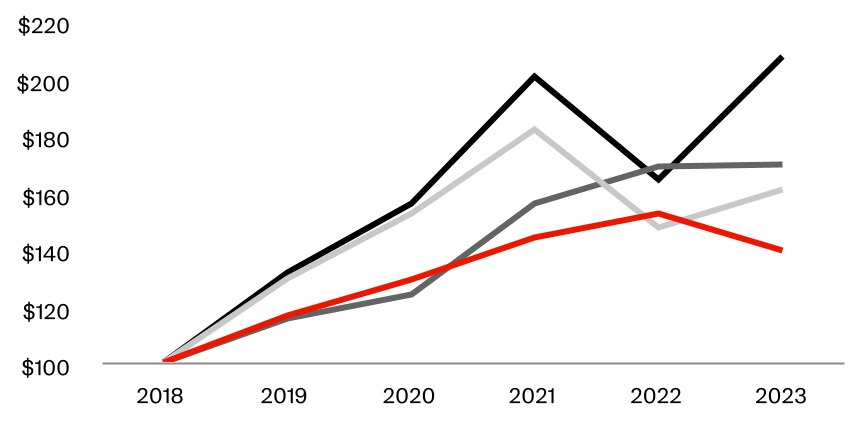
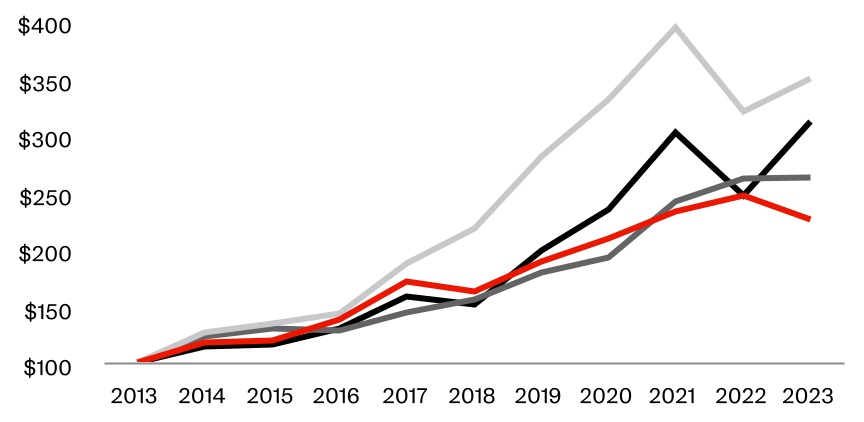
Set forth below are line graphs comparing the cumulative total shareholder return on the Company’s Common Stock for periods of five years and ten years ending December 31, 2023, against the cumulative total return of the Standard & Poor’s 500 Stock Index, the Standard & Poor’s Pharmaceutical Index and the Standard & Poor’s Healthcare Equipment Index. The graphs and tables assume that $100 was invested on December 31, 2018 and December 31, 2013 in each of the Company’s Common Stock, the Standard & Poor’s 500 Stock Index, the Standard & Poor’s Pharmaceutical Index and the Standard & Poor’s Healthcare Equipment Index and that all dividends were reinvested.
5 Year Shareholder Return Performance J&J vs. Indices
| | | | | |
| Johnson & Johnson |
| S&P 500 Index |
| S&P Pharmaceutical Index |
| S&P Healthcare Equipment Index |
| | | | | |
| 5-year CAGR |
| J&J | 6.8 | % |
| S&P 500 | 15.7 | % |
| S&P Pharm | 11.1 | % |
| S&P H/C Equip | 9.9 | % |
| | | | | | | | | | | | | | | | | | | | | | | | | | | | | | | | | | | |
| 2018 | | 2019 | | 2020 | | 2021 | | 2022 | | 2023 |
| Johnson & Johnson | $100.00 | | $116.21 | | $128.82 | | $143.57 | | $152.14 | | $139.05 |
| S&P 500 Index | $100.00 | | $131.47 | | $155.65 | | $200.29 | | $163.98 | | $207.04 |
| S&P Pharmaceutical Index | $100.00 | | $115.09 | | $123.75 | | $155.62 | | $168.77 | | $169.33 |
| S&P Healthcare Equipment Index | $100.00 | | $129.32 | | $152.12 | | $181.56 | | $147.32 | | $160.64 |
10 Year Shareholder Return Performance J&J vs. Indices
| | | | | |
| Johnson & Johnson |
| S&P 500 Index |
| S&P Pharmaceutical Index |
| S&P Healthcare Equipment Index |
| | | | | |
| 10-year CAGR |
| J&J | 8.4 | % |
| S&P 500 | 12.0 | % |
| S&P Pharm | 10.1 | % |
| S&P H/C Equip | 13.3 | % |
| | | | | | | | | | | | | | | | | | | | | | | | | | | | | | | | | | | |
| 2013 | 2014 | 2015 | 2016 | 2017 | 2018 | 2019 | 2020 | 2021 | 2022 | 2023 |
| Johnson & Johnson | $100.00 | $117.34 | $118.69 | $136.88 | $170.29 | $161.54 | $187.73 | $208.10 | $231.92 | $245.76 | $224.62 |
| S&P 500 Index | $100.00 | $113.67 | $115.23 | $129.00 | $157.15 | $150.24 | $197.53 | $233.85 | $300.91 | $246.37 | $311.06 |
| S&P Pharmaceutical Index | $100.00 | $122.22 | $129.29 | $127.27 | $143.27 | $154.86 | $178.23 | $191.64 | $240.99 | $261.37 | $262.23 |
| S&P Healthcare Equipment Index | $100.00 | $126.28 | $133.82 | $142.50 | $186.53 | $216.82 | $280.39 | $329.83 | $393.66 | $319.42 | $348.30 |
Item 9. Changes in and disagreements with accountants on accounting and financial disclosure
Not applicable.
Item 9A. Controls and procedures
Disclosure controls and procedures. At the end of the period covered by this Report, the Company evaluated the effectiveness of the design and operation of its disclosure controls and procedures. The Company’s disclosure controls and procedures are designed to ensure that information required to be disclosed by the Company in the reports that it files or submits under the Exchange Act is recorded, processed, summarized and reported within the time periods specified in the SEC’s rules and forms. Disclosure controls and procedures include, without limitation, controls and procedures designed to ensure that information required to be disclosed by the Company in the reports that it files or submits under the Exchange Act is accumulated and communicated to the Company’s management, including its principal executive and principal financial officers, or persons performing similar functions, as appropriate to allow timely decisions regarding required disclosure. Joaquin Duato, Chairman and Chief Executive Officer, and Joseph J. Wolk, Executive Vice President, Chief Financial Officer, reviewed and participated in this evaluation. Based on this evaluation, Messrs. Duato and Wolk concluded that, as of the end of the period covered by this Report, the Company’s disclosure controls and procedures were effective.
Reports on internal control over financial reporting. The information called for by this item is incorporated herein by reference to Management’s report on internal control over financial reporting, and the attestation regarding internal controls over financial reporting included in the report of independent registered public accounting firm included in Item 8 of this Report.
Changes in internal control over financial reporting. During the fiscal quarter ended December 31, 2023, there were no changes in the Company’s internal control over financial reporting identified in connection with the evaluation required under Rules 13a-15 and 15d-15 under the Exchange Act that have materially affected, or are reasonably likely to materially affect, the Company’s internal control over financial reporting. The Company continues to monitor and assess the effectiveness of the design and operation of its disclosure controls and procedures.
The Company is implementing a multi-year, enterprise-wide initiative to integrate, simplify and standardize processes and systems for the human resources, information technology, procurement, supply chain and finance functions. These are enhancements to support the growth of the Company’s financial shared service capabilities and standardize financial systems. This initiative is not in response to any identified deficiency or weakness in the Company’s internal control over financial reporting. In response to this initiative, the Company has and will continue to align and streamline the design and operation of its financial control environment.
Item 9B. Other information
Securities trading plans of Directors and Executive Officers. During the fiscal fourth quarter of 2023, none of our directors or officers (as defined in Rule 16a-1(f) of the Exchange Act) informed us of the or of a “Rule 10b5-1 trading arrangement” or “non-Rule 10b5-1 trading arrangement,” each as defined in Item 408 of Regulation S-K.
Item 9C. Disclosure regarding foreign jurisdictions that prevent inspections
Not applicable.
Part III
Item 10. Directors, executive officers and corporate governance
The information called for by this item is incorporated herein by reference to the discussion of the Audit Committee under the caption Item 1. Election of Directors - Board committees; and the material under the captions Item 1. Election of Directors and, if applicable, Delinquent Section 16(a) reporting in the Proxy Statement; and the material under the caption “Executive Officers of the Registrant” in Part I of this Report.
The Company’s Code of Business Conduct, which covers all employees (including the Chief Executive Officer, Chief Financial Officer and Controller), meets the requirements of the SEC rules promulgated under Section 406 of the Sarbanes-Oxley Act of 2002. The Code of Business Conduct is available on the Company’s website at www.jnj.com/code-of-business-conduct, and copies are available to shareholders without charge upon written request to the Secretary at the Company’s principal executive offices. Any substantive amendment to the Code of Business Conduct or any waiver of the Code granted to the Chief Executive Officer, the Chief Financial Officer or the Controller will be posted on the Company’s website at www.jnj.com/code-of-business-conduct within five business days (and retained on the website for at least one year).
In addition, the Company has adopted a Code of Business Conduct & Ethics for Members of the Board of Directors and Executive Officers. The Code of Business Conduct & Ethics for Members of the Board of Directors and Executive Officers is available on the Company’s website at www.investor.jnj.com/governance/corporate-governance-overview/code-of-business-conduct--ethics, and copies are available to shareholders without charge upon written request to the Secretary at the Company’s principal executive offices. Any substantive amendment to the Code or any waiver of the Code granted to any member of the Board of Directors or any executive officer will be posted on the Company’s website at www.investor.jnj.com/governance/corporate-governance-overview/code-of-business-conduct--ethics within five business days (and retained on the website for at least one year).
Item 11. Executive compensation
The information called for by this item is incorporated herein by reference to the material under the captions Item 1. Election of Directors – Director compensation, and Item 2. Compensation Committee report, Compensation discussion and analysis and Executive compensation tables in the Proxy Statement.
The material incorporated herein by reference to the material under the caption Compensation Committee report in the Proxy Statement shall be deemed furnished, and not filed, in this Report and shall not be deemed incorporated by reference into any filing under the Securities Act of 1933, as amended, or the Securities Exchange Act of 1934, as amended, as a result of this furnishing, except to the extent that the Company specifically incorporates it by reference.
Item 12. Security ownership of certain beneficial owners and management and related stockholder matters
The information called for by this item is incorporated herein by reference to the material under the caption Item 1. Stock ownership in the Proxy Statement; and Note 16 Common stock, stock option plans and stock compensation agreements of the Notes to Consolidated Financial Statements in Item 8 of this Report.
Equity compensation plan information
The following table provides certain information as of December 31, 2023 concerning the shares of the Company’s Common Stock that may be issued under existing equity compensation plans. | | | | | | | | | | | |
| Plan Category | Number of
Securities to
be Issued Upon
Exercise of
Outstanding
Options and Rights | Weighted Average
Exercise Price of
Outstanding Options
and Rights | Number of Securities Remaining Available for Future Issuance Under Equity Compensation Plans(2)(3) |
Equity Compensation Plans Approved by Security Holders(1) | 127,211,785 | $123.41 | 130,112,007 |
| Equity Compensation Plans Not Approved by Security Holders | — | — | — |
| Total | 127,211,785 | $123.41 | 130,112,007 |
(1)Included in this category are the following equity compensation plans which have been approved by the Company’s shareholders: 2012 Long-Term Incentive Plan and 2022 Long-Term Incentive Plan.
(2)This column excludes shares reflected under the column “Number of Securities to be Issued Upon Exercise of Outstanding Options and Rights.”
(3)The 2012 Long-Term Incentive Plan expired April 26, 2022. All options and restricted shares granted subsequent to that date were under the 2022 Long-Term Incentive Plan.
Item 13. Certain relationships and related transactions, and director independence
The information called for by this item is incorporated herein by reference to the material under the captions Item 1. Election of Directors - Related person transactions & Director independence in the Proxy Statement.
Item 14. Principal accountant fees and services
The information called for by this item is incorporated herein by reference to the material under the caption Item 3. Ratification of appointment of independent registered public accounting firm in the Proxy Statement.
Part IV
Item 15. Exhibits and financial statement schedules
The following documents are filed as part of this report:
1.Financial Statements
Consolidated balance sheets at end of fiscal years 2023 and 2022
Consolidated statements of earnings for fiscal years 2023, 2022 and 2021
Consolidated statements of comprehensive income for Fiscal Years 2023, 2022 and 2021
Consolidated statements of equity for fiscal years 2023, 2022 and 2021
Consolidated statements of cash flows for fiscal years 2023, 2022 and 2021
Notes to Consolidated Financial Statements
Report of independent registered public accounting firm
All schedules are omitted because they are not applicable or the required information is included in the financial statements or notes.
2.Exhibits required to be filed by item 60l of regulation S-K
The information called for by this item is incorporated herein by reference to the Exhibit Index in this Report.
Item 16. Form 10-K summary
Registrants may voluntarily include a summary of information required by Form 10-K under this Item 16. The Company has elected not to include such summary information.
Signatures
Pursuant to the requirements of Section 13 of the Securities Exchange Act of 1934, the registrant has duly caused this Report to be signed on its behalf by the undersigned, thereunto duly authorized.
| | |
| JOHNSON & JOHNSON |
| (Registrant) |
| | | | | |
| By | /s/ J. Duato |
| J. Duato, Chairman of the Board and Chief Executive Officer |
Pursuant to the requirements of the Securities Exchange Act of 1934, this report has been signed below by the following persons on behalf of the registrant and in the capacities and on the dates indicated. | | | | | | | | |
| Signature | Title | Date |
| | |
/s/ J. Duato | Chairman of the Board | February 16, 2024 |
| J. Duato | Chief Executive Officer
(Principal Executive Officer) | |
| | |
/s/ J. J. Wolk | Chief Financial Officer | February 16, 2024 |
| J. J. Wolk | (Principal Financial Officer) | |
| | |
/s/ R. J. Decker Jr. | Controller and Chief Accounting Officer | February 16, 2024 |
| R. J. Decker Jr. | (Principal Accounting Officer) | |
| | |
/s/ D. Adamczyk | Director | February 16, 2024 |
| D. Adamczyk | | |
| | |
/s/ M. C. Beckerle | Director | February 16, 2024 |
| M. C. Beckerle | | |
| | |
/s/ D. S. Davis | Director | February 16, 2024 |
| D. S. Davis | | |
| | |
/s/ J. A. Doudna | Director | February 16, 2024 |
| J. A. Doudna | | |
| | | | | | | | |
| Signature | Title | Date |
| | |
/s/ M. A. Hewson | Director | February 16, 2024 |
| M. A. Hewson | | |
| | |
/s/ P. A. Johnson | Director | February 16, 2024 |
| P. A. Johnson | | |
| | |
/s/ H. Joly | Director | February 16, 2024 |
| H. Joly | | |
| | |
/s/ M. B. McClellan | Director | February 16, 2024 |
| M. B. McClellan | | |
| | |
/s/ A. M. Mulcahy | Director | February 16, 2024 |
| A. M. Mulcahy | | |
| | |
/s/ M. A. Weinberger | Director | February 16, 2024 |
| M. A. Weinberger | | |
| | |
/s/ N. Y. West | Director | February 16, 2024 |
| N. Y. West | | |
| | |
/s/ E. A. Woods | Director | February 16, 2024 |
| E. A. Woods | | |
Exhibit index
| | | | | | | | |
| Reg. S-K | | |
| Exhibit Table | | Description |
| Item No. | | of Exhibit |
| | Agreement and Plan of Merger, dated as of October 31, 2022, by and among Johnson & Johnson, Athos Merger Sub, Inc. and ABIOMED, Inc. – Incorporated herein by reference to Exhibit 2.1 of the Registrant’s Form 8-K Current Report filed November 1, 2022.† |
| | Restated Certificate of Incorporation effective February 19, 2016 — Incorporated herein by reference to Exhibit 3(i) of the Registrant’s Form 10-K Annual Report for the fiscal year ended January 3, 2016. |
| | Certificate of Amendment to the Certificate of Incorporation of Johnson & Johnson effective April 30, 2020 — Incorporated herein by reference to Exhibit 3.1 of the Registrant's Form 8-K Current Report filed April 29, 2020. |
| | By-Laws of the Company, as amended effective June 9, 2020 — Incorporated herein by reference to Exhibit 3.1 of the Registrant’s Form 8-K Current Report filed June 10, 2020. |
| 4(a) | | Upon the request of the Securities and Exchange Commission, the Registrant will furnish a copy of all instruments defining the rights of holders of long-term debt of the Registrant. |
| | Description of Securities Registered Pursuant to Section 12 of the Securities Exchange Act of 1934 — Incorporated herein by reference to Exhibit 4.1 of the Registrant’s Form 8-K Current Report filed August 12, 2020. |
| | 2012 Long-Term Incentive Plan — Incorporated herein by reference to Appendix A of the Registrant’s Proxy Statement filed on March 15, 2012.* |
| | Form of Stock Option Certificate under the 2012 Long-Term Incentive Plan — Incorporated herein by reference to Exhibit 10.2 of the Registrant’s Form 10-Q Quarterly Report for the quarter ended April 1, 2012.* |
| | Form of Restricted Share Unit Certificate under the 2012 Long-Term Incentive Plan — Incorporated herein by reference to Exhibit 10.3 of the Registrant’s Form 10-Q Quarterly Report for the quarter ended April 1, 2012.* |
| | Form of Performance Share Unit Certificate under the 2012 Long-Term Incentive Plan — Incorporated herein by reference to Exhibit 10.4 of the Registrant’s Form 10-Q Quarterly Report for the quarter ended April 1, 2012.* |
| | Global NonQualified Stock Option Award Agreement under the 2012 Long-Term Incentive Plan — Incorporated herein by reference to Exhibit 10.1 of the Registrant’s Form 10-Q Quarterly Report for the quarter ended April 1, 2018.* |
| | Global Restricted Share Unit Award Agreement under the 2012 Long-Term Incentive Plan — Incorporated herein by reference to Exhibit 10.2 of the Registrant’s Form 10-Q Quarterly Report for the quarter ended April 1, 2018.* |
| | Global Performance Share Unit Award Agreement under the 2012 Long-Term Incentive Plan — Incorporated herein by reference to Exhibit 10.3 of the Registrant’s Form 10-Q Quarterly Report for the quarter ended April 1, 2018.* |
| | Global Restricted Share Unit Award Agreement granted to John Reed on May 1, 2023 under the 2022 Long-Term Incentive Plan — Filed with this document.* |
| | Domestic Deferred Compensation (Certificate of Extra Compensation) Plan — Incorporated herein by reference to Exhibit 10(g) of the Registrant’s Form 10-K Annual Report for the year ended December 28, 2003.* |
| | Amendments to the Certificate of Extra Compensation Plan effective as of January 1, 2009 — Incorporated herein by reference to Exhibit 10(j) of the Registrant’s Form 10-K Annual Report for the year ended December 28, 2008.* |
| | 2009 Certificates of Long-Term Performance Plan — Incorporated herein by reference to Exhibit 10.1 of the Registrant’s Form 10-Q Quarterly Report for the quarter ended September 27, 2009.* |
| | Amended and Restated Deferred Fee Plan for Directors (Amended as of January 17, 2012) — Incorporated herein by reference to Exhibit 10(k) of the Registrant's Form 10-K Annual Report for the fiscal year ended January 1, 2012.* |
| | | | | | | | |
| Reg. S-K | | |
| Exhibit Table | | Description |
| Item No. | | of Exhibit |
| | The Johnson & Johnson Executive Income Deferral Plan Amended and Restated Effective January 1, 2010 — Incorporated herein by reference to Exhibit 10.1 of the Registrant’s Form 10-Q Quarterly Report for the quarter ended September 30, 2012.* |
| | The Johnson & Johnson Excess Savings Plan (amended and restated as of January 1, 2022) — Incorporated herein by reference to Exhibit 10(l) of the Registrant’s Form 10-K Annual Report for the fiscal year ended January 1, 2023.* |
| | Excess Benefit Plan of Johnson & Johnson and Affiliated Companies (amended and restated as of January 1, 2020) — incorporated by reference to Exhibit 10(n) of the Registrant’s Form 10-K Annual Report for the fiscal year ended January 3, 2021.* |
| 10(p)** | | Executive Life Plan Agreement — Incorporated herein by reference to Exhibit 10(i) of the Registrant’s Form 10-K Annual Report for the fiscal year ended January 3, 1993.* |
| | Executive Life Plan Agreement Closure Letter — Incorporated herein by reference to Exhibit 10.1 of the Registrant’s Form 10-Q Quarterly Report for the quarter ended March 29, 2015.* |
| | 2022 Long-Term Incentive Plan — Incorporated by reference to Appendix A of the Registrant’s Proxy Statement filed on March 16, 2022.* |
| | Severance Pay Plan of Johnson & Johnson and U.S. Affiliated Companies, Amended and Restated as of October 1, 2014 — Incorporated herein by reference to Exhibit 10.1 of the Registrant's Form 10-Q Quarterly Report for the quarter ended September 28, 2014.* |
| | First Amendment to the Severance Pay Plan of Johnson & Johnson and U.S. Affiliated Companies (as amended and restated effective October 1, 2014) — Incorporated herein by reference to Exhibit 10.1 of the Registrant's Form 10-Q Quarterly Report for the quarter ended June 28, 2015.* |
| | Second Amendment to the Severance Pay Plan of Johnson & Johnson and U.S. Affiliated Companies (as amended and restated effective October 1, 2014) — Incorporated herein by reference to Exhibit 10(x) of the Registrant's Form 10-K Annual Report for the fiscal year ended January 3, 2016.* |
| | Contingent Value Rights Agreement, dated as of December 22, 2022, by and between Johnson & Johnson and American Stock Transfer & Trust Company, LLC – Incorporated herein by reference to Exhibit 10.1 of the Registrant’s Form 8-K Current Report filed December 22, 2022.† |
| | Separation Agreement, dated as of May 3, 2023, by and between Johnson & Johnson and Kenvue Inc. |
| | Tax Matters Agreement, dated as of May 3, 2023, by and between Johnson & Johnson and Kenvue Inc. |
| | Employee Matters Agreement, dated as of May 3, 2023, by and between Johnson & Johnson and Kenvue Inc. |
| | Intellectual Property Agreement, dated as of May 3, 2023, by and between Johnson & Johnson and Kenvue Inc. |
| | Trademark Phase-Out License Agreement, dated as of April 3, 2023, by and between Johnson & Johnson and Johnson & Johnson Consumer Inc. |
| | Transition Services Agreement, dated as of May 3, 2023, by and between Johnson & Johnson and Kenvue Inc. |
| | Transition Manufacturing Agreement, dated as of May 3, 2023, by and between Johnson & Johnson and Kenvue Inc. |
| | Registration Rights Agreement, dated as of May 3, 2023, by and between Johnson & Johnson and Kenvue Inc. |
| | Johnson & Johnson Deferred Compensation Plan* |
| | Global Performance Share Unit Award Agreement* |
| | | | | | | | |
| Reg. S-K | | |
| Exhibit Table | | Description |
| Item No. | | of Exhibit |
| | Global Restricted Share Unit Award Agreement* |
| | Global Nonqualified Stock Option Award Agreement* |
| | Amendment One to the Johnson & Johnson Excess Savings Plan (amended and restated effective as of January 1, 2022) — Incorporated herein by reference to Exhibit 10.1 of the Registrant’s Form 10-Q Quarterly Report for the quarter ended October 1, 2023.* |
| | Johnson & Johnson Executive Incentive Plan (Amended as of September 7, 2023) — Incorporated herein by reference to Exhibit 10.2 of the Registrant’s Form 10-Q Quarterly Report for the quarter ended October 1, 2023.* |
| | Johnson & Johnson Stock Trading Policy for Directors, Executive Officers and Insiders (Amended as of April 27, 2023) — Filed with this document. |
| | Subsidiaries — Filed with this document. |
| | Consent of Independent Registered Public Accounting Firm — Filed with this document. |
| | Certification of Chief Executive Officer Pursuant to Section 302 of the Sarbanes-Oxley Act — Filed with this document. |
| | Certification of Chief Financial Officer Pursuant to Section 302 of the Sarbanes-Oxley Act — Filed with this document. |
| | Certification of Chief Executive Officer Pursuant to Section 906 of the Sarbanes-Oxley Act — Furnished with this document. |
| | Certification of Chief Financial Officer Pursuant to Section 906 of the Sarbanes-Oxley Act — Furnished with this document. |
| | Johnson & Johnson Clawback Policy (effective as of August 8, 2023) — Filed with this document. |
| Exhibit 101: | | |
| EX-101.INS | | Instance Document - the instance document does not appear in the Interactive Data File because its XBRL tags are embedded within the Inline XBRL document |
| EX-101.SCH | | Inline XBRL Taxonomy Extension Schema |
| EX-101.CAL | | Inline XBRL Taxonomy Extension Calculation Linkbase |
| EX-101.LAB | | Inline XBRL Taxonomy Extension Label Linkbase |
| EX-101.PRE | | Inline XBRL Taxonomy Extension Presentation Linkbase |
| EX-101.DEF | | Inline XBRL Taxonomy Extension Definition Document |
| Exhibit 104: | | Cover Page Interactive Data File––the cover page interactive data file does not appear in the Interactive Data File because its XBRL tags are embedded within the Inline XBRL document. |
| | | | | |
| * | Management contract or compensatory plan. |
| ** | Paper filing. |
| † | Certain exhibits and schedules have been omitted pursuant to Item 601(b)(2)(ii) or 601(b)(10)(iv) of Regulation S-K, as applicable. |
A copy of any of the Exhibits listed above will be provided without charge to any shareholder submitting a written request specifying the desired exhibit(s) to the Secretary at the principal executive offices of the Company. Pursuant to Item 601(b)(4)(iii)(A) of Regulation S-K, the Company has not filed as exhibits to this Form 10-K certain long-term debt instruments, including indentures, under which the total amount of securities authorized does not exceed 10% of the total assets of the Company and its subsidiaries on a consolidated basis. The Company hereby agrees to furnish a copy of any such instrument to the SEC upon request.

Similar companies
See also ELI LILLY & Co -
Annual report 2024 (10-K 2024-12-31)
Annual report 2025 (10-Q 2025-06-30)
See also PFIZER INC -
Annual report 2024 (10-K 2024-12-31)
Annual report 2025 (10-Q 2025-03-30)
See also AbbVie Inc. -
Annual report 2024 (10-K 2024-12-31)
Annual report 2025 (10-Q 2025-06-30)
See also NOVO NORDISK A S
See also Merck & Co., Inc. -
Annual report 2024 (10-K 2024-12-31)
Annual report 2025 (10-Q 2025-06-30)
 Open main menu